





BEATRIZ MILHAZES
b. 1960, BrazilBeatriz Milhazes is a leading Brazilian contemporary artist whose vibrant abstract paintings, collages, prints and sculptures fuse the visual culture of Rio de Janeiro with the legacies of European modernism and global abstraction. She has become one of Brazil’s most internationally recognised artists, with major institutional exhibitions including Beatriz Milhazes: Rigor and Beauty at the Solomon R. Guggenheim Museum, New York, and participation in the Venice Biennale.
Early life and background
Beatriz Milhazes was born in 1960 in Rio de Janeiro, where she continues to live and work. She studied Social Communication before training in art at the Escola de Artes Visuais do Parque Lage in Rio de Janeiro from 1980 to 1983, later teaching and developing painting programmes there between 1986 and 1996.
Emerging in the 1980s Brazilian art scene, Milhazes was associated with a generation that renewed painting in Brazil while engaging critically with international modernism. Her work draws on Rio’s architecture, tropical flora, textiles, folk traditions and Carnival, along with the influence of artists such as Henri Matisse, Piet Mondrian and Bridget Riley.
Beatriz Milhazes artworks
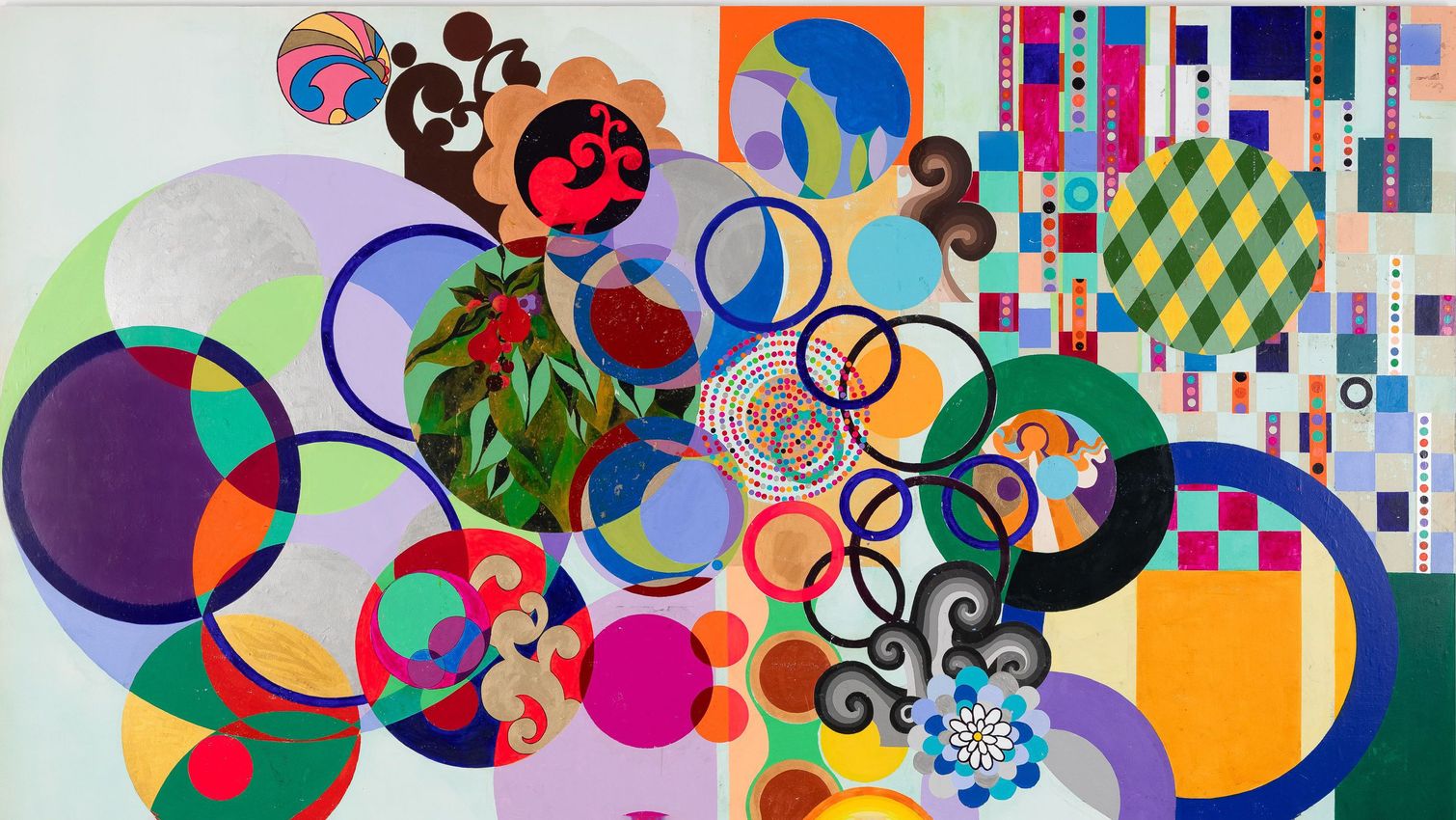
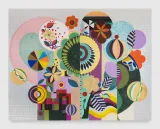
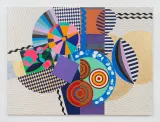
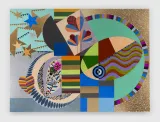
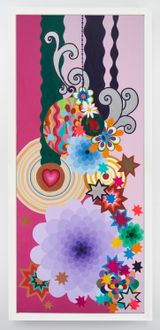
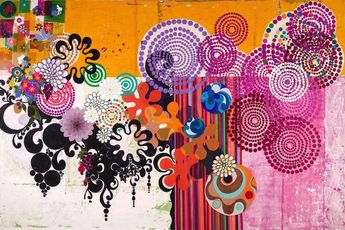
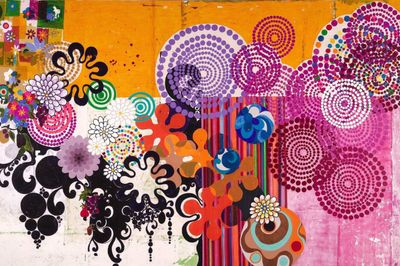
Beatriz Milhazes creates densely layered compositions that orchestrate saturated colour, geometric structure and ornamental pattern into dynamic abstract images. Working across painting, collage, printmaking and sculpture, she has developed a distinctive transfer technique, painting motifs on plastic and then collaging them onto canvas to build complex surfaces.
Milhazes use of colour and geometry is rooted in place and memory, informed by the botanical gardens and Tijuca Forest near her Rio de Janeiro studio, the city’s oceanfront, and Brazilian cultural motifs that range from vernacular decoration to Carnival. Milhazes has described her ongoing challenge as translating the life and surroundings that inspire her into rigorously constructed images, thinking as a geometric and conceptual artist in the studio to transform sensory experience into what she calls “chromatic free geometry”, a mode of abstraction that balances structure, rhythm and exuberant colour.
Artworks by Milhazes often combine circles, spirals, latticework and floral forms with references to lace, jewellery, baroque architecture and popular decoration, producing images that hover between order and exuberant excess. While visually opulent, Milhazes describes her process as highly controlled, balancing intuition with a rigorous compositional logic.
Geração 80 and chromatic free geometry
In the 1980s Milhazes was part of Geração 80 (the ‘80s Generation’), a new wave of Brazilian artists who reasserted the importance of painting after the conceptual and politically focused practices of the 1970s. The movement coalesced around the landmark 1984 exhibition Como vai você, Geração 80? at Parque Lage in Rio de Janeiro, which embraced expressive colour, experimental studio processes and a hybrid approach to Brazilian art making influenced by European modernism, the baroque and the anthropophagic ideas first articulated in Brazil in the late 1920s.
Within this context Milhazes developed a studio-based practice that mines the visual density of Rio—its urban fabric, coastal landscape and cultural symbolism—while subjecting it to a disciplined, geometric framework, a synthesis she has described as ‘chromatic free geometry’. This notion captures the way her compositions stage a productive tension between formal order and improvisation, using colour as both structure and sensation.
Key series and developments
- In the 1990s Milhazes consolidated her signature method of transferring painted motifs from plastic to canvas, allowing her to layer translucent colour and pattern while preserving crisp edges in works that helped establish her international reputation.
- Large-scale paintings from the 2000s, including works such as Meu Limão (2000), brought heightened visibility on the art market and underscored her status as one of the most prominent Brazilian contemporary painters.
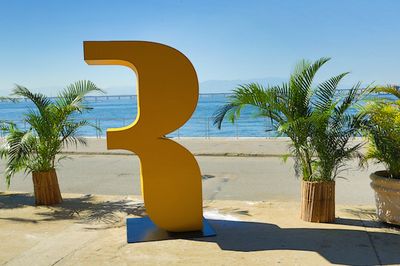
- Over the past decade she has expanded her vocabulary into intricate collage, relief, and sculpture, including suspended mobiles and public projects that translate her pictorial language into three dimensions and architectural settings.
- Recent institutional exhibitions, including Beatriz Milhazes: Maresias at Tate St Ives and Beatriz Milhazes: Rigor and Beauty at the Guggenheim Museum, have traced the evolution of her practice from the mid-1990s to the present, highlighting shifts in scale, chromatic range and structural complexity.
Select awards and accolades
- Iberê Camargo Prize, acquisition prize, 7th National Salon of Visual Arts, Museum of Modern Art, Rio de Janeiro, 1984
- Special reference from the jury, II International Biennial of Cuenca, Ecuador, 1989
- Brasília Prize for Plastic Arts, Brasília Museum of Art, 1990
- Eco Art Award, Museum of Modern Art, Rio de Janeiro, 1992
- Chevalier de l’Ordre des Arts et des Lettres, French Ministry of Culture, 2007
- Order of Ipiranga, State of São Paulo, 2010
- Order of Cultural Merit, Commander Class, Brazil, 2016
To be kept up to date with news relating to Beatriz Milhazes follow her on Ocula.
Beatriz Milhazes exhibitions
Beatriz Milhazes has been the subject of significant solo and group exhibitions at museums and biennials worldwide, including major surveys in Europe, the Americas and Asia. Below is a selection of important exhibitions.
To be kept up to date with upcoming exhibitions featuring Beatriz Milhazes follow her on Ocula. You can also view her exhibitions on Ocula here.
Select solo exhibitions
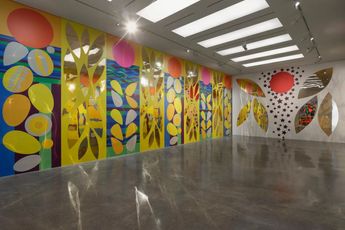
- In 2026, White Cube Mason’s Yard in London presents Beatriz Milhazes: Além do Horizonte, on view from 19 November 2025 to 25 January 2026 at Mason’s Yard, St James’s, London. This solo exhibition of new paintings, collages and a site-specific installation extends the artist’s enquiry into the optical and emotional force of colour, pattern and ornament, drawing on sources that range from mid-20th-century psychedelic print culture and indigenous Brazilian and European design to the accumulated textiles and decorative fragments of her Rio de Janeiro studio.
- 2025, Beatriz Milhazes: Rigor and Beauty, Solomon R. Guggenheim Museum, New York
- 2024, Beatriz Milhazes: Maresias, Tate St Ives, St Ives
- 2023, Beatriz Milhazes: Paisagem em Desfile (Landscape on Parade), Galerie Max Hetzler, Berlin
- 2022, Beatriz Milhazes, Turner Contemporary, Margate
- 2018, Beatriz Milhazes: Jardim Botânico, Long Museum, Shanghai
- 2012, Beatriz Milhazes, Fundação Calouste Gulbenkian, Lisbon
- 2011, Beatriz Milhazes, Fondation Beyeler, Riehen / Basel
- 2009, Beatriz Milhazes, Fondation Cartier pour l’art contemporain, Paris
- 2008, Beatriz Milhazes, Pinacoteca do Estado de São Paulo, São Paulo
Select group exhibitions
- 2025, Reinventing Landscape: Highlights of the Centre Pompidou Collection vol. IV, West Bund Museum, Shanghai
- 2024, 60th Venice Biennale, Applied Arts Pavilion, Venice
- 2023, Symbiosis | Living Island, Japan House Los Angeles, Los Angeles
- 2006, Shanghai Biennale, Shanghai
- 2004, São Paulo Biennial, São Paulo
- 2003, Venice Biennale, Venice
- 1998, São Paulo Biennial, São Paulo
- 1998, Sydney Biennial, Sydney
- 1995, Carnegie International, Carnegie Museum of Art, Pittsburgh
Beatriz Milhazes FAQs
Who is Beatriz Milhazes?
Beatriz Milhazes is a Brazilian contemporary artist, born in Rio de Janeiro in 1960, known for vibrant abstract paintings, collages, prints and sculptures that merge Brazilian cultural motifs with geometric abstraction and the legacy of European modernism.
You can follow Beatriz Milhazes on Ocula to learn more about her work, find out about art for sale, contact her gallery, and keep up to date with upcoming exhibitions.
Where can I see work by Beatriz Milhazes?
Beatriz Milhazes’s artworks are held in major museum collections and are frequently shown in international exhibitions, including recent presentations such as Beatriz Milhazes: Rigor and Beauty at the Solomon R. Guggenheim Museum in New York and Beatriz Milhazes: Maresias at Tate St Ives in the United Kingdom.
You can follow Beatriz Milhazes on Ocula to receive alerts on upcoming exhibitions by the artist and to discover where her work is currently on view.
Are there any lesser known facts about Beatriz Milhazes?
A lesser-known fact about Beatriz Milhazes is that she initially trained in Social Communication before fully committing to art and later taught and developed painting courses at the Escola de Artes Visuais do Parque Lage in Rio de Janeiro for a decade. Another interesting detail is that her meticulous transfer technique, which involves painting on plastic and collaging the dried paint onto canvas, grew out of studio experimentation rather than traditional collage training.
Where does Beatriz Milhazes live?
Beatriz Milhazes lives and works in Rio de Janeiro, Brazil, the city where she was born and which remains a vital source of imagery, colour and rhythm in her art.
How is Beatriz Milhazes’s name pronounced?
Beatriz Milhazes’s name is generally pronounced ‘Beh-ah-TREES meel-HAH-zes’ in English, approximating the Brazilian Portuguese pronunciation, with the stress on the final syllable of Milhazes.
Where can I buy Beatriz Milhazes’s work?
Beatriz Milhazes has been and continues to be, represented by leading contemporary art galleries, including Pace Gallery, White Cube and Galerie Max Hetzler. These galleries have presented and sold her artworks internationally.
You can explore Ocula to find out which Ocula galleries represent Beatriz Milhazes and enquire directly about buying art by the artist and follow her and her galleries to keep up to date. You can also get in touch with Ocula’s art advisory team to find out more about buying or selling work by Beatriz Milhazes.
Ocula | 2025





















Explore Beatriz Milhazes' Exhibitions












Explore and Follow Artists Shaping Contemporary Art
A respected voice in contemporary art discourse.
Focusing on ambitious storytelling and insightful art-world commentary. Ocula Magazine publishes in-depth interviews, critical essays and timely analysis on the artists, exhibitions and ideas driving the global art world.
Learn more about Ocula Magazine
Showcasing the best of the art world.
Ocula partners with galleries from around the world to highlight their artists, artworks and exhibitions. Gallery membership is by application and invitation, with each member vetted by an independent panel.
Learn more about Ocula Membership
Specialises in the sale of major artworks.
Led by a team with deep ties to the world’s leading auction houses, galleries and collectors. Ocula’s advisory team offers bespoke services to high-net-worth clients from around the world who are looking to acquire the best of contemporary and modern art.
Learn more about our team and services