Press Release

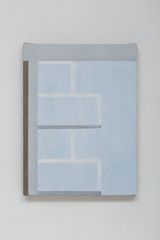
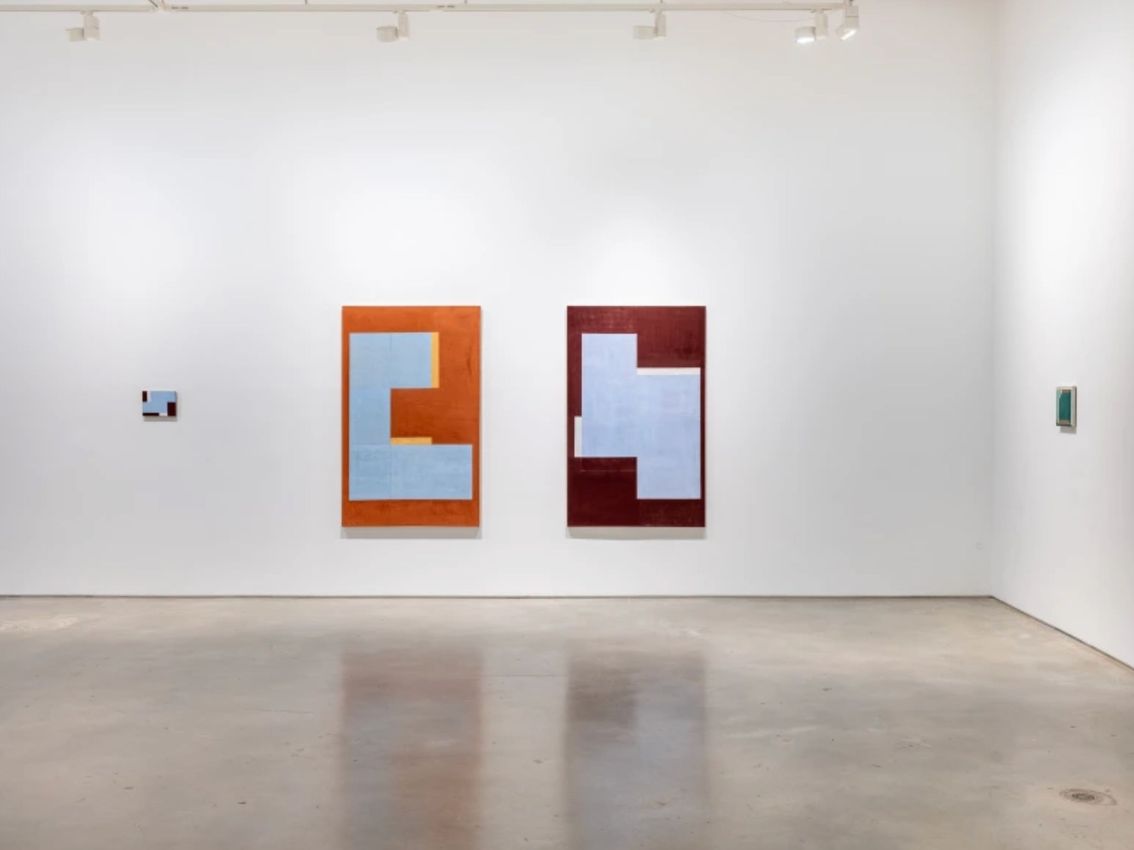
Nara Roesler New York is pleased to present Fabio Miguez: Ichnographies, the first solo show by Fabio Miguez (b. 1962, São Paulo, Brazil) at the gallery’s New York headquarters. Curated by Luis Pérez-Oramas, the exhibition offers a comprehensive overview of the artist’s work, featuring a selection of recent pieces interspersed with paintings developed by the artist in the last decade. According to the curator, the title of the show references an observation by the 17th-century French architect and poet Charles Perrault, who noted that the so-called ichnographic view of a building—its projective and initial plan—inevitably coincides with its final trace as a ruin, the mark of its existence on earth, thus articulating concept and life in a single, inexorable becoming.

One of the founders of the Casa 7 studio—along with Carlito Carvalhosa, Nuno Ramos, Paulo Monteiro, and Rodrigo Andrade—a group that, in the 1980s, played a key role in the renewal of Brazilian painting through material and monochromatic practices influenced by the neo-expressionist figurations of the time, such as those of Basquiat, Anselm Kiefer, and Philip Guston, Fabio Miguez‘s pictorial research focuses on the spatiality and materiality of painting. In the 1990s, the artist began producing, alongside his pictorial work, the Derivas series of photographs, later published in the book Paisagem Zero (2013). From then on, his research increasingly centred on luminosity, developing abstract compositions in which expressive gestures gave way to geometry and clear, transparent colours. Most interested in the architectural qualities of the paintings produced by the Casa 7 members, Miguez further explores the representational power of architecture until his work ultimately transitions into literally three-dimensional painting.

In the 2000s, his practice expanded into installations and objects that encouraged greater viewer interaction. During this period, the language of painting and its planar nature became challenged by the presence of geometric protrusions in the artwork, referencing the Brazilian tradition of the _active object_and slats. This shift defines what remains the most emblematic aspect of Miguez‘s work to this day: the activation of the representational space through the representation of space. In some pieces, Miguezcontrasts perspective lines with flat surfaces, incorporating words and signs that serve as self-reflective markers, offering interpretative cues within the painting itself, as seen in Um Segundo Quase Nunca (2014) and (2012).

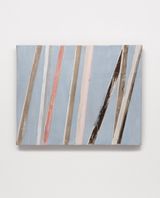
The relationship between spatiality, geometry, and colour has also been explored through smaller formats, leading to the development of the Atalhos series. More than just the title of a series, Atalhos (Shortcuts) is a guiding concept in Miguez‘s practice. ”Atalhos allows works to be combined into sentences. Depending on their proximity to one another, they can take on entirely new meanings. That’s the essence of the shortcut—the transition from one referential field to another that occurs in the creation of these sets, potentially generating new interpretations,” the artist explains.

Building on this series, Miguez has developed new iterations, some of which reinterpret works by pre-Renaissance masters such as Giotto, Fra Angelico, Sassetta, and Piero della Francesca—pioneers in Western pictorial spatiality, perspective, and illusionism from the 13th century onward. In revisiting these old masters, Miguez removes the narrative episodes, instead focusing on the geometries and spatial relationships within the original compositions. His interest in the primitives of Western painting serves to reveal the primal structure of painting as a space of representation. A significant part of this body of work—central to the artist’s poetics—has been Miguez‘s engagement with extending, through Atalhos inspired by Italian primitives, the practice of reinterpretation across different scales, initially monumental, of selected compositions by the Italian-Brazilian artist Alfredo Volpi, known as a primitive or a vernacular outsider.

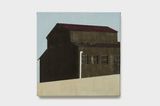
More recently, in 2024, the artist traveled to the historic cities of São Luís and Alcântara, both in Maranhão, in northern Brazil, which resulted in the Maranhão series—compositions depicting the facades and interiors of vernacular buildings found throughout the cities’ streets. “What struck me about these buildings was that most of them were abandoned, some in ruins. This condition made architectural elements such as cornices, façades, and interiors stand out even more,” Miguez observes. While in previous works, Miguez has used the reinterpretation of historical paintings as a point of departure, here, the foundation is real architecture, directly observed from the city.

Miguez‘s interest in the architectural dimension of painting—its ability to structurally represent (itself)—is evident in larger works such as Planta #2 (2019) and Sem título (Untitled, 2023), as well as Sem título (Casa Ohtake) (Untitled [Casa Ohtake], 2024). The latter was inspired by the living room of the residence of Japanese-Brazilian artist Tomie Ohtake (1913–2015), an emblematic project of São Paulo brutalism designed by Ruy Ohtake. Once again, this work functions as a self-reflective key to Miguez‘s poetics, as the painting itself embodies the projective dimension of real architecture.

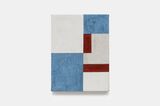
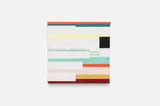
Another branch of Miguez‘s work, also featured in the exhibition, consists of experiments based on paper boxes. By analysing the diagrams derived from them, Miguez began to observe their combinatorial structures—the rules governing their arrangement and the exceptions implied within those rules—unfolding into a series of possible compositions and new formal and chromatic arrangements. Although initially developed in small formats, more recent iterations of the series have explored larger dimensions, resulting in works presented here for the first time, evoking the modern tradition of abstract compositions based on textile and clothing patterns, from Matisse to Franz Erhard Walther. Due to the use of beeswax in many of these works, Miguez‘s paintings acquire a distinctive physicality, achieving a consistency reminiscent of fresco or mural painting, making the texture of the compositions resonate—almost tautologically—with the architectural inquiries that poetically inform them.

Read More
About the Artist

Fabio Miguez began his artistic career in the 1980s when, alongside Carlito Carvalhosa, Nuno Ramos, Paulo Monteiro, and Rodrigo Andrade, he founded the artist’s space Casa 7. Miguez initially worked with painting like the others group members. During the 1990s, he started to produce, parallel to his paintings, the series of photographs entitled ‘Derivas’, later published with the name Paisagem Zero in 2013. Those photos are closely related to the paintings as we can see in the tension between the indeterminacy of the process and the apparent construction of the final product and in the density of light and dark shades.

View Artist Profile

Also Exhibiting at Galeria Nara Roesler

About the Gallery

Founded in São Paulo in 1989, Galeria Nara Roesler is a leading Brazilian gallery dedicated to showing the work of contemporary Brazilian and international artists. The gallery established another branch in Rio de Janeiro in 2014, followed by its first international outpost in New York City in 2015.

View Gallery Profile
Address
Avenida Europa 655
JD Europa
São Paulo
Brazil
Opening Hours
Mon - Fri, 10am - 6pm
Sat, 11am - 3pm
Book your visit via the link or by emailing agendamento@nararoesler.art
(1)
São Paulo Avenida Europa 655, JD Europa
Galeria Nara Roesler
Avenida Europa 655, JD Europa, São Paulo, Brazil
+55 112 039 5454
http://www.nararoesler.art

Opening hours
Mon - Fri, 10am - 6pm
Sat, 11am - 3pm
Book your visit via the link or by emailing agendamento@nararoesler.art
The art world in focus