




RENÉ MAGRITTE
1898-1967, BelgiumRené Magritte was a Belgian surrealist known for his witty and cerebral paintings that challenged observers’ perceptions of reality and representation.
Early Years
Magritte was born in Lessines, Belgium, in 1898. He grew up in a middle-class family; his father, Léopold, was a tailor and textile merchant, and his mother, Régina (née Bertinchamps), was a milliner before marriage. The family experienced periods of financial difficulty despite some comfort from his father’s manufacturing business, and his childhood was marked by trauma, notably the early death of his mother. In 1912, when Magritte was 13, his mother died by suicide, drowning herself in the River Sambre. This event deeply affected Magritte and his family.
In 1916, he enrolled at the Académie Royale des Beaux-Arts in Brussels, where he studied under Constant Montald. However, he found the academic training uninspiring.
After serving briefly in the military and working in advertising, Magritte developed a distinctive artistic style. Futurism and Cubism influenced his early career, but his focus shifted toward Surrealism in 1925 after a pivotal encounter with Giorgio de Chirico‘s painting.
René Magritte’s Artworks
Magritte’s artworks are characterised by their use of ordinary objects placed in unusual contexts, encouraging viewers to question the assumptions underlying visual reality.
Early Surrealist Works (1926–1930)
Magritte’s signature style began to crystallise in the late 1920s. One of his first significant works, The Lost Jockey (1926), exemplified his interest in dreamlike composition. Moving to Paris in 1927, he became associated with the French Surrealists, including André Breton, though he remained somewhat ideologically independent. During this period, he painted The Treachery of Images (1929), featuring a pipe and the famous caption ‘Ceci n’est pas une pipe’.
Mature Period (1930s–1940s)
Returning to Brussels in 1930, Magritte continued refining his philosophical approach to painting. Works such as The Human Condition (1933) and Not to Be Reproduced (1937) explored themes of identity, illusion, and perception, often using mirrors and veiled figures to explore the tension between image and reality.
Later Works and Variations (1950s–1960s)
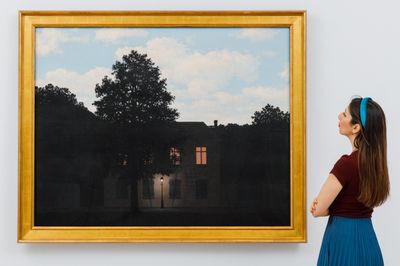
In his later years, Magritte developed a series of works exploring new material approaches and darker tonalities, including his ‘vache’ period - an uncharacteristically expressionist phase in the late 1940s. He returned to his classic style in the 1950s with iconic works such as Golconda (1953) and The Empire of Light (1954). These pieces solidified his international reputation.
René Magritte’s Exhibitions
Magritte’s work has been the subject of, and included in, numerous important institutional shows. Below is a selection.
Solo Exhibitions
- Magritte, Art Gallery of New South Wales, Sydney (2024–2025)
- The Magritte machine, Thyssen-Bornemisza National Museum, Madrid; Caixaforum, Barcelona (2021–2022)
- Magritte: The Treachery of Images, Centre Pompidou, Paris; SCHIRN, Frankfurt (2016–2017)
- Magritte: The Mystery of the Ordinary, 1926–1938, Museum of Modern Art, New York (2013–2014)
- Magritte, Albertina Museum, Vienna (2011–2012)
- Magritte and Contemporary Art: The Treachery of Images, LACMA, Los Angeles (2006–2007)
- Magritte, Hayward Gallery, London; Metropolitan Museum of Art, New York; Menil Collection, Houston; Art Institute of Chicago (1992–1993)
Group Exhibitions
- The Key to Dreams. Surrealist Masterworks From the Collection Hersaint, Foundation Beyeler, Riehen (2025)
- Imagine! 100 Years of International Surrealism, Royal Museums of Fine Arts Belgium, Brussels; Centre Pompidou, Paris; Musée National d’Art Moderne, Paris; Hamburger Kunsthalle, Hamburg; Fundación Mapfré, Madrid; Philadelphia Museum of Art, Philadelphia (2024–2026)
- Surrealism, Centre Pompidou, Paris (2024–2025)
- Fantastic Visions: 100 Years of Surrealism from the National Galleries of Scotland, Museum of Art Pudong, Shanghai,
- Surrealism Beyond Borders, Metropolitan Museum of Art, New York; Tate Modern, London (2021–2022)
- Surrealism: The Poetry of Dreams, Centre Pompidou, Paris; Gallery of Modern Art, Brisbane (2011)
- Surrealism: Two Private Eyes, Solomon R. Guggenheim Museum, New York (1999)
- Fantastic Art, Dada, Surrealism, Museum of Modern Art, New York (1936)
Website
A website dedicated to the work of René Magritte can be found here.
Further Reading
René Magritte’s work has been widely discussed in major publications including Apollo Magazine, The Guardian, and The New York Times.
René Magritte FAQs
What is René Magritte best known for?
René Magritte is best known for his Surrealist paintings that subvert visual logic, especially The Treachery of Images (1929), which depicts a pipe with the caption ‘This is not a pipe’.
What was Magritte’s artistic philosophy?
Magritte explored the limitations and ambiguities of language and image, often using ordinary objects in paradoxical settings to question reality.
What themes recur in Magritte’s work?
Common themes include perception, identity, illusion, reality, and the conflict between words and images.
Where can I see René Magritte’s work today?
The Royal Museums of Fine Arts of Belgium in Brussels holds the largest and most comprehensive collection of René Magritte’s artworks, including the dedicated Magritte Museum which showcases over 200 of his pieces. Other significant collections can be found at the Menil Collection in Houston and the Museum of Modern Art in New York.
Ocula | 2025


Explore René Magritte's Exhibitions



René Magritte in Ocula Magazine









Explore and Follow Artists Shaping Contemporary Art
A respected voice in contemporary art discourse.
Focusing on ambitious storytelling and insightful art-world commentary. Ocula Magazine publishes in-depth interviews, critical essays and timely analysis on the artists, exhibitions and ideas driving the global art world.
Learn more about Ocula Magazine
Showcasing the best of the art world.
Ocula partners with galleries from around the world to highlight their artists, artworks and exhibitions. Gallery membership is by application and invitation, with each member vetted by an independent panel.
Learn more about Ocula Membership
Specialises in the sale of major artworks.
Led by a team with deep ties to the world’s leading auction houses, galleries and collectors. Ocula’s advisory team offers bespoke services to high-net-worth clients from around the world who are looking to acquire the best of contemporary and modern art.
Learn more about our team and services