




JEFFREY GIBSON
b. 1972, United StatesIn 2024, Jeffrey Gibson became the first Indigenous artist to represent the United States with a solo exhibition at the Venice Biennale. Drawing on his Cherokee and Choctaw heritage, Gibson fuses pop culture, queer iconography, commercial objects, and Indigenous motifs to examine identity and cultural hybridity. His works frequently transform everyday items—such as punching bags—through the formal languages of modernism, recontextualising familiar forms to challenge the boundaries of modern art. This approach, combined with intricate beadwork and vibrant references to both tradition and contemporary culture, allows Gibson to offer a powerful reflection on individual and collective narratives in a global context.
Early Years
Gibson is of Mississippi Choctaw and Cherokee heritage and grew up living in urban centres in the United States, Germany, and South Korea, moving often because of his father’s role in the military. These international and cross-cultural experiences underpin much of his art, which frequently reflects a nuanced perspective on identity and belonging in contemporary society. Gibson earned a BFA from the School of the Art Institute of Chicago in 1995 and an MA in Painting at the Royal College of Art, London, in 1998. Early in his career, he also worked as a research assistant on the Native American Graves Protection and Repatriation Act at the Field Museum, shaping his ongoing interest in cultural ownership and historical narratives.
Jeffrey Gibson Artworks
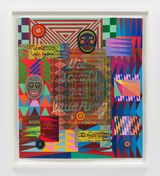
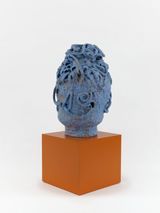
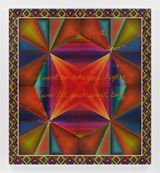
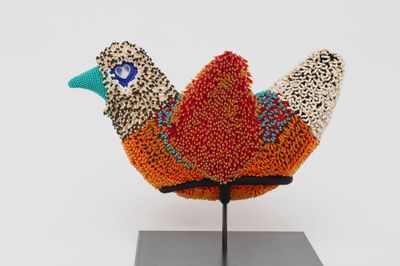
Jeffrey Gibson’s multifaceted practice encompasses painting, sculpture, textiles, performance, and video, uniting Native American traditions with elements from pop, queer culture, and political activism. By merging industrial and traditional materials—beadwork, hide, jingles, fabric, found objects, and commercial commodities—Gibson explores the construction and celebration of personal and collective identities.
‘One Becomes the Other’ and Early Innovations
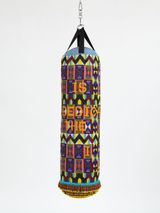
Gibson’s influential exhibition one becomes the other in 2012 at PARTICIPANT INC marked a shift to integrating beadwork, hide, and jingles into both found objects and sculptural forms, transforming the familiar into profound contemporary art. This series initiated Gibson’s celebrated use of repurposed punching bags, reimagined with intricate beadwork and streaming textiles, symbolising protection, transformation, and resistance.
Beaded Punching Bags and Protest
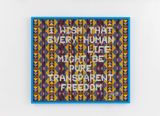
The beaded punching bags are among Gibson’s most iconic motifs, embedding protest texts, pop lyrics, and mantras into hybrid forms that challenge clichés around masculinity, violence, and survival. This period also saw a growing engagement with performance, costume, and community, further broadening his artistic vocabulary.
Textiles, Garments, and Performance
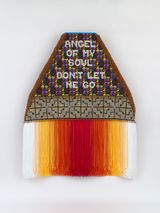
Gibson’s textile-based sculptures and ceremonial garments serve equally as gallery artworks and performance regalia, bridging Native American traditions with contemporary social commentary and collaborative storytelling. Key works include performance costumes seen in projects such as To Name An Other commissioned by the Smithsonian’s National Portrait Gallery in 2019, expanding on the cultural potency of regalia in a contemporary, activist context.
Venice Biennale 2024: the space in which to place me
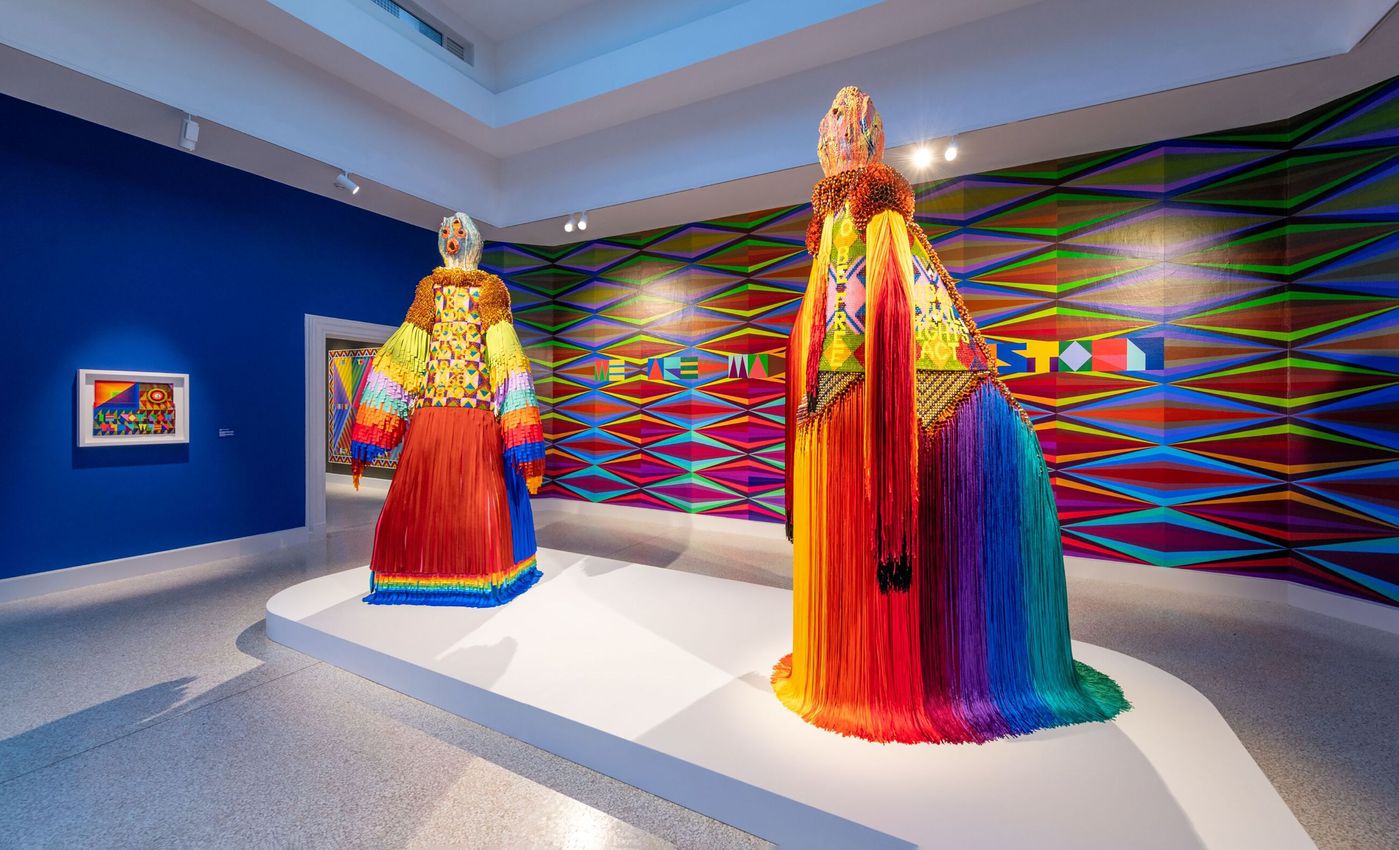
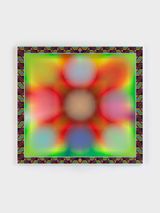
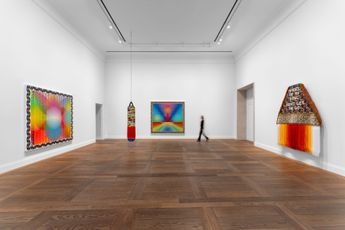
At the 60th Venice Biennale, Gibson transformed the U.S. Pavilion into a kaleidoscopic immersion of paintings, sculptures, murals, video, and large-scale outdoor installations. The works incorporate Native beadwork, found objects, legislative texts, and motifs from Dakota proverbs and Nina Simone’s music, forming a radiant affirmation of pluralism and belonging. The exhibition’s vibrant palette and lush materiality initiate a dialogue about American identity, power, and the enduring presence of Indigenous culture within the contemporary art world.
Select Public Commissions
- Because Once You Enter My House It Becomes Our House, Socrates Sculpture Park, New York, 2020
- Freedom Is for Everybody, Times Square Arts, New York, 2021
- To Name An Other, National Portrait Gallery, Smithsonian Institution, Washington, D.C., 2019
Select Awards and Accolades
- Represented the United States of America at the Venice Biennale, 2024
- MacArthur Fellow, 2019
- Joan Mitchell Foundation Grant, 2012
- Honorary Doctorate, Claremont Graduate University, Claremont, California
- Visiting Artist, Bard College
Exhibitions
Jeffrey Gibson has been the subject of significant solo and group exhibitions at leading institutions internationally.
Solo Exhibitions
- the space in which to place me, U.S. Pavilion, Venice Biennale, 2024
- Jeffrey Gibson: THE BODY ELECTRIC, Site Santa Fe, 2022
- Jeffrey Gibson: When Fire Is Applied to a Stone It Cracks, Brooklyn Museum, 2024
- Jeffrey Gibson: Like A Hammer, Denver Art Museum (touring), 2018–2019
- Jeffrey Gibson: To Feel Myself Beloved on the Earth, Aspen Art Museum, 2021
- Jeffrey Gibson: This Is the Day, Blanton Museum of Art, Austin, 2018
Group Exhibitions
- Whitney Biennial, Whitney Museum of American Art, New York, 2019
- Greater New York, MoMA PS1, New York, 2015
- State of the Art, Crystal Bridges Museum of American Art, 2014
- Shapeshifting: Transformations in Native American Art, Peabody Essex Museum, 2012
More Reading
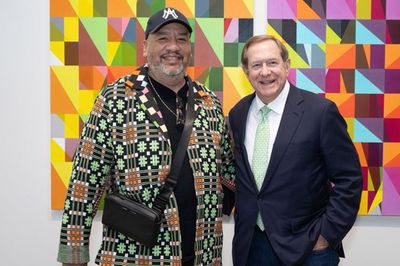
The artist’s work and impact have been profiled in international magazines and museum publications, including Ocula Magazine (see Anna Dickie’s article featuring collector Jordan Schnitzer discussing Jeffrey Gibson’s work)7, as well as major features in Art in America, Artnews, and The New York Times.
Jeffrey Gibson FAQs
Where can I see Jeffrey Gibson’s artworks in public collections?
Jeffrey Gibson’s artworks are in the permanent collections of more than 20 museums, including the Denver Art Museum; Museum of Fine Arts, Boston; Philbrook Museum of Art, Tulsa; Portland Museum of Art, Maine and Oregon; High Museum of Art, Atlanta; San Francisco Museum of Modern Art; Seattle Art Museum; and the Smithsonian American Art Museum, Washington, D.C.
What materials and techniques does Jeffrey Gibson use in his contemporary art practice?
Jeffrey Gibson combines traditional materials such as glass beads, hide, and fabric with found and industrial objects, alongside pop and protest texts, to craft works that straddle the boundaries of craft, contemporary art, and activism. His aesthetic merges beadwork, textiles, ready-mades, and painting with influences from Western modernism, popular music, and queer subcultures.
How does Jeffrey Gibson’s art reflect his cultural background?
Gibson’s heritage as Mississippi Choctaw and Cherokee deeply informs both the techniques and conceptual underpinnings of his art, which often references intertribal aesthetics, powwow regalia, and the complexities of hybridity and cross-cultural experience. Gibson engages with both Native and global history to challenge stereotypes and advocate for greater inclusivity in contemporary art. His multifarious practice redresses the exclusion and erasure of indigenous art traditions from the history of Western art as it explores the complexity and fluidity of identity.
What is the meaning behind Jeffrey Gibson’s beaded punching bag artworks?
The beaded punching bags, first developed around 2012, repurpose objects associated with violence and resilience into vibrant, tactile symbols of protection, personal history, and community strength. They serve as metaphors for reclaiming agency and identity, weaving together elements from various traditions.
Is there a correct way to pronounce Jeffrey Gibson’s name?
Jeffrey Gibson’s name is pronounced JEFF-ree GIB-suhn.
Are there any random and interesting facts about Jeffrey Gibson?
Gibson’s ceremonial garments are often used both as sculptural objects in museums and as regalia in public performances and activist gatherings. He frequently collaborates with choreographers, dancers, and musicians, making his art practice especially dynamic. His 2024 Venice Biennale pavilion included not only visual art but also large-scale outdoor works and performance-based elements.
Ocula | 2025








Explore Jeffrey Gibson's Exhibitions




Jeffrey Gibson in Ocula Magazine







Explore and Follow Artists Shaping Contemporary Art
A respected voice in contemporary art discourse.
Focusing on ambitious storytelling and insightful art-world commentary. Ocula Magazine publishes in-depth interviews, critical essays and timely analysis on the artists, exhibitions and ideas driving the global art world.
Learn more about Ocula Magazine
Showcasing the best of the art world.
Ocula partners with galleries from around the world to highlight their artists, artworks and exhibitions. Gallery membership is by application and invitation, with each member vetted by an independent panel.
Learn more about Ocula Membership
Specialises in the sale of major artworks.
Led by a team with deep ties to the world’s leading auction houses, galleries and collectors. Ocula’s advisory team offers bespoke services to high-net-worth clients from around the world who are looking to acquire the best of contemporary and modern art.
Learn more about our team and services