




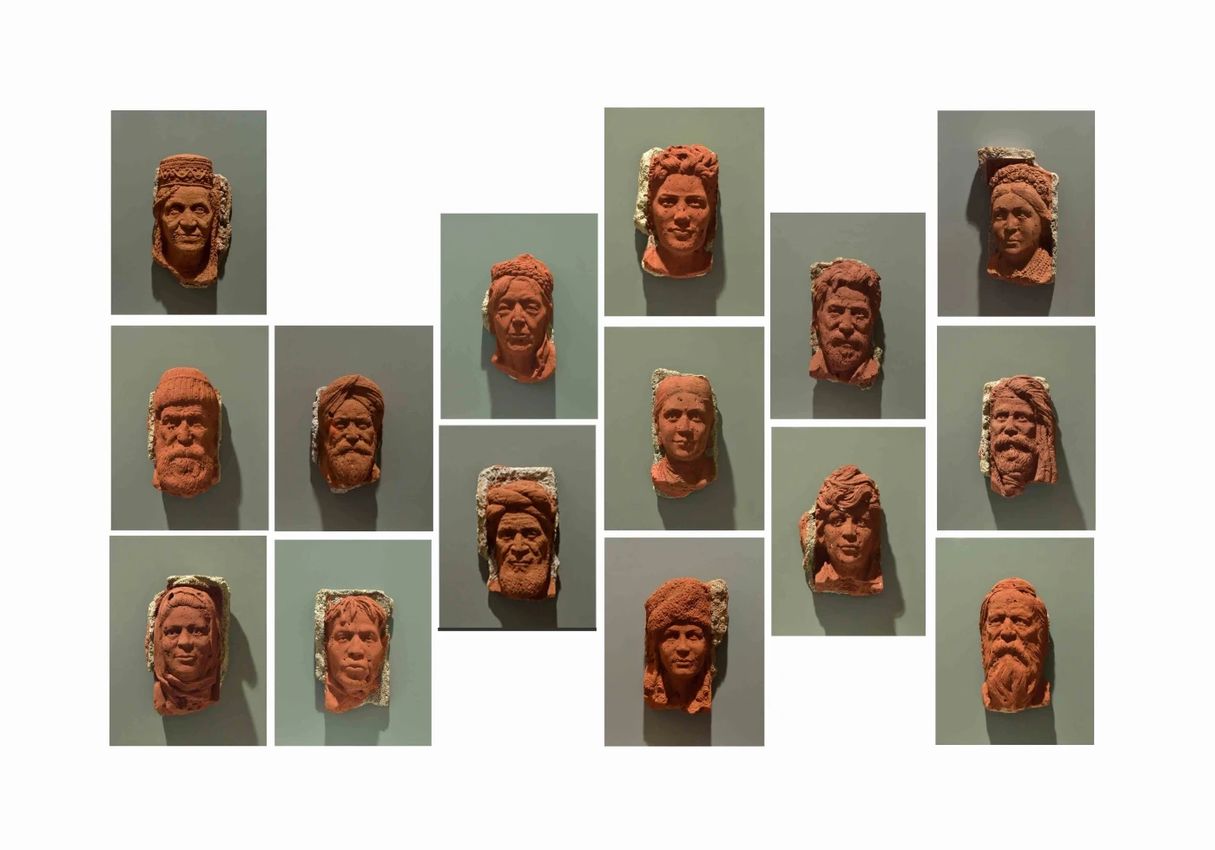
gallery rosenfeld is delighted to be hosting the second solo European exhibition of Indian artist Girjesh KumarSingh entitled Life in the Rubble. Contemporaneously, there will be an accompanying exhibition entitled, Looking at the Human displaying a collection of sculptural heads from 450 BC - early 20th Century from anotable private collection.
Western civilisation from its earliest days has been centred around humanism, the human figure has nearly alwaysbeen at the centre of the artist’s search for truth. Even not delving very far back in time, Picasso, Soutine, Bacon,Freud, and Auerbach have shown us different ways of portraying human features. The overriding theme of boththe shows asks the question, ‘What is it to be a Human?’. Girjesh Kumar Singh creates his sculptures from hisscavenging amidst the rubble of destroyed buildings near where he lives. As the building material is brick, heworks with the broken bricks which he finds at the various sites. As he himself states with great modesty: ‘thesculpture is already in the brick and I am merely completing the process’.
The idea that out of what appears to be total destruction, just as with the first shoots of a plant after an extremelycold winter, life will find a way to always re-emerge. Viewing an exhibition of Singh’s work, which comprisesinstallations of 15 meticulously sculpted human heads and single visions of architecture, is profoundly moving, notjust for the impact of the works but even more for what it tells us about the human spirit.
The different heads are always individual and inspired from different ages of the human being, cultures, and epochsso what we find ourselves looking at is a compendium of the physiology of the human being in time. Furthermore,we shall be showing two brand new series of works. One comprises very large individual heads where the mixtureof red brick and cement create a strange hybrid where the heads are never viewed completely. The other seriesis made up of a series of ‘pebbles’ where on each individual stone, the artist has sculpted individual architecturalscenes. All Kumar Singh’s works are also referencing the problems of peoples’ impermanence in their homes andhis sculptures are a cry against the forced migration which so many peoples are forced to undergo due to war, alack of natural resources and extreme poverty. In this sense, the partner exhibition entitled, ‘Looking at the Human’will show a selection of works from an important private British collection, which will represent a perfect dialoguewith Singh’s work as we find ourselves looking at various heads from various cultures and epochs. Sculptures ondisplay range from a Cypriot monumental male votive head of 450 BC, a Gandra Head of Buddha from the 3rd/4thcentury, a Hip Mask from the Edo period and a Benin Kingdom in Nigeria to a Korean head from the 1930’s givean idea of the extremely wide net which has been used to put this show together.
Singh, due to his extreme humility, maintains his heads within a very realistic physiognomy, whereas the sculptedheads in the exhibition downstairs, emerging as they do from many different cultures, have a bewildering variety.This combination of shows has the aim not just to make us wonder at an artist’s or an artisan’s ability at expressingthe mysteries and expressiveness of the human physiognomy but also Girjesh Kumar Singh’s tenacity in workingwith such an unrelenting material as broken bricks to communicate the profound ability of human beings’ endlessquest for survival.
Girjesh Kumar Singh’s compelling sculptures made from broken bricks of destroyed homes provide a perfect artistic testimony to the traumas we are living with in our contemporary societies. The artist’s practice manages to combine the poetics of destruction with something human and historical, transforming the inanimate into the visceral, and bringing to light difficult truths which are too often suppressed or ignored by those unaffected.


gallery rosenfeld is a leading contemporary art gallery dedicated to presenting ambitious, concept-driven work by an international community of artists. Founded in London’s Fitzrovia in 2011 by Ian Rosenfeld, the gallery has established itself as a dynamic platform for artistic discovery, supporting both emerging and established practitioners across painting, sculpture, installation, performance and multidisciplinary practice.

A respected voice in contemporary art discourse.
Focusing on ambitious storytelling and insightful art-world commentary. Ocula Magazine publishes in-depth interviews, critical essays and timely analysis on the artists, exhibitions and ideas driving the global art world.
Learn more about Ocula Magazine
Showcasing the best of the art world.
Ocula partners with galleries from around the world to highlight their artists, artworks and exhibitions. Gallery membership is by application and invitation, with each member vetted by an independent panel.
Learn more about Ocula Membership

Specialises in the sale of major artworks.
Led by a team with deep ties to the world’s leading auction houses, galleries and collectors. Ocula’s advisory team offers bespoke services to high-net-worth clients from around the world who are looking to acquire the best of contemporary and modern art.
Learn more about our team and services
