



CECILY BROWN
b. 1969, United KingdomCecily Brown is a British painter best known for large-scale canvases that fuse abstraction and figuration through dense, vibrant brushwork and fragmented motifs of bodies, landscapes, and vanitas imagery. Drawing on Willem de Kooning, Francis Bacon, Joan Mitchell, and Old Masters such as Rubens, Poussin, and Goya, her paintings explore desire, mortality, eroticism, and the instability of images, often pushing representations of the body toward the grotesque.
Currently on view at the Serpentine South in London through 6 September 2026, her exhibition Picture Making (26 March—6 September 2026) highlights recent paintings, drawings, and monotypes alongside earlier works, focusing on park life, nature, and English landscape traditions.
Early Life, Education, and Career
Born in London in 1969, Brown grew up in a creative family; her mother is the novelist Shena Mackay and her father is the influential critic and curator David Sylvester, who introduced her to Francis Bacon. At 16, she left traditional schooling to study at Epsom School of Art and Design, later taking drawing and printmaking at Morley College in London, where she studied under painter Maggi Hambling while supporting herself with cleaning work. Brown completed her BA in Fine Art with first-class honours at the Slade School of Fine Art, University College London, in 1993, winning first prize in the National Competition for British Art Students and spending a formative period studying in New York.
Inspired by her time in the United States and seeking a context beyond the media-driven Young British Artists scene in London, she left for New York City in 1994, initially working in animation and making the erotic mixed‑media film Four Letter Heaven, which premiered at the Telluride Film Festival in 1995 and was later shown in Europe. During this period she lived a classic ‘starving artist’ life—waiting tables and painting obsessively in her Meatpacking District studio, often working on numerous canvases at once as she honed a highly charged, gestural idiom centred on chaotic, violent sexuality.
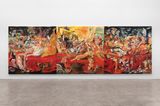
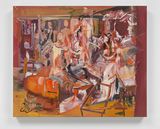
Soon after arriving in New York, Brown was offered a solo exhibition by Jeffrey Deitch at Deitch Projects: Spectacle (1997), a show of six erotic paintings of colourful bunny rabbits that became the first group of her ‘Bunny Paintings’ to be presented there. At Deitch Projects her work was acquired by Charles Saatchi, a moment often described as launching her career to a new level of visibility and leading to rapid institutional and market recognition, including representation by Gagosian from 2000. By the late 1990s she had established herself with large-scale oil paintings that fused figurative motifs with vigorous abstraction; works such as The Girl Who Had Everything (1998) and High Society (1999) exemplify her lush, energetic style, in which human forms appear to dissolve within turbulent fields of colour and gesture. Her early paintings frequently explored eroticism, desire, and mortality through a visceral painterly language that deliberately courts the grotesque.
The ‘Bunny Paintings’
In the late 1990s and early 2000s, Brown developed her influential ‘Bunny Paintings’, depicting anthropomorphic rabbits entangled in frenzied, erotic scenes. Paintings such as Rabbit Habit (1999) and The Fugitive Kind (2000) use her gestural technique to merge fantasy, sexuality, and abstraction, transforming cartoon-inflected imagery into vivid meditations on excess and desire. Closely associated with her breakthrough exhibitions at Deitch Projects, this body of work attracted significant attention for its provocative subject matter and painterly bravura, consolidating Brown’s position as a leading figure in the New York contemporary art scene and as a key female voice expanding a grotesque tradition historically dominated by male artists like Bacon and Gilbert & George.
Later Developments
Since the early 2000s, Brown’s practice has shifted from overtly figurative and erotic themes toward increasingly layered, fragmented compositions in which figures, landscapes, and mythological or narrative scenes emerge and dissolve within denser and more open passages of paint. Her mid-career works have incorporated expanded art-historical references to Old Master paintings and the vanitas tradition, further complicating the relationship between abstraction and representation while bringing in motifs from Bruegel, Snyders, and Goya, among others.
In recent years, particularly with works exhibited in Cecily Brown: Death and the Maid at The Metropolitan Museum of Art, New York (4 April–3 December 2023), her paintings have taken on a darker tone, meditating on mortality, transience, and memento mori imagery. Critics have connected this sustained focus on sex and death to Brown’s long-standing interest in the grotesque and to the ‘abject ideas about the body’ she has described as central to her work. The Serpentine exhibition Picture Making (Serpentine South, London, 27 March–6 September 2026) continues this trajectory, presenting new and recent paintings alongside monotypes from across her career, with imagery of amorous couples, woodland scenes, and cautionary-tale undertones drawn from English park life, illustration, and the surrounding Kensington Gardens.
Today, Brown lives and works in New York City and has been represented by major galleries. Over three decades, she has helped reinvigorate figurative painting at a time when it was often dismissed as exhausted, demonstrating that the medium can still accommodate complex engagements with history, sexuality, and the image-saturated present. Her influence is visible in a generation of younger painters who similarly fuse references to art history, popular culture, and personal experience in unstable, hybrid images.
Style, Materials and Techniques
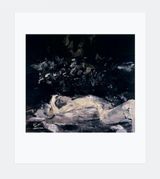
Brown works primarily in oil on canvas, layering paint wet‑on‑wet and scraping, wiping, and reworking surfaces over extended periods to achieve the rich textures and dynamic brushwork that have come to define her style. She also produces drawings and prints using ink, watercolour, and pastel, with works on paper that complement her paintings and extend her exploration of form, movement, and composition across different media, as well as monotypes that have featured prominently in exhibitions and publications such as The English Garden.
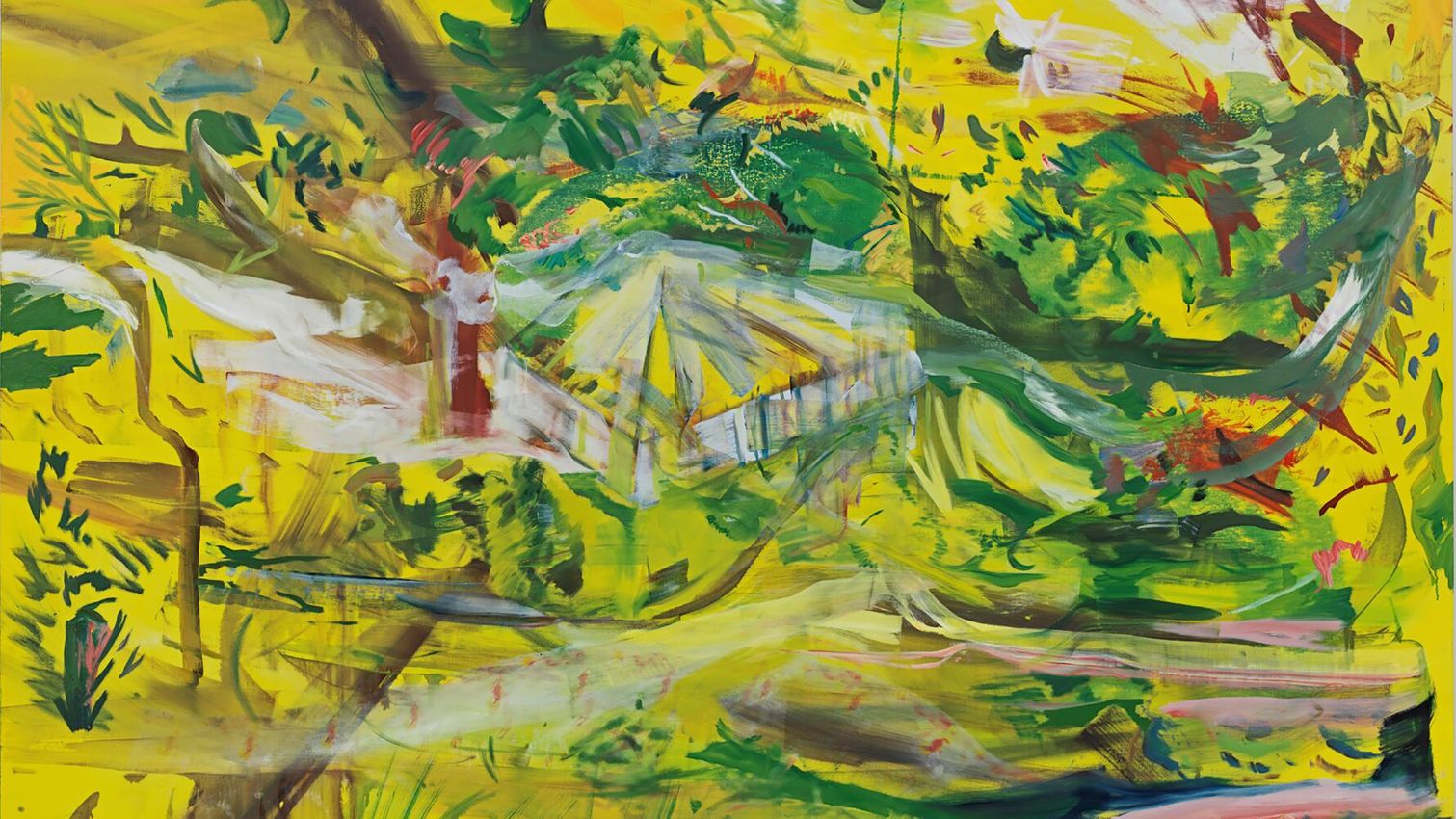
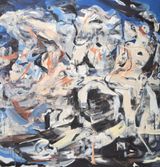
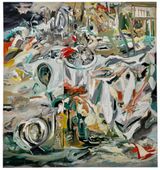
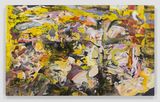
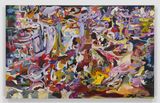
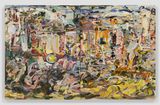
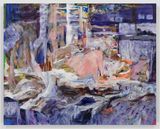
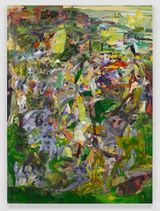
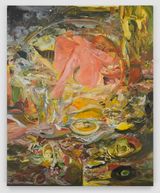
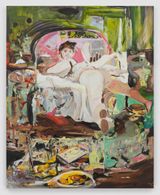
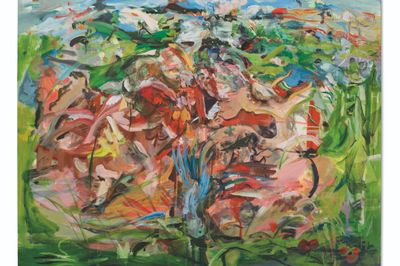
Her paintings are characterised by dense, all-over brushwork, large scale canvases, and a palette that ranges from muddy, flesh-like tones to luminous, almost garish colour. In many works she borrows compositional structures, motifs, or specific scenes from historical paintings, reconfiguring them through fragmentation, repetition, and overlay so that recognisable figures and objects hover at the edge of legibility before dissolving back into paint. Throughout, her method emphasises ambiguity and flux: forms double back on themselves, limbs and torsos overlap, mirrors and reflective surfaces multiply viewpoints, and the viewer’s eye is forced into a constant act of searching and reassembling. Brown is known to have described painting as a process in which ideas are discovered through making rather than executed from a fixed plan.
Public Commissions, Awards and Accolades
- The English Garden, permanent mural, Metropolitan Opera House, New York (completed 2018).
- Elected Royal Academician, Royal Academy of Arts, London (2020).
- Her work is held in major institutional collections, including Tate (London), the Museum of Modern Art (MoMA, New York), the Whitney Museum of American Art (New York), and the Centre Pompidou (Paris).
Major Exhibitions
Solo Exhibitions
- Cecily Brown: Picture Making, Serpentine South, London (2026)
- Cecily Brown: Death and the Maid, The Metropolitan Museum of Art, New York (2023)
- Cecily Brown, Blenheim Palace, Oxfordshire, UK (2020)
- Cecily Brown: Where, When, How Often, and with Whom, Louisiana Museum of Modern Art, Humlebaek, Denmark (2018)
- Cecily Brown: Shipwreck Drawings, The Drawing Center, New York (2017)
- Cecily Brown, Museum of Fine Arts, Boston, MA (2006) * Based on a True Story, MACRO – Museo d’Arte Contemporanea, Rome (2003) * Directions-Cecily Brown, Hirshhorn Museum and Sculpture Garden, Washington D.C. (2002)
Group Exhibitions
- Women Painting Women, Modern Art Museum of Fort Worth (2022)
- Radical Figures: Painting in the New Millennium, Whitechapel Gallery, London (2020)
- All Too Human, Tate Britain, London (2018)
- Versus Rodin: Bodies across space and time, Art Gallery of South Australia, Adelaide (2017)
- Forever Now: Contemporary Painting in an Atemporal World, Museum of Modern Art, New York (2014–2015)
- At Century’s End: The John P. Morrissey Collection of 90’s Art, Museum of Contemporary Art, Lake Worth (1999)
- Sensation: Young British Artists from the Saatchi Collection, Royal Academy of Arts, London (1997)
Critical Reception
Brown’s work has been widely discussed in leading art and culture publications including The Brooklyn Rail, The Financial Times, and The New York Times__.
Website
Cecily Brown’s website can be found here.
Cecily Brown FAQs
What is Cecily Brown best known for?
Cecily Brown is best known for her large-scale paintings that blend abstraction and figuration through dense, gestural brushwork and fragmented motifs of bodies, landscapes, and eroticism. Key series include her early Bunny Paintings like Rabbit Habit (1999) and later vanitas-themed works such as those included in Death and the Maid, the major survey of her work at The Metropolitan Museum of Art in 2023, and other dense paintings such as those in Picture Making at the Serpentine Galleries in 2026.
What are Cecily Brown’s most famous works?
Cecily Brown’s most recognised works include The Girl Who Had Everything (1998), High Society (1999), Rabbit Habit (1999), and The Fugitive Kind (2000), which fuse figurative suggestion with turbulent abstraction. Recent pieces like those in Picture Making (Serpentine South, 2026) continue this with park scenes and woodland imagery.
What are the ‘Bunny Paintings’?
Cecily Brown’s ‘Bunny Paintings’ are a series from the late 1990s and early 2000s in which she depicted anthropomorphic rabbits in erotic, chaotic scenes, merging fantasy, figuration, and abstraction. Closely associated with her early exhibitions at Deitch Projects, these works helped establish her reputation for provocative imagery handled with virtuosic painterly technique.
How has Cecily Brown’s work evolved?
Her work has shifted from overtly figurative and erotic themes to more layered, fragmented compositions that reference Old Master paintings and explore mortality, memory, and the vanitas tradition.
What influences Cecily Brown’s painting style?
Cecily Brown draws from Willem de Kooning, Francis Bacon, Joan Mitchell, and Old Masters like Rubens, Poussin, and Goya, creating layered surfaces where forms dissolve between recognition and chaos. Her Slade School training and 1994 move to New York shaped her gestural, art-historical approach.
What materials does Cecily Brown use?
Cecily Brown primarily works in oil on canvas but also creates drawings and prints using ink, watercolor, and pastel.
Has Cecily Brown received any major awards or honours?
Yes, she was elected a Royal Academician by the Royal Academy of Arts in London in 2020.
What is unique about Cecily Brown’s approach to painting?
Brown’s work is distinguished by its energetic brushwork, layered surfaces, and the way she merges art historical references with contemporary themes, creating paintings that are both sensual and psychologically charged.
Where can I see Cecily Brown’s work?
Cecily Brown’s work is held in major museum collections and has been exhibited at the Metropolitan Museum of Art, Museum of Modern Art, Tate Britain, and other leading institutions worldwide. Cecily Brown’s current exhibition is Picture Making at Serpentine South, London (27 March–6 September 2026), featuring new paintings, drawings, and monotypes from 2001 onward focused on nature, narrative, and park life. It marks a major UK homecoming for the New York-based artist.
What public commissions has Cecily Brown completed?
Cecily Brown created The English Garden, a permanent mural at the Metropolitan Opera House in New York.
Ocula | 2026























Explore and Follow Artists Shaping Contemporary Art
A respected voice in contemporary art discourse.
Focusing on ambitious storytelling and insightful art-world commentary. Ocula Magazine publishes in-depth interviews, critical essays and timely analysis on the artists, exhibitions and ideas driving the global art world.
Learn more about Ocula Magazine
Showcasing the best of the art world.
Ocula partners with galleries from around the world to highlight their artists, artworks and exhibitions. Gallery membership is by application and invitation, with each member vetted by an independent panel.
Learn more about Ocula Membership
Specialises in the sale of major artworks.
Led by a team with deep ties to the world’s leading auction houses, galleries and collectors. Ocula’s advisory team offers bespoke services to high-net-worth clients from around the world who are looking to acquire the best of contemporary and modern art.
Learn more about our team and services