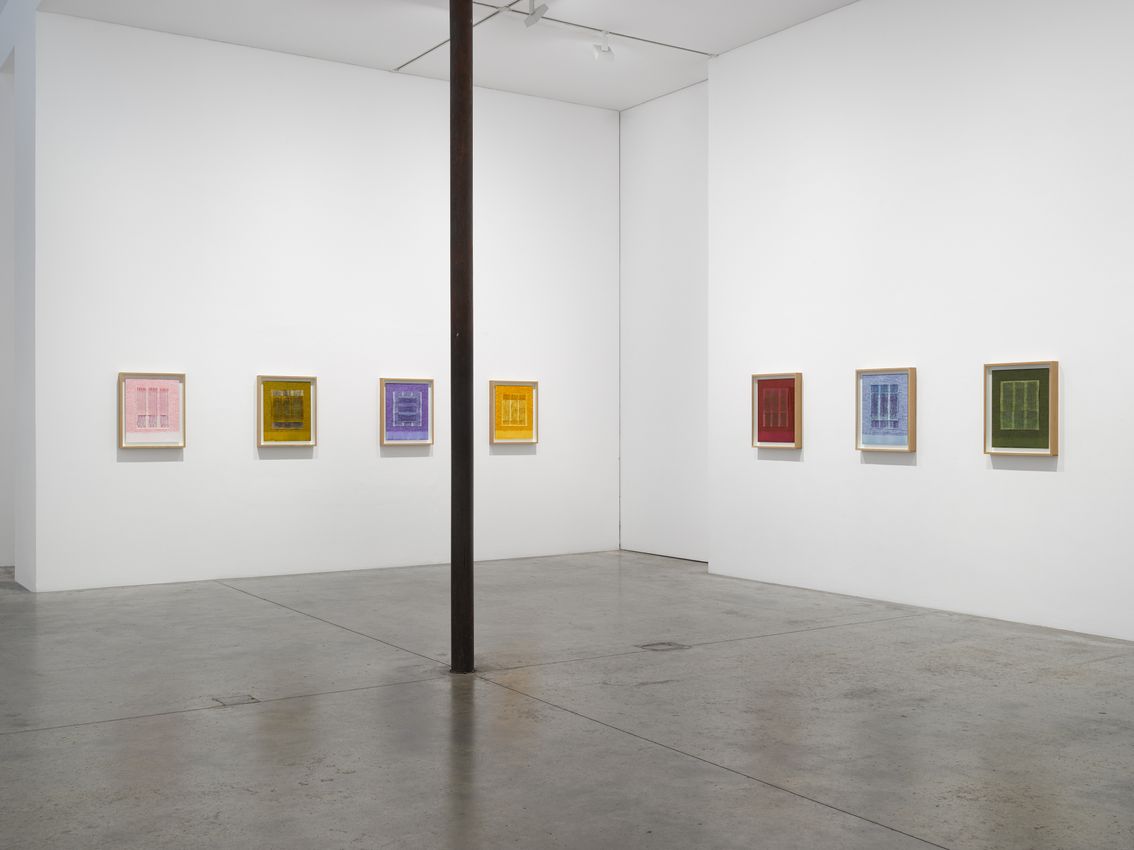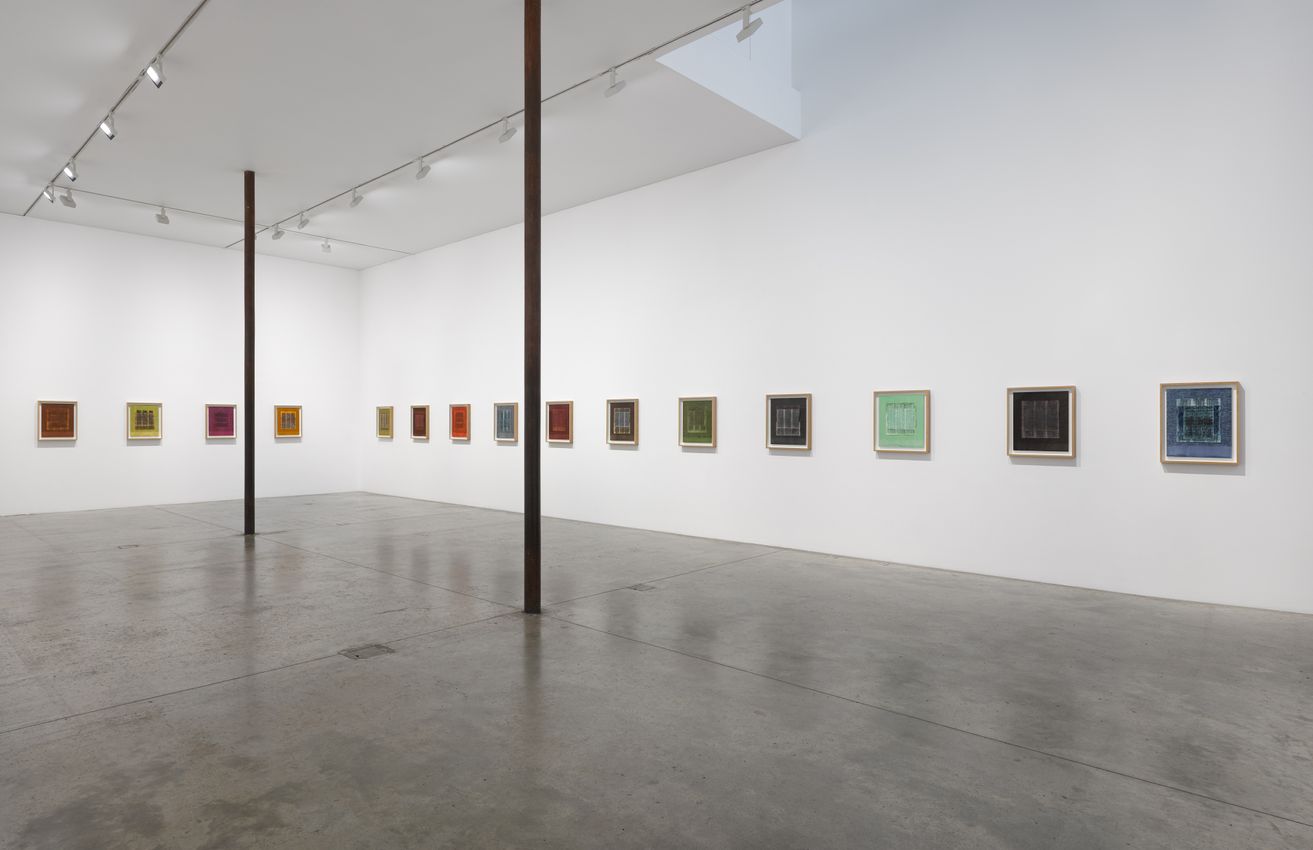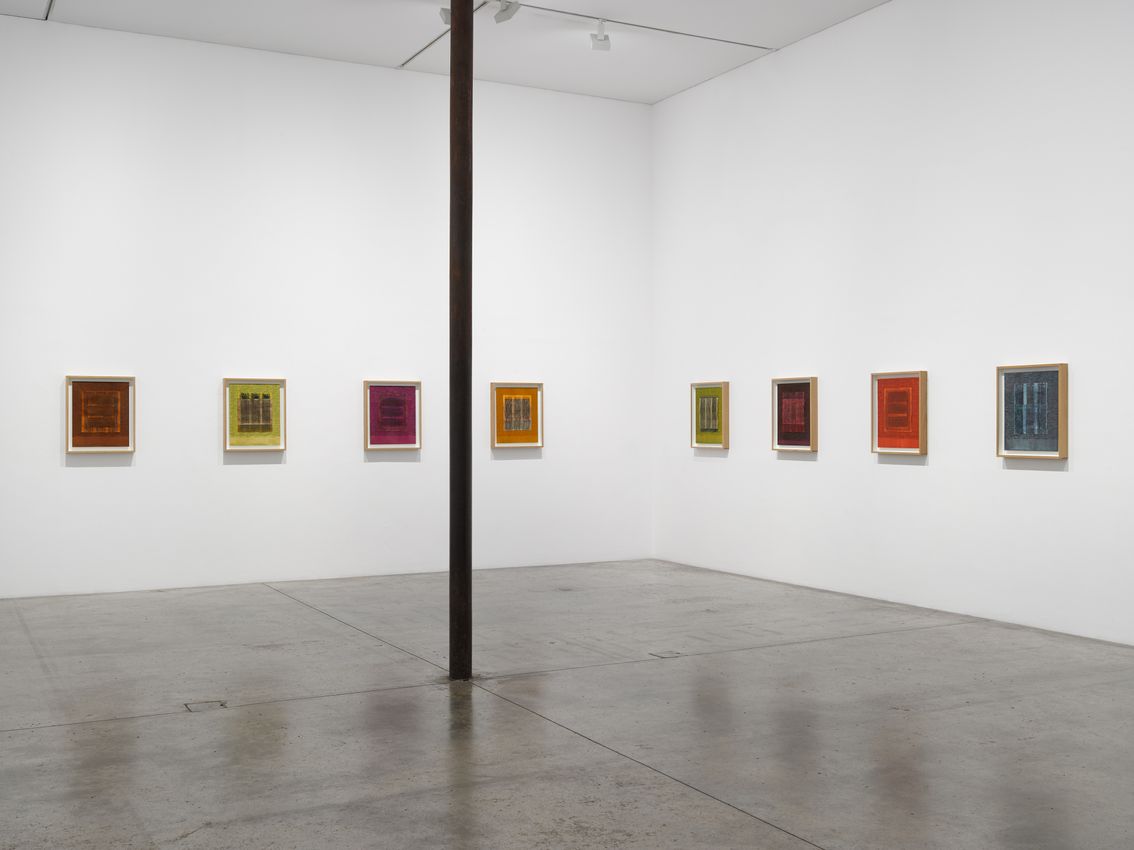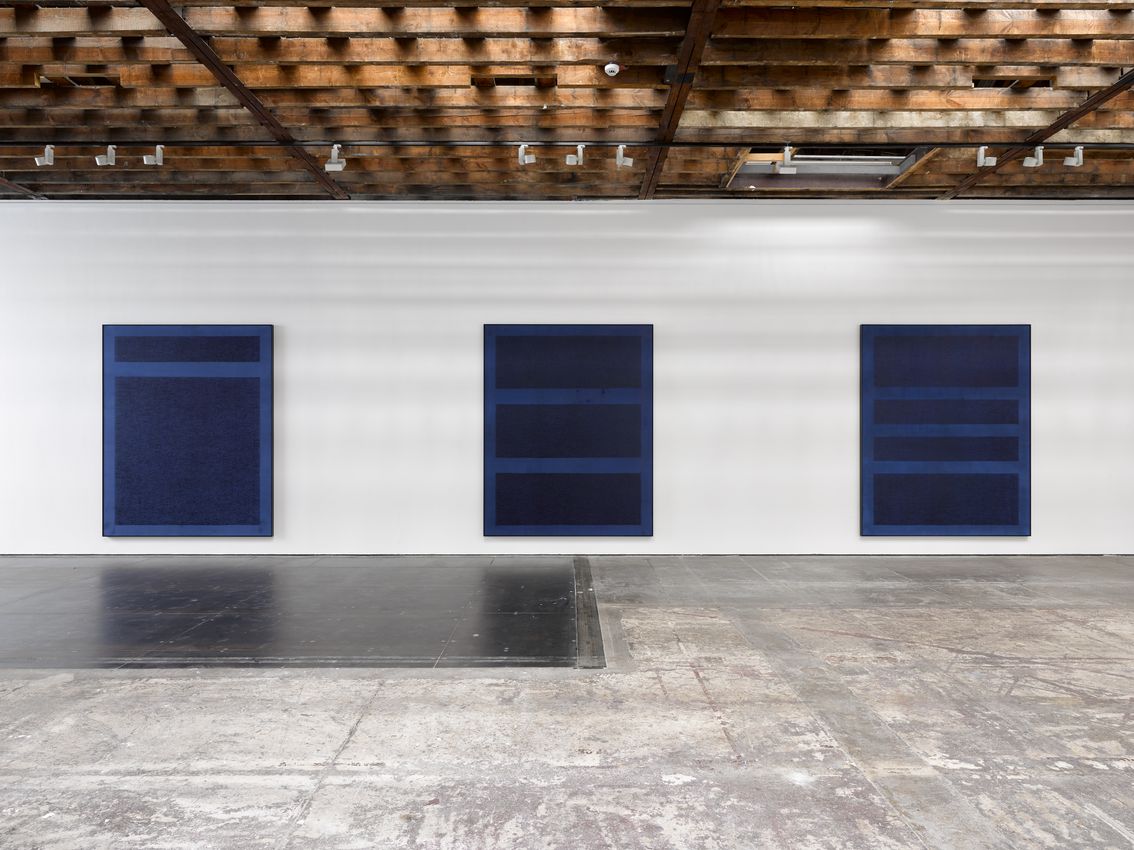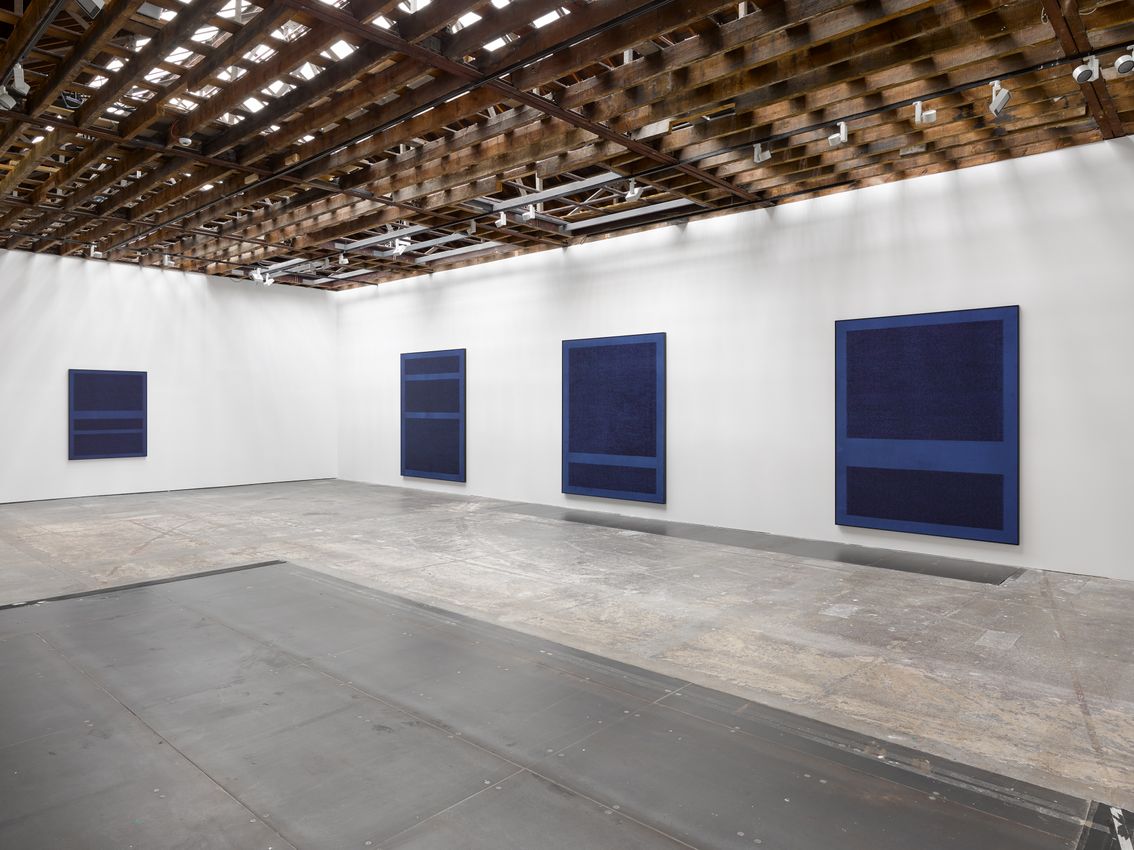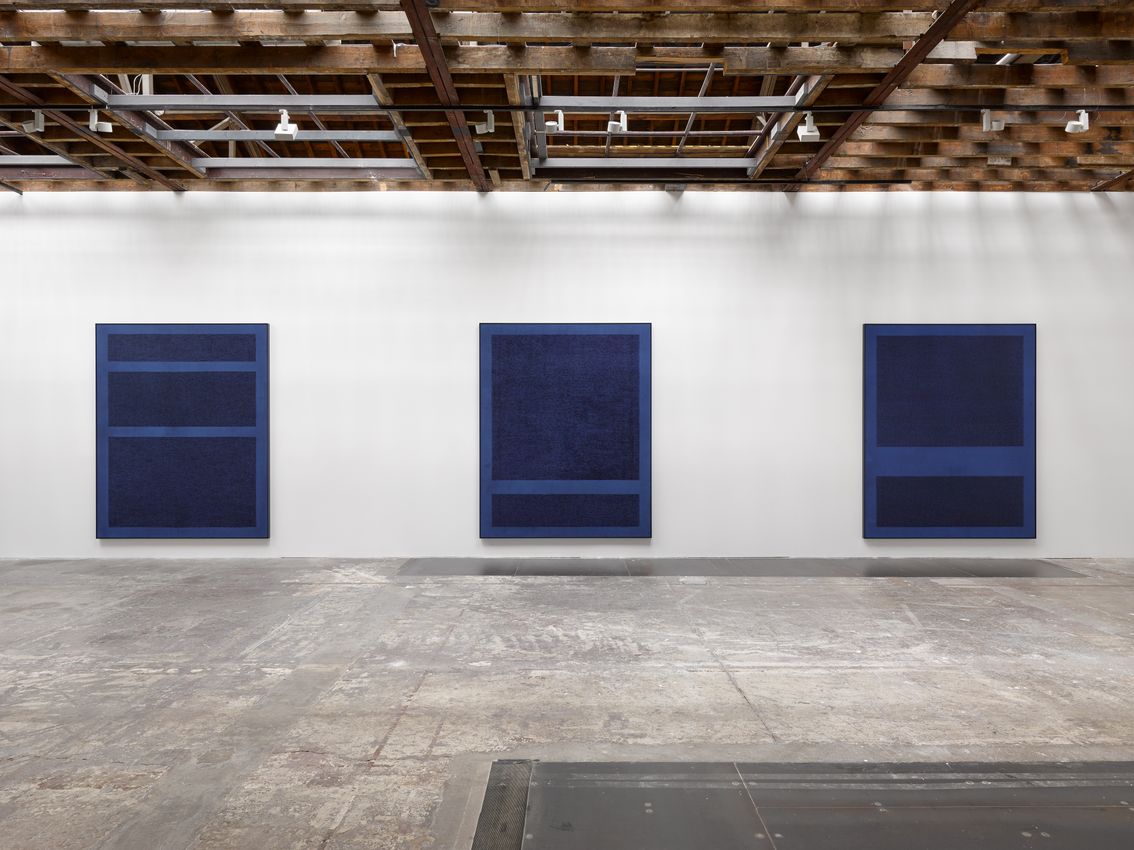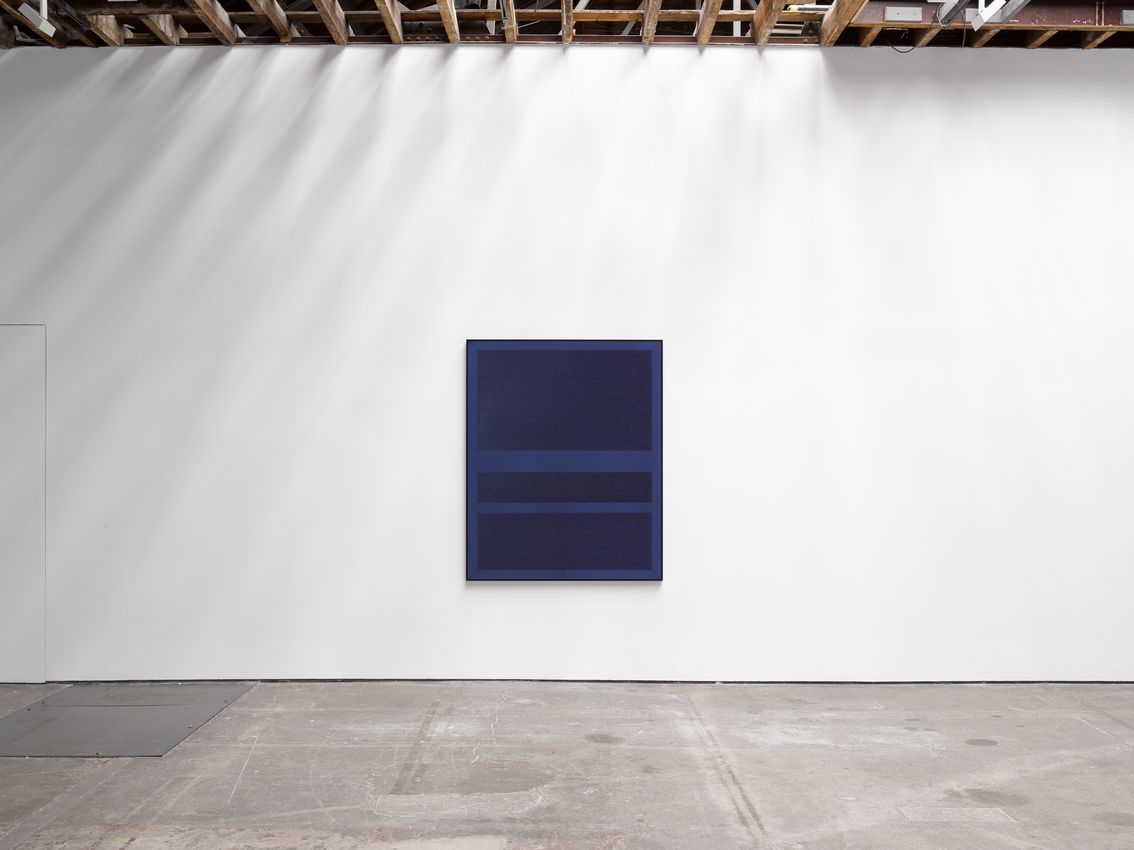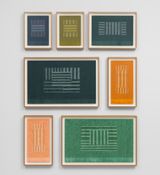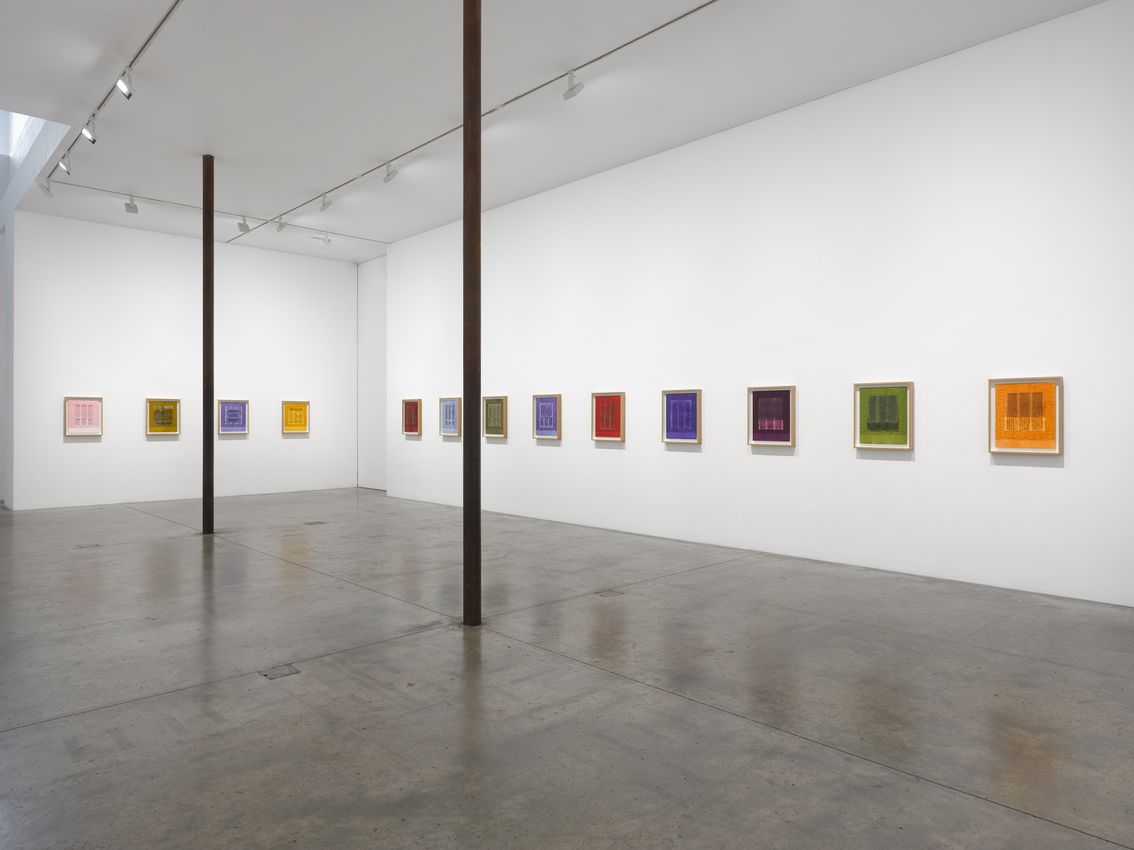
Victoria Miro is delighted to announce an exhibition of new works by Idris Khan. Conceived of as two distinct installations, each a reflection on aspects of the past year, The Seasons Turn includes a suite of 28 watercolour and oil collaged works on paper that incorporate fragments of the score of Vivaldi’s The Four Seasons, and an environment of enveloping blue paintings whose rich bands of colour are layered with the artist’s thoughts, feelings and responses to 2020.
Music in its written and played forms has long been a source of inspiration for Khan who, in two- and three-dimensional works and film, has reimagined the work of composers including Beethoven, Chopin, Schubert and Bach. In these new works Khan returns to Vivaldi’s baroque masterpiece The Four Seasons, using fragments of the violin concerti’s scores as a springboard for his own visual evocation of a calendar year. Khan’s work has often alluded to the excessive proliferation of information in the technical age, whilst simultaneously advocating for a slower, more considered way of looking. Forced to slow down during this period of lockdown, in these works he reflects on his own increased awareness of the changing rhythms and colours of the natural world.
Seven works correspond with each of the seasons. Each individual work comprises a ground of watercolour in a selected hue on to which a smaller sheet, stamped with fragments of Vivaldi’s score in a contrasting or complementary colour, is affixed. Stamping further across the sheets in a free and improvisatory way, Khan arrives at combinations of colour and gesture that, referring to the natural world, also reflect his own emotions amid the turbulence of the past year. The effect is twofold. Just as Vivaldi’s work brims with allusions to nature, in Khan’s work colour—stepping forward here to become a major protagonist—changes with seasonal nuance, the vibrancy of spring giving way to the lushness of summer, the burnished hues of autumn and winter’s stark palette as the viewer moves around the gallery. Yet, while the works line the gallery in chronological order—with a compositional linearity that might be considered akin to a line of music—individually and collectively they are subject to staccato change, each line of music a fragment of time that might be overlaid or repeated at any point in the year, irrespective of the music’s progression. For Khan, this manner of working is reflective of a year in which a sense of time’s passage and collapse has been unlike any other. It is one, as the artist says, ‘with uncertainty built into the process’. Yet, it is also one perfectly in tune with the ‘live’ quality of creating the work and the fortuitous emergence of unforeseen beauty.
Khan has often drawn inspiration from key philosophical and theological texts in his work, yet increasingly his own writings have become a conduit for investigating memory, creativity and the layering of experience. Unified by the use of the colour blue, which the artist describes as having ‘an immediate effect on emotion’, a number paintings, some large scale, feature passages of texts in which Khan expresses thoughts, feelings and responses to 2020. Diaristic in nature, these texts, once repeated and layered in sonorous blue oil, are distilled, a number fragmentary experiences and disparate ideas becoming a single image. In this manner, while Khan ultimately eradicates the meaning of the original text, he constructs an abstract and universal language. Moving between the works in a specially conceived installation, the viewer becomes aware of the way in which each painting is subtly different, the horizontal bands appearing to rise and fall almost like breathing, shifting in a rhythmic way that also relates to the musicality of the works in his Vivaldi series. It is in this contemplative space that both the processes of Minimalist art and allusions to the role of repetition in the world’s major religions are brought into focus—as a vehicle for transcendence and a conduit of the sublime.
About the artist
Born in Birmingham in 1978, Idris Khan completed his Master’s Degree at the Royal College of Art and lives and works in London. Idris Khan was appointed OBE for services to Art in the Queen’s Birthday 2017 Honours List. In 2023, Milwaukee Art Museum, Milwaukee, Wisconsin, USA will present the first career survey exhibition by the artist in the United States.
A major survey exhibition Idris Khan: A World Within was held at The New Art Gallery Walsall in February 2017, with solo presentations of the artist’s work previously staged at national and international institutional venues including the Whitworth Gallery, University of Manchester (2016–2017 and 2012); Sadler’s Wells, London (2011); Gothenburg Konsthall, Sweden (2011); Museum of Contemporary Canadian Art, Toronto (2010); Kunsthaus Murz, Mürzzuschlag, Austria (2010) and K20, Düsseldorf (2008). His work has also been included in group shows at the National Gallery of Art, Washington (2015); Bass Museum of Art, Miami (2014–2015); Tel Aviv Museum of Art (2014); Jeu de Paume, Paris (2013); Museum of Contemporary Art, Jacksonville, Florida (2013); The British Museum, London (2012); National Museum of Contemporary Art, Oslo (2012); Fundament Foundation, Tilburg (2011); Solomon R Guggenheim Museum, New York (2010); and Martin-Gropius Bau, Berlin (2009).
A major public sculpture for London by Khan, commissioned by St George’s Plc with London Borough of Southwark as part of the development of One Blackfriars, was unveiled in autumn 2019. Khan’s 21 Stones is currently displayed in The Albukhary Foundation Islamic Gallery, which recently opened at the British Museum, London. 21 Stones is the British Museum’s first site-specific artwork. In 2016, Khan was commissioned to make a permanent public monument, forming the centrepiece of the new Memorial Park in Abu Dhabi, which was unveiled on the UAE Commemoration Day. In 2017, it received an American Architecture Prize, a World Architecture News Award and a German Design Award. Further commissions include a wall drawing commissioned by the British Museum in 2012 for its exhibition Hajj: Journey to the Heart of Islam. In addition, for the duration of the exhibition, Khan’s monumental floor installation, Seven Times, was installed in the museum’s Great Court.
Drawing inspiration from the history of art and music as well as key philosophical and theological texts, Idris Khan investigates memory, creativity and the layering of experience. Khan’s works – in media including sculpture, painting and photography – rely on a continuous process of creation and erasure, or the adding of new layers while retaining traces of what has gone before. He is well known for his large-scale works in which techniques of layering are used to arrive at what might be considered the essence of an image, and to create something entirely new through repetition and superimposition.


A respected voice in contemporary art discourse.
Focusing on ambitious storytelling and insightful art-world commentary. Ocula Magazine publishes in-depth interviews, critical essays and timely analysis on the artists, exhibitions and ideas driving the global art world.
Learn more about Ocula Magazine
Showcasing the best of the art world.
Ocula partners with galleries from around the world to highlight their artists, artworks and exhibitions. Gallery membership is by application and invitation, with each member vetted by an independent panel.
Learn more about Ocula Membership

Specialises in the sale of major artworks.
Led by a team with deep ties to the world’s leading auction houses, galleries and collectors. Ocula’s advisory team offers bespoke services to high-net-worth clients from around the world who are looking to acquire the best of contemporary and modern art.
Learn more about our team and services