





ANTONY GORMLEY
b. 1950, United KingdomAntony Gormley is a renowned British artist. At the centre of his sculptural practice lies a concern with the subjective space of the human body and its relationship with the objective space of the collective environment that surrounds it.
Education and early career
Gormley studied archaeology, anthropology, and art history at Trinity College, Cambridge, from 1968 to 1971. He then attended London‘s Central Saint Martins and Goldsmiths, before completing his studies with a postgraduate course in sculpture at the Slade School of Fine Art, London, in 1979.
‘Sleeping Place’ series and plaster casts
Gormley’s earliest works include a series of ‘Sleeping Place’ sculptures from the 1970s. The works in this series no longer exist, but have been documented in photographs. Gormley created the works by draping plaster-soaked sheets over his friends’ bodies on the ground, and then removing the moulded sheets and presenting them as free-standing sculptures. Although hollow, the curves of the plastered sheets suggest a human form in the foetal position. According to the artist’s website, he was fascinated by ‘the minimum space necessary for a person to establish shelter’ that he witnessed during his travels in India (undertaken in the 1970s), where people in the streets or railway platforms would cover their bodies with a sheet of cloth.
Bread, beds, and Christian iconography
Gormley began to incorporate his own body into his work by building sculptures out of bread or making plaster casts sheathed in an outer casing of lead in the 1980s. Bed (1980–1981), for example, is a sculpture roughly in proportion to a king-sized double bed, consisting of stacks of bread that were dried and dipped in parafin to prevent them from rotting. On the surface of the bed are two mirroring negative spaces, each in the form of the artist’s silhouette lying down.
Gormley used bread as a metaphor for consumption and the progress of life, combining it with the association between bed and milestones of life such as conception, birth, and death. Completed four years later, Untitled (for Francis) is a life-sized sculpture made from a plaster mould of Gormley’s body. The figure, encased in lead, stands upright with his arms wide open, slightly looking up at the sky, a posture that recalls St Francis in Giovanni Bellini’s painting St Francis in Ecstasy (c. 1479–1485). Gormley’s reference to Christianity is reinforced by the punctures in the lead surface of the sculpture, which evoke a Christian saint receiving the stigma.
Important Antony Gormley Artworks
Critical Mass (1995)
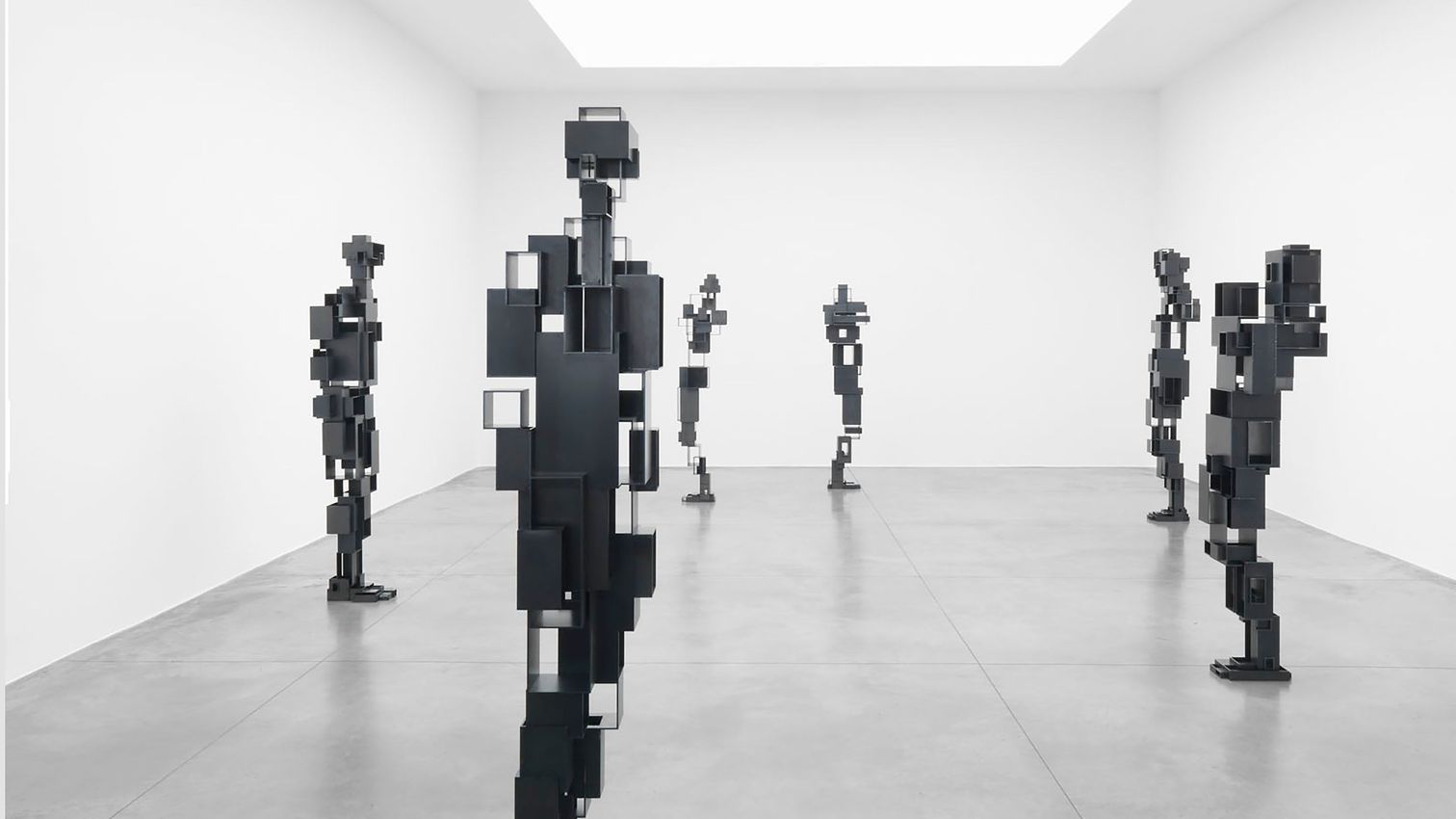
In 1995, Gormley created a seminal artwork entitled Critical Mass. The work explores the body’s solid mass and comprises 60 life-sized cast-iron sculptures cast in 12 basic body postures, from the contemplative to the supplicant. Critical Mass was originally made to be installed in the Remise (an old tram storage station in Vienna). For this version of the installation the artist dumped many of the sculptures from the back of a truck to allude to the victims of the 20th century.
Since then, the work has been exhibited in different sites, such as on the roof of the De La Warr Pavilion in East Sussex in 2010, and at Forte di Belvedere, Florence, as part of the artist’s solo exhibition, Human, in 2015. In an interview with Ocula Magazine in 2015, the artist described Critical Mass as ‘the forensic evidence of a lived moment in time’, responding to the horrors of the past and overpopulation.
Angel of the North (1998)
Gormley’s sculptures can be found in various public spaces and around the world. Angel of the North (1998), a 20-metre-tall steel sculpture overseeing a hill in Gateshead, is arguably the best known and shows an upright figure with a pair of outstretched wings for arms. Conceived as a memorial to the coal miners who brought wealth to the North East to the 19th and 20th centuries, the work has since become a landmark of Gateshead.
Another Place (1997), which consists of 100 life-sized cast iron figures staring out to the horizon, was installed on Crosby Beach in 2005 by Liverpool Biennial and is also among the artist’s most famous public artworks. In 2007, the artist initiated a touring public art project called Event Horizon that installs life-sized figures looking out into space on the ground level or atop buildings in international cities. First displayed in London, the project has travelled to New York (2010), São Paulo (2012), and Hong Kong (2015).
‘Field’ (1989–2003)
Gormley was the winner of the Turner Prize in 1994 for ‘Field’ (1989–2003), a series of works in which he gave directions to a local community to produce tens of thousands of hand-sized figures. The resulting sculptures were baked locally and installed on the floor of a gallery space. For the American version in 1990, the artist worked with an extended family of brick-makers in San Matias, Cholula, Mexico, members of whom—ranging from age six to over sixty—made 35,000 figures. For the 2006 Biennale of Sydney, the installation consisted of 180,000 small clay figurines crafted by 350 Chinese villagers in five days from 100 tonnes of red clay.
Awards and Accolades
In addition to being awarded the Turner Prize, Gormley was awarded the South Bank Prize for Visual Art in 1999, the Bernhard Heiliger Award for Sculpture in 2007, the Obayashi Prize in 2012, and the Praemium Imperiale in 2013. In 1997, he was made an Officer of the British Empire (OBE) and was made a knight in the New Year’s Honours list in 2014. He is an Honorary Fellow of the Royal Institute of British Architects, an Honorary Doctor of the University of Cambridge and a Fellow of Trinity and Jesus Colleges, Cambridge. The artist has been a Royal Academician since 2003.
Exhibitions
Antony Gormley has been the subject of numerous exhibitions. Selected solo exhibitions include:
- Witness: Early Lead Works, White Cube Mason’s Yard, London (2025)
- Critical Mass, Musée Rodin, Paris (2023)
- Body Field, Xavier Hufkens, Brussels (2022)
- Antony Gormley, National Gallery Singapore (2021)
- Feel, Busan Museum of Art, Busan (2019)
- Antony Gormley, Royal Academy of Arts, London (2019)
Antony Gormley FAQs
Who is Antony Gormley?
Antony Gormley (born August 30, 1950, London, England) is a British sculptor and installation artist renowned for his works exploring the human body’s relationship to space. Using his own body as a model, Gormley creates sculptures and large-scale installations that examine human existence and our connection to the environment.
Where can I see Antony Gormley’s sculptures in public spaces?
Antony Gormley’s sculptures are installed in numerous public locations worldwide. Notable examples include:
- Angel of the North, A 20-metre-tall steel sculpture located in Gateshead, UK, completed in 1998.
- Another Place, Consisting of 100 cast-iron figures spread across Crosby Beach near Liverpool, UK.
- Exposure, A 25-metre-tall crouching figure made of steel lattice, situated near Lelystad in the Netherlands.
- Inside Australia, A series of 51 sculptures installed on Lake Ballard, Western Australia.
- LOOK II, A cast-iron sculpture installed on West Hoe Pier in Plymouth, UK, unveiled in 2020.
Has Antony Gormley received any notable awards or honours?
Yes, Antony Gormley has been recognised with several prestigious awards including the Turner Prize (1994); Officer of the Order of the British Empire (OBE) (1997); South Bank Prize for Visual Art (1999); Bernhard Heiliger Award for Sculpture (2007); Obayashi Prize (2012); Praemium Imperiale (2013); Knighted in the New Year’s Honours list (2014).
How does Antony Gormley approach the human form in his art?
Antony Gormley’s work often involves casting his own body to create sculptures that explore the human condition and our relationship to space. By using his body as a template, he investigates themes of existence, consciousness, and the human experience within both natural and urban environments.
Is Antony Gormley involved in any educational or collaborative projects?
Yes, Gormley is committed to arts education and public engagement. During the 2020 pandemic, he participated in the BBC’s ‘Get Creative at Home’ series, providing a print-making masterclass. He has also collaborated with various institutions to promote the accessibility of art and its role in society.
What are Antony Gormley’s most famous works?
Some of Antony Gormley’s most famous works include: Angel of the North (1998); Another Place (1997); Eve__nt Horizon (2007–ongoing), Quantum Cloud (1999); and Field (1989). These works are widely celebrated for their scale, conceptual insight, and interaction with public spaces.
Why did Antony Gormley make the Angel of the North?
Antony Gormley created the Angel of the North to symbolise hope and regeneration in the post-industrial landscape of Northern England. Standing 20 metres tall with a wingspan of 54 metres, the sculpture marks a gateway between the past (coal mining heritage) and the future, acting as a guardian figure welcoming visitors and locals alike.
Where is Antony Gormley’s studio located?
Antony Gormley lives and works in London, England. His studio is based there, where he develops his sculptures and installations.
How do you pronounce Antony Gormley’s name?
Antony Gormley is pronounced “AN-tuh-nee GORM-lee.
Ocula | 2025






Explore Antony Gormley's Exhibitions





Antony Gormley in Ocula Magazine









Explore and Follow Artists Shaping Contemporary Art
A respected voice in contemporary art discourse.
Focusing on ambitious storytelling and insightful art-world commentary. Ocula Magazine publishes in-depth interviews, critical essays and timely analysis on the artists, exhibitions and ideas driving the global art world.
Learn more about Ocula Magazine
Showcasing the best of the art world.
Ocula partners with galleries from around the world to highlight their artists, artworks and exhibitions. Gallery membership is by application and invitation, with each member vetted by an independent panel.
Learn more about Ocula Membership
Specialises in the sale of major artworks.
Led by a team with deep ties to the world’s leading auction houses, galleries and collectors. Ocula’s advisory team offers bespoke services to high-net-worth clients from around the world who are looking to acquire the best of contemporary and modern art.
Learn more about our team and services