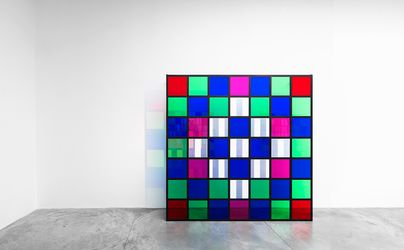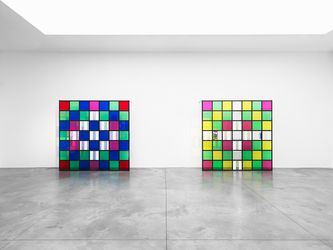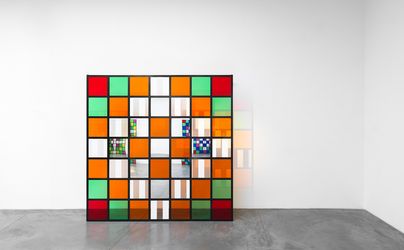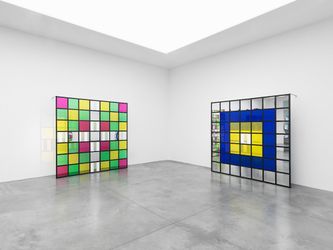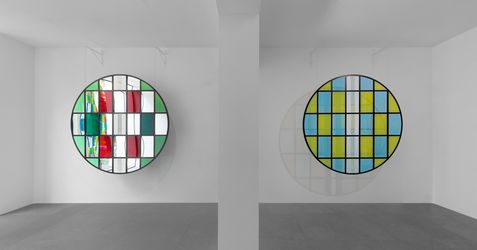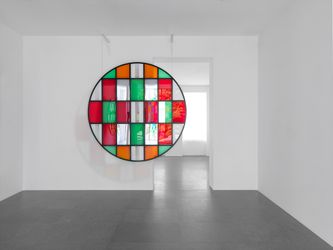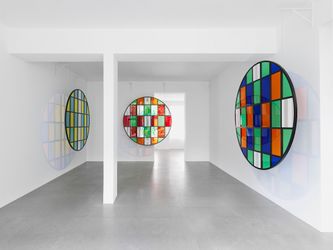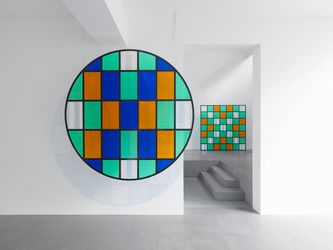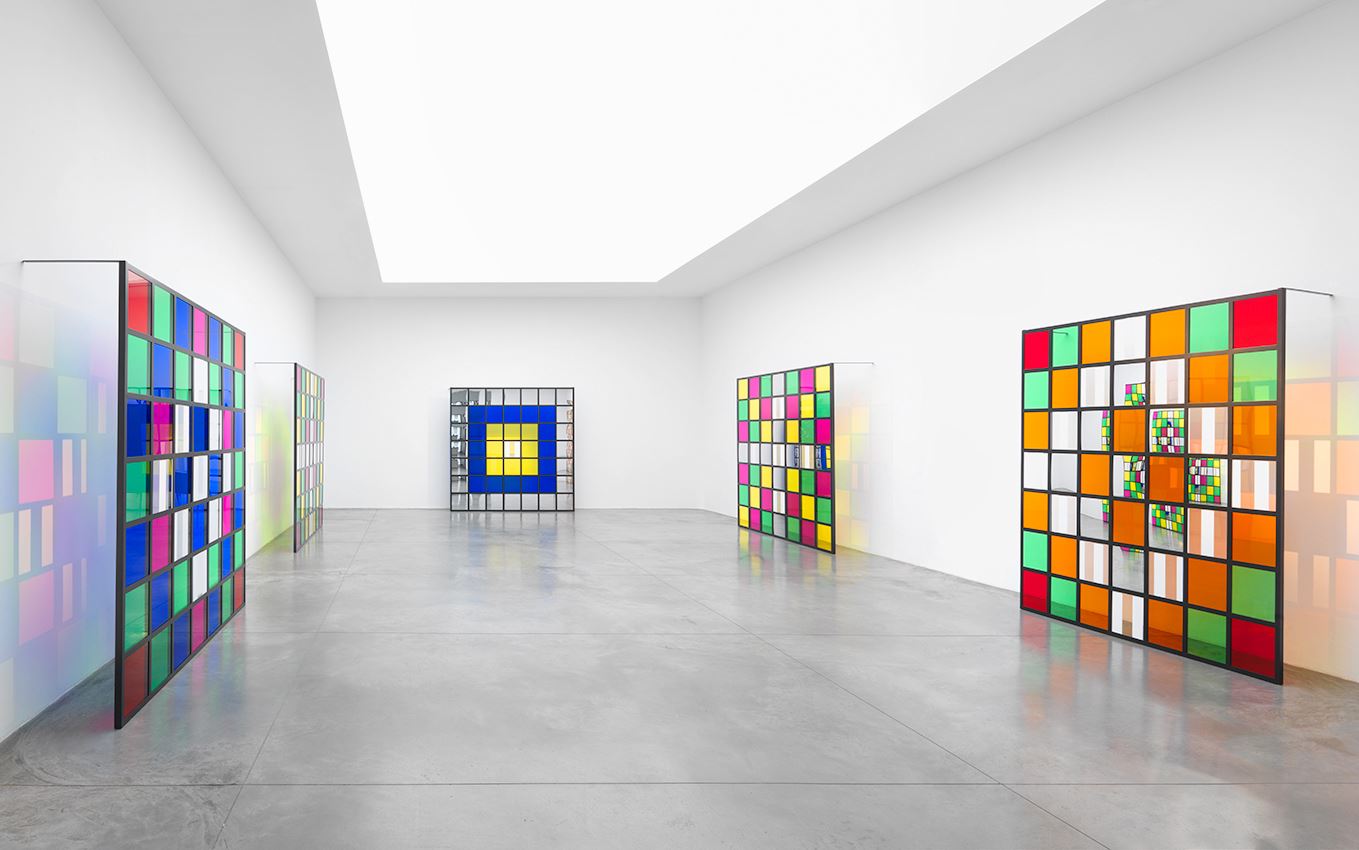
Xavier Hufkens is delighted to announce an exhibition of new works by Daniel Buren.
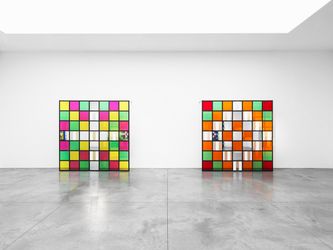
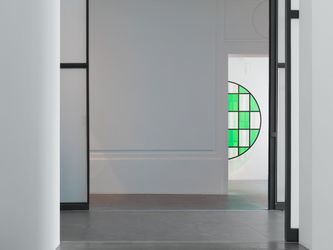
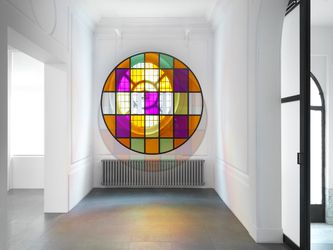
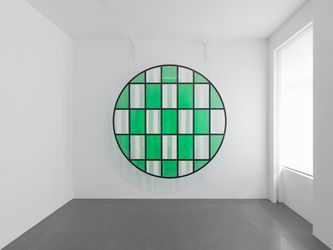
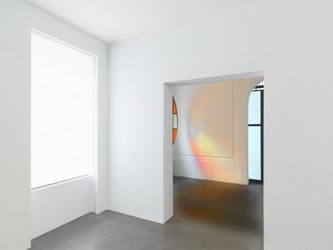
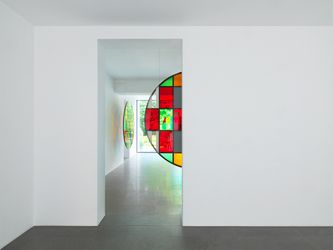
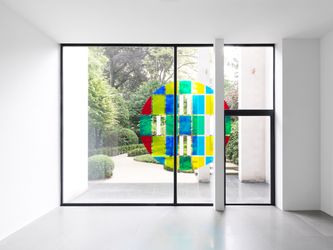
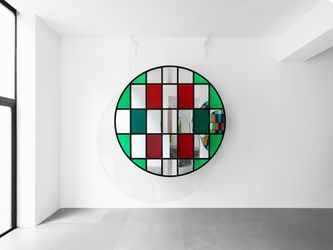
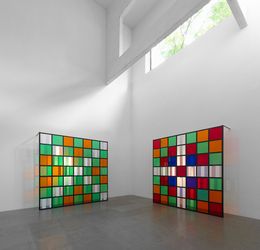
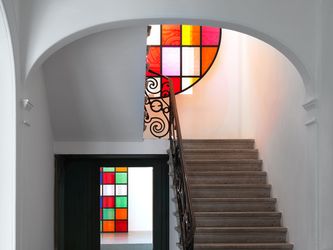
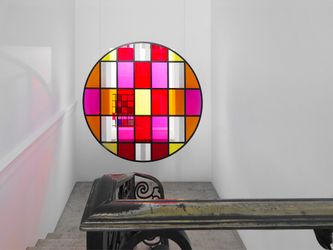
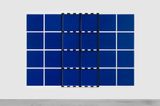
For this exhibition, the artist has created a series of large-scale tondos and floor-based works that are designed to draw attention – via colour, form and light – to the architectural and contextual specificity of the gallery space. Most of the pieces on display can be described as ‘situated’, which means that while they are, in general, inspired by an individual site, the elements can be reinstalled in different locations, following certain criteria. Other works are made ‘in situ’, and are unique to the time and place in which they were realised, in this case the exhibition at the Xavier Hufkens gallery in Brussels.
In a career spanning five decades, Buren has realised his artistic objectives through a unique visual tool, the alternating white and coloured stripes that have become his artistic ‘signature’. This pattern is derived from a striped awning fabric that he first discovered in 1965. While early works were made out of the canvas itself, Buren subsequently began applying the stripes, in various materials, to urban architectural supports, such as façades, floors, doors and pavements. In so doing, he created situations in which his visual intervention and the built environment became mutually dependent. These works were not so much about the stripes or the pre-existing context, but the completely new set of circumstances – both spatial and perceptual – that arose as a result of their fusion. As Buren has explained: ‘The visual tool is no longer a work to be seen, or to be beheld, but is the element that permits you to see or behold something else.’
By deploying stripes of a fixed width, and in set colours, Buren was also undermining the idea that art is primarily concerned with the expression of emotion. In opting for a mass-produced and easily replicated visual motif, he not only divested his art of all personal connotations, but also alighted upon a mechanism for creating expansive and immersive environments that would challenge preconceived notions about the definition of art, the function of the artist, and the role of the viewer.
These concerns permeate his oeuvre to this very day, and continue to act as the catalyst for interventions that draw the eye in unexpected directions, highlight what might otherwise be neglected, and which have the power, despite being resolutely devoid of emotional gesture, to transform and confound our perceptual sensibilities. While he continues to work with stripes, his practice also incorporates other geometric shapes, such as circles and squares, as well as new materials and an extended palette. Glass is a particularly favourite medium as it enables him to harness the power of light, transparency and reflection. Over the course of his long career, Buren’s practice has become increasingly architectural, not to mention diverse and varied in scale, with projects ranging from immense museum installations to public commissions, by way of smaller interventions in the domestic sphere.
Daniel Buren was born in Paris in 1938, and lives and works in situ. His most recent solo shows include: L’Observatoire de la lumière, travail in situ, Fondation Vuitton, Paris, France (2016); Daniel Buren. A Fresco, Bozar, Brussels, Belgium (2016); Axer / Désaxer, lavoro in situ, Madre, Naples, Italy (2015-2016), Les Fleches, travail in situ et en movement, Musée de Picardie, Amiens, France (2015); Daniel Buren – Zwei Werke für Recklinghausen, Festspielhaus and Kunsthalle, Recklinghausen, Germany (2015); Catch as Catch Can: works in situ, BALTIC Centre for Contemporary Art, Gateshead, United Kingdom (2014). In 2014, he designed the set for Daphnis et Chloé for the Opéra Bastille, Paris, France and, in 2012, created an acclaimed work in situ, Excentrique(s) at the Grand Palais as part of Monumenta.


Daniel Buren is a world-renowned French conceptual artist whose work lies at the crossroads of sculpture, installation and painting, as well as action and intervention. He came to fame in Paris with the B.M.P.T. group (the initials of Buren, Mosset, Parmentier and Toroni) in 1966–1967 and continued to develop a critique of the art establishment. Buren appropriated a standard format fabric motif of 8.75 cm-wide vertical stripes (which alternate between white and a colour) as a visual instrument, or sign, to ‘expose’. He works on site, or in situ, in relation to the setting, a particular building and its story and context. Two examples that caused heated debate were Peinture-Sculpture at the Guggenheim Museum in New York, 1971 and the public commission Les Deux Plateaux (1986) at the Palais Royal in Paris. Throughout his career, he has documented all these events and grouped the images under the title Photo-souvenirs. Since the 1990s, his work has become increasingly architectural using fencing or grids, and stained glass window structures, such as his installation for Monumenta at the Grand Palais in Paris, 2012.


A respected voice in contemporary art discourse.
Focusing on ambitious storytelling and insightful art-world commentary. Ocula Magazine publishes in-depth interviews, critical essays and timely analysis on the artists, exhibitions and ideas driving the global art world.
Learn more about Ocula Magazine
Showcasing the best of the art world.
Ocula partners with galleries from around the world to highlight their artists, artworks and exhibitions. Gallery membership is by application and invitation, with each member vetted by an independent panel.
Learn more about Ocula Membership

Specialises in the sale of major artworks.
Led by a team with deep ties to the world’s leading auction houses, galleries and collectors. Ocula’s advisory team offers bespoke services to high-net-worth clients from around the world who are looking to acquire the best of contemporary and modern art.
Learn more about our team and services