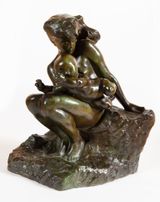
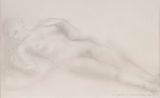
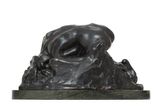
Auguste Rodin produced a large number of expressive busts, figures, torsos, and fragments in cast bronze, carved marble, drawings, and watercolour sketches.
Marble Forms
With his glowing marble sculptures, Rodin usually left areas of unpolished, rough marble untouched, as if the smooth naked human form was emerging alive from a raw, mineral bed.
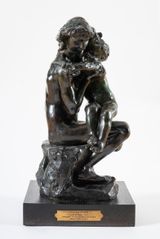
Some works, like The Kiss (1882) and The Thinker (1904), were made in bronze, marble, plaster, and stone.
Bronze Developments
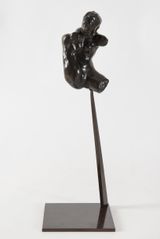
Rodin’s embrace of a baroque expressiveness and turbulent emotion via twisted bodies, contorted postures, rippling muscles, and large hands and feet was for some shocking, as was his incorporation of repeated forms within the one bronze sculpture—like in The Gates of Hell (1880—1917) or its detail The Three Shades (1886). He also sometimes made limbs, heads, and other parts separately, so when casting he could recombine these elements. As part of a move away from naturalism, Rodin deliberately left surface traces of the bronze casting process, such as not removing air bubbles, as seen in Man’s Torso (1877). He also exposed the processes of throwing lumps of clay together, rather than smoothing over the joins. Sometimes, he would cut through them with a sharp knife, not replacing the missing pieces, creating ‘disruptive’ flat planes as seen in Flying Figure (1890—1991).
Between 1883 and 1892, Rodin had an affair with Camille Claudel, his model, who became an accomplished sculptor herself.