





ROBERTO BURLE MARX
1909-1994, BrazilBrazilian modernist Roberto Burle Marx transformed landscape design into an art form, integrating abstract painting principles with tropical horticulture across nearly 3,000 gardens worldwide.
In 2026, Andrew Kreps Gallery, in collaboration with Almeida & Dale, opened a solo exhibition in New York—the first dedicated exclusively to Burle Marx’s work on canvas in the city and spanning five decades of his practice. In 1991, New York’s Museum of Modern Art presented a survey show dedicated to the artist’s practice.
Background
Burle Marx was born in São Paulo and raised in Rio de Janeiro. In the late twenties, he travelled to Berlin with his family, where he studied painting and immersed himself in the city’s cultural scene. Studying at the Degner Klemm School, his exposure to the European Avant-Garde, particularly the works of Picasso, Van Gogh, and German Expressionism, deeply influenced his early artistic practice. Visits to Berlin’s Dahlem Botanical Gardens also proved transformative; there he encountered tropical plants native to Brazil, sparking a lifelong dedication to exploring the artistic possibilities of indigenous flora.
Returning to Brazil in 1930, Burle Marx enrolled at the Escola Nacional de Belas Artes (National School of Fine Arts) in Rio de Janeiro, studying painting, architecture, and landscape design under the guidance and mentorship of architect Lúcio Costa. He also studied painting and was guided by painter Leo Putz, and the Brazilian artist Candido Portinari during the 1930s. Growing into his practice during the 1930s, amid Getúlio Vargas’ drive to broadcast a modern Brazilian image overseas, he deepened his commitment to articulating a national identity grounded in the forms and colours of Brazil’s indigenous plant life.
Roberto Burle Marx developed an interdisciplinary practice spanning landscape architecture, painting, tapestry, jewellery, and theatre design—each medium informed by the sinuous forms and bold colours that characterise his gardens.
Roberto Burle Marx Gardens and Landscape Architecture
Burle Marx pioneered the use of native tropical vegetation as a structural design element rather than mere decoration. Working in collaboration with such celebrated architects as Le Corbusier, Oscar Niemeyer, and Rino Levi, he was an integral figure in the development of the Brazilian cityscape. His first professional landscape commission came in 1932 with the garden for the Schwartz House, designed for architects Lúcio Costa and Gregori Warchavchik, with his subsequent 1938 rooftop garden for the Ministry of Education and Health building in Rio de Janeiro marking a breakthrough for modernist design. The garden was created featuring organic forms that introduced movement, texture, and vivid colour to the architectural complex. The composition resembles an abstract river winding alongside a high-rise ‘mountain’, intended as much for workers viewing from floors above as for those in the garden itself.
Throughout his career, Burle Marx brought his horticultural skills into symbiotic play with his artistic training. The precise lines and interlocking forms of his landscapes reveal his affinity for abstract art, notably the work of Jean Arp, Alexander Calder, Fernand Léger, and Joan Miró; many of his gardens also incorporate mosaics and sculpture of his own design.
Robert Burle Marx Paintings
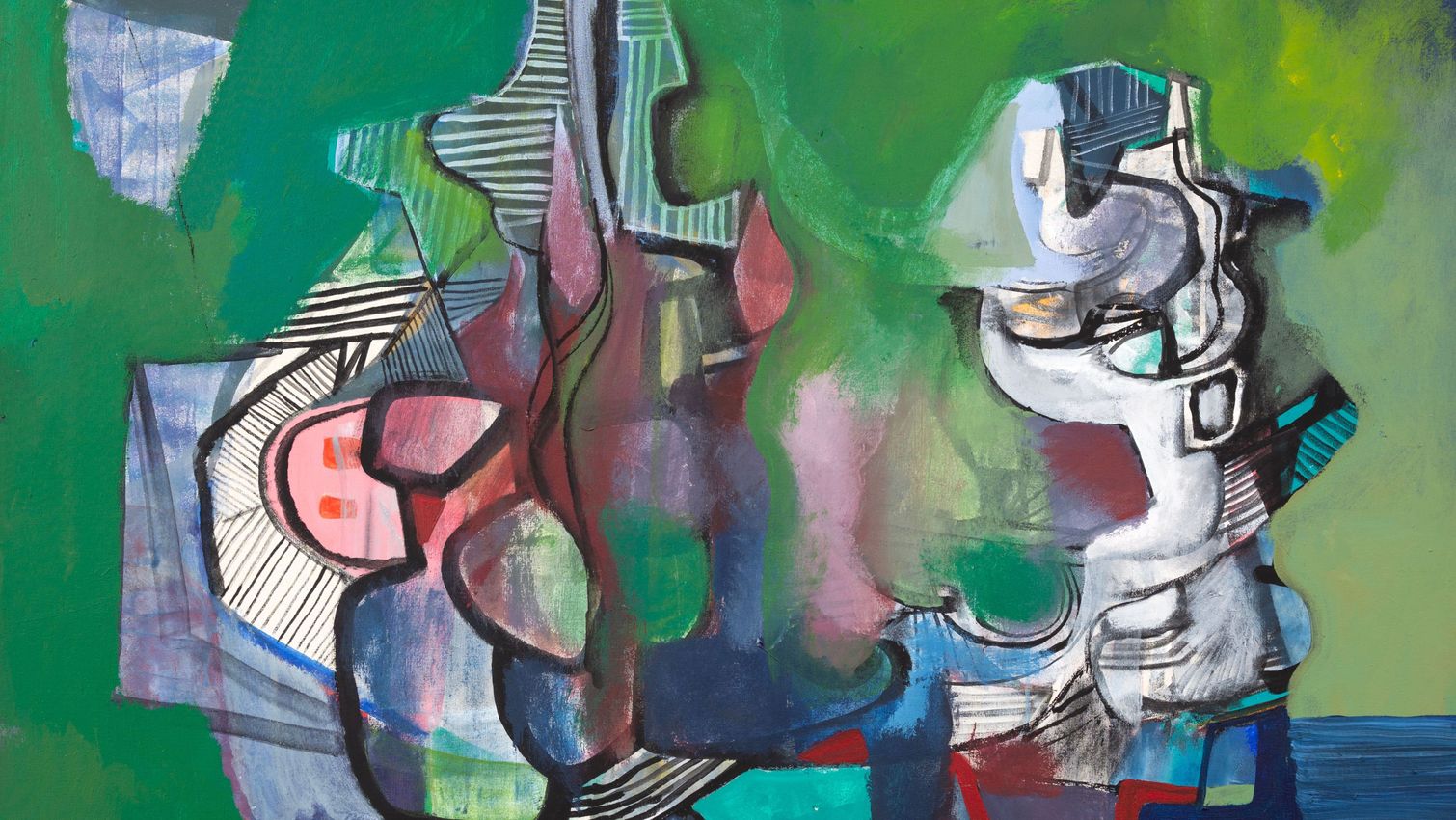
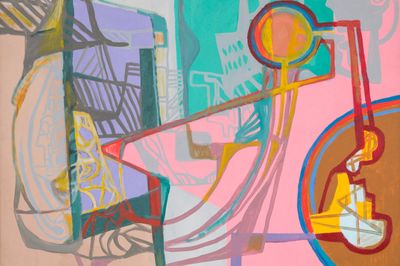
Throughout his career, painting and landscape thinking remained closely intertwined. The sinuous and geometric forms defining Burle Marx’s canvases closely echo the curves, rhythms, and colours of his gardens. His work consolidated into pure abstraction from the 1950s onward, though earlier pieces toggle between abstraction and figurative modes.
The 2026 exhibition Works: 1940–1993 at Andrew Kreps Gallery, organised in collaboration with Almeida & Dale, devoted solely to Burle Marx’s painting practice presented five decades of work, charting his progression from early figurative experiments to the undulating fields of colour that came to define his mature style. Oil paintings such as Untitled (1986) demonstrate how abstract forms shift dynamically from foreground to background, creating a sense of depth and movement that mirrors the seasonal chromatic changes Burle Marx engineered in his living landscapes. While he saw nature as the ultimate act of creation, these works underscore his belief in the generative potential of human intervention and artistic practice.
Tapestries, Jewellery, and Theatre Design
Burle Marx produced handwoven wool textiles that paralleled the harmony of colour, texture, and form found in his landscapes, including works for the prestigious Atelier Pinton Frères in France. He created unique jewellery pieces showcasing natural materials and vibrant colours inspired by Brazilian flora, and designed sets and costumes for theatrical productions. In 1952, he collaborated with the architect Lina Bo Bardi, who designed jewellery with Brazilian stones for a fashion show in São Paulo that also featured Burle Marx’s printed textile designs.
Select Public Commissions by Roberto Burle Marx
- Ibirapuera Park, São Paulo (1954)—landscaping designed in collaboration with Oscar Niemeyer, intended to unite modernist architecture with Brazil’s native flora
- Flamengo Park, Rio de Janeiro (completed 1965)
- Copacabana Beach Promenade, Rio de Janeiro (completed 1970)—featuring the iconic undulating wave pattern in black-and-white Portuguese stone mosaic
- Ministry of Foreign Affairs gardens, Brasília
- UNESCO Building gardens, Paris
- Parque del Este, Caracas, Venezuela
- Brazilian Pavilion, Brussels International Exposition (1958)
- Biscayne Boulevard, Miami (first proposed 1988, completed posthumously in 2004)
Select Awards and Accolades
- Fine Arts Medal, American Institute of Architects
- Sítio Roberto Burle Marx designated UNESCO World Heritage Site (2021)
- Close to 50 plant species bear his name, discovered during expeditions throughout Brazil
- To be kept up to date with news relating to Roberto Burle Marx, follow him on Ocula.
Roberto Burle Marx Exhibitions
Roberto Burle Marx has been the subject of both solo exhibitions and group exhibitions at important institutions and galleries. Burle Marx was included in three editions of the Venice Biennale (1950, 1968, and 1970) as well as two editions of the São Paulo Bienal (1953 and 1959). His work was first exhibited in the United States as part of Brazil Builds: Architecture, Landscape, and Design at MoMA, New York, in 1943. In 1952, Lina Bo Bardi designed an exhibition of his paintings at MASP, São Paulo, where his works were hung on the museum’s distinctive half-height walls alongside live plants and photographs of his gardens. This was followed by a series of solo exhibitions throughout the United States developed in collaboration between the Pan-American Union and the Smithsonian.
To be kept up to date with upcoming exhibitions featuring Roberto Burle Marx, follow him on Ocula.
Select Solo Exhibitions
- Works: 1940–1993, Andrew Kreps Gallery, New York (2026)
- Places of Being: The Burle Marx, Museu de Arte Moderna, Rio de Janeiro (2024)
- Brazilian Modern: The Living Art of Roberto Burle Marx, New York Botanical Garden (2019)
- Roberto Burle Marx: Brazilian Modernist, The Jewish Museum, New York (2016)
- Roberto Burle Marx: The Unnatural Art of the Garden, Museum of Modern Art, New York (1991)
- Roberto Burle Marx, MASP, São Paulo (1952)—exhibition designed by Lina Bo Bardi
Select Group Exhibitions
- Venice Biennale (1950, 1968, 1970)
- São Paulo Bienal (1953, 1959)
- Burle Marx | Santídio Pereira, Bortolami Gallery, New York (2021)
- From Le Corbusier to Oscar Niemeyer: Savoye House – Tremaine House 1949, Museum of Modern Art, New York (1949)
- Painting toward Architecture, Miller Company Collection of Abstract Art, various venues, United States (1948–52)
- Brazil Builds: Architecture, Landscape, and Design, Museum of Modern Art, New York (1943)
Collections
Roberto Burle Marx’s work is held in the permanent collections of Museu de Arte Moderna do Rio de Janeiro, Rio de Janeiro; MASP, São Paulo; MoMA The Museum of Modern Art, New York; the New York Botanical Garden, New York; The Art Institute of Chicago; and The Jewish Museum, New York, among others.
Roberto Burle Marx FAQs
Who is Roberto Burle Marx?
Roberto Burle Marx (1909–1994) was a Brazilian modernist artist and landscape architect who revolutionised garden design by integrating abstract art principles with native tropical flora. He designed nearly 3,000 gardens worldwide and was also a prolific painter, tapestry designer, jeweller, and passionate environmental conservationist.
What is a quote by Roberto Burle Marx?
A famous quote by Roberto Burle Marx is, ‘A garden is the result of an arrangement of natural materials according to aesthetic laws; interwoven throughout are the artist’s outlook on life, his past experiences, his affections, his attempts, his mistakes, and his successes.’
Where can I see work by Roberto Burle Marx?
Roberto Burle Marx’s paintings have been shown in important commercial galleries. In 2026, an exhibition dedicated to his works on canvas opened at Andrew Kreps Gallery in New York. His landscape designs can be experienced at sites including the Copacabana Beach promenade, Flamengo Park, and Ibirapuera Park in Brazil, as well as at the UNESCO-listed Sítio Roberto Burle Marx estate in Barra de Guaratiba, Rio de Janeiro.
Where did Roberto Burle Marx live?
Roberto Burle Marx lived primarily in Rio de Janeiro, Brazil. From 1949 until his death in 1994, he resided at his estate called Sítio Santo Antonio da Bica in Barra de Guaratiba, on the outskirts of Rio, which served as his home, studio, and garden laboratory.
How is Roberto Burle Marx’s name pronounced?
Roberto Burle Marx’s name is pronounced ‘Ho-BAIR-toh BOOR-leh MARKS’ in Brazilian Portuguese. The ‘R’ at the beginning of ‘Roberto’ is pronounced with an aspirated ‘H’ sound characteristic of Brazilian Portuguese.
What is Roberto Burle Marx known for?
Roberto Burle Marx is known for pioneering modernist landscape architecture, introducing native Brazilian tropical plants into garden design and applying abstract art principles to outdoor spaces. He was included in three editions of the Venice Biennale and two editions of the São Paulo Bienal, and his 1991 exhibition at the Museum of Modern Art was the institution’s first devoted to a landscape architect.
What is the Sítio Roberto Burle Marx?
The Sítio Roberto Burle Marx is a 400-hectare estate in Barra de Guaratiba, Rio de Janeiro, that the artist purchased in 1949. It houses his former home, studio, nursery, multiple gardens, and greenhouses containing thousands of rare plant species, and was inscribed as a UNESCO World Heritage Site in 2021.
What major public projects did Roberto Burle Marx design?
Roberto Burle Marx’s major public projects include Ibirapuera Park in São Paulo (1954), designed in collaboration with Oscar Niemeyer; Flamengo Park in Rio de Janeiro (completed 1965); the Copacabana beachfront Promenade (completed 1970); and a design for Biscayne Boulevard in Miami, first proposed in 1988 and completed posthumously in 2004.
Was Roberto Burle Marx an environmentalist?
Yes, Roberto Burle Marx was widely regarded as an environmentalist as well as an artist and landscape architect. He campaigned against deforestation and unchecked urbanisation in Brazil, advocated for the protection of native ecosystems, and used his gardens to foreground indigenous plant species. Through his lectures, writings, and the living laboratory of Sítio Roberto Burle Marx, he argued that biodiversity conservation and thoughtful landscape design were inseparable, making environmental stewardship a central part of his legacy.
Ocula | 2026





Explore and Follow Artists Shaping Contemporary Art
A respected voice in contemporary art discourse.
Focusing on ambitious storytelling and insightful art-world commentary. Ocula Magazine publishes in-depth interviews, critical essays and timely analysis on the artists, exhibitions and ideas driving the global art world.
Learn more about Ocula Magazine
Showcasing the best of the art world.
Ocula partners with galleries from around the world to highlight their artists, artworks and exhibitions. Gallery membership is by application and invitation, with each member vetted by an independent panel.
Learn more about Ocula Membership
Specialises in the sale of major artworks.
Led by a team with deep ties to the world’s leading auction houses, galleries and collectors. Ocula’s advisory team offers bespoke services to high-net-worth clients from around the world who are looking to acquire the best of contemporary and modern art.
Learn more about our team and services