Press Release

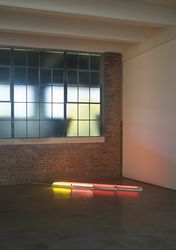
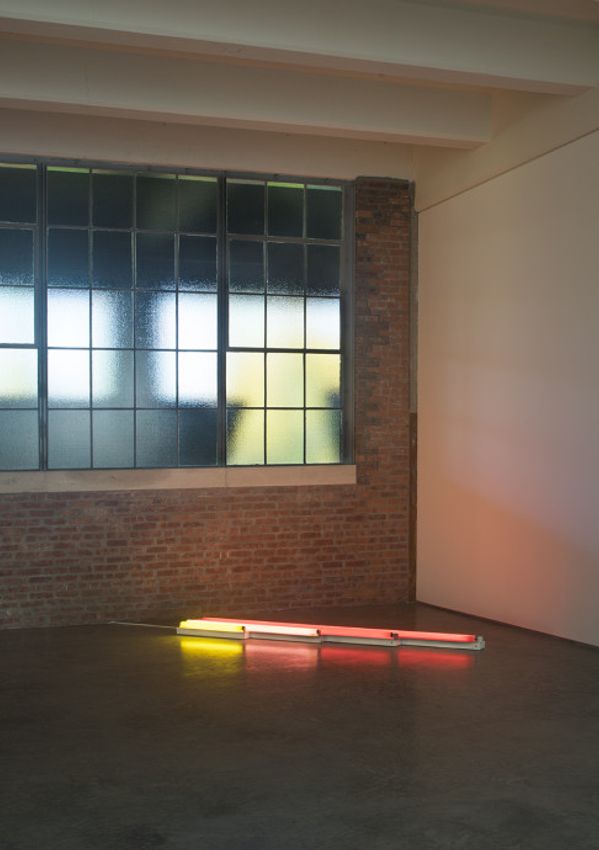
Few artists are more identified with a particular medium than Dan Flavin. After 1963 Flavin’s work was composed almost entirely of light, in the form of commercially available fluorescent tubes in ten colors (blue, green, pink, red, yellow, ultraviolet, and four whites) and five shapes (one circular and four straight fixtures of different lengths). Initially arranging these fixtures in varying autonomous configurations, Flavin increasingly made work in relation to architecture, such as his monumental barriers that physically block a passageway or segment of a space with light. Dan Flavin frequently referenced political subjects in his work. This is evident in monument 4 for those who have been killed in ambush (to P. K. who reminded me about death) (1966). The sculpture consists of four red fluorescent lights of equal size crossing midair, and it evocatively suggests the violence of the Vietnam War. Conceived for the landmark exhibition Primary Structures at the Jewish Museum in 1966, the work was subsequently and temporarily installed at Max’s Kansas City, a beloved bar and gathering place in lower Manhattan for many of the artists in Dia’s collection. On view here is a second edition, fabricated by Flavin for his 1969 retrospective at the National Gallery of Canada, Ottawa. In 1972 the artist contributed to an exhibition in support of George McGovern, the Democratic Party presidential nominee and an opponent of the Vietnam War. Later that year Flavin exhibited a large body of sculptures dedicated to the politician, including untitled (to a man, George McGovern) 2 (1972). Flavin used titles to dedicate individual works to public figures and personal friends throughout his career. However, far from sentimental, such titular references often demonstrated his satirical humor. For example, untitled (to the real Dan Hill) 1b (1978) conflates two artists by the name of Dan Hill, one of which was Flavin’s friend. The work consists of four lights bound together in a colorful embrace. Like many of his peers in the early sixties Flavin turned to readymade industrial materials as an antidote to the dominance of gestural painting. For his works in light, he never altered the dimensions nor the colors of standard-issue fluorescent bulbs. Both untitled (to the real Dan Hill) and the earlier gold, pink and red, red (1964) are therefore partial inventories of the colors and sizes of fluorescent lights that were commercially available at the time. Flavin’s gold, pink and red, red was originally exhibited in 1964 as part of the artist’s first show of fluorescent lights. Presented at the Green Gallery, a New York venue for advanced practices in the early sixties, the exhibition summarized Flavin’s interest in prefabricated materials and rational forms that together test the boundaries of painting and sculpture. His first experiments with electric light involved attaching bulbs to the sides of small monochromatic canvases. He ironically called these objects “icons,” because they evoked the luminescence of religious icons. Through light, Flavin was able to engage the optical nature of painting while radically extending beyond its material limits. The lights at once emit a dematerializing glow and bluntly expose their device as banal fixtures bound to obsolescence. The ambivalent “image-objects,” as the artist referred to them, suggest that space itself can be a sculptural medium while presenting substantial installations of industrial hardware.

Installation Views

About the Artist

Daniel Nicholas Flavin Jnr was a pioneer light artist and installation-maker associated with the Minimalist movement.

View Artist Profile

Also Exhibiting at DIA Beacon

About the Gallery

DIA Beacon is a renowned contemporary art museum situated in Beacon, New York, on the banks of the Hudson River. Housed in a repurposed 1929 Nabisco box printing factory, its expansive galleries and minimalist architecture make it a destination for lovers of postwar art and industrial design.

View Gallery Profile
Address
3 Beekman Street
Beacon
New York
United States
Opening Hours
January–March
Friday–Monday 11 am–4 pm

April–October
Thursday–Monday 11 am–6 pm

November–December
Thursday–Monday 11 am–4 pm
(1)
New York 3 Beekman Street, Beacon
DIA Beacon
3 Beekman Street, Beacon, New York, United States
+1 845 440 0100
http://www.diaart.org

Opening hours
January–March
Friday–Monday 11 am–4 pm

April–October
Thursday–Monday 11 am–6 pm

November–December
Thursday–Monday 11 am–4 pm
The art world in focus