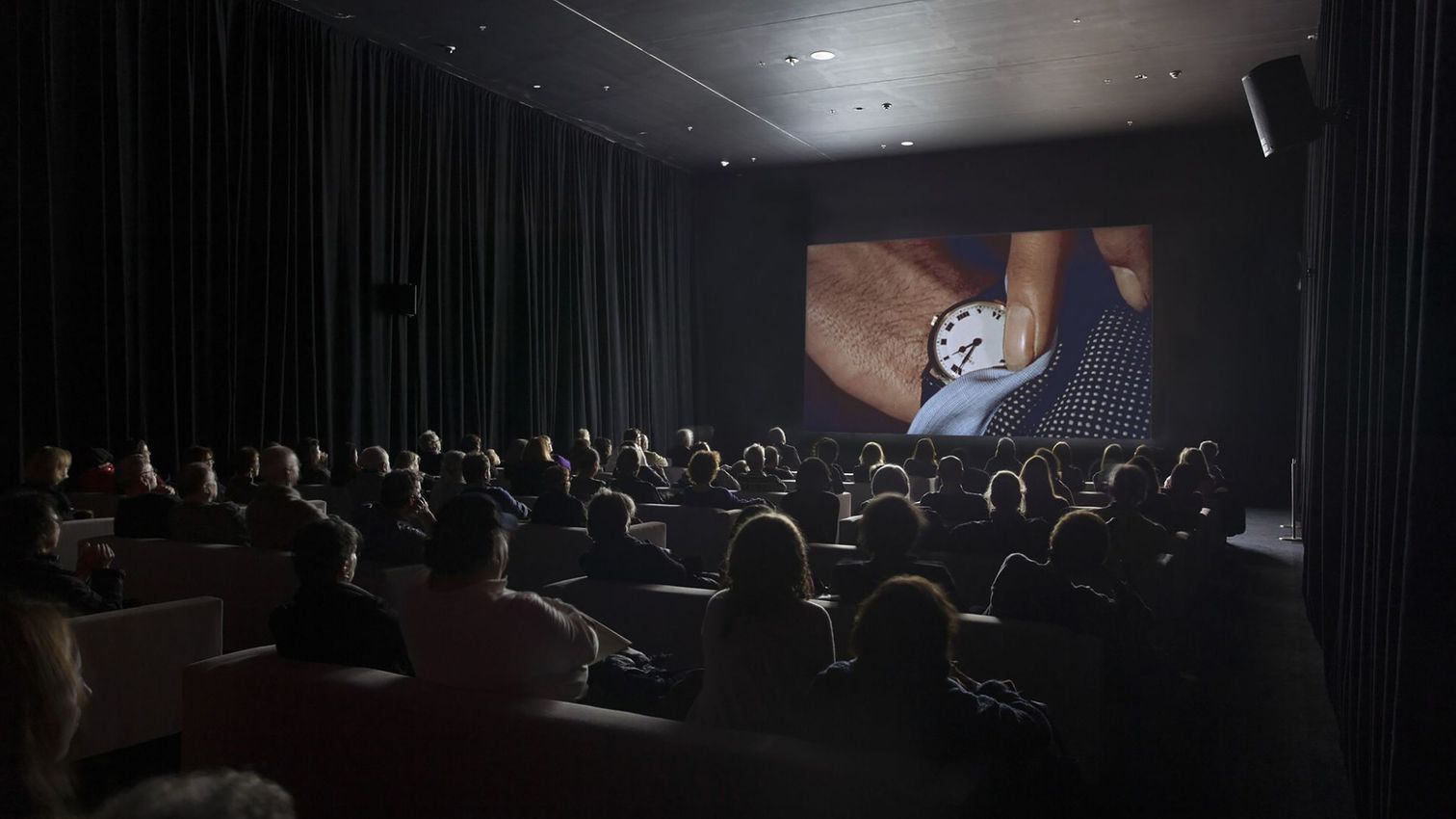
Encapsulating 100 years of moving-image history, Christian Marclay’s The Clock (2010) is a 24-hour montage composed from thousands of film and television clips depicting clocks and other references to time. James Bond checks his watch at 12:20 a.m.; Meryl Streep turns off an alarm clock at 6:30 a.m.; a pocket watch ticks at 11:53 a.m. as the Titanic departs. With each clip synchronized to the local time, The Clock collapses the fictional time presented on screen with the actual time of each passing minute. The work is both a cinematic tour-de-force and a functioning timepiece.
Building on his background as a musician in Boston and New York’s underground scenes of the late 1970s and 1980s, Marclay has for five decades combined visual and sonic fragments to explore the complex relationships between image and sound. His resulting works have taken form across a wide range of mediums: sculpture, painting, photography, print, performance, and video. With the help of assistants searching for footage, Marclay spent three years meticulously editing The Clock—the culmination of his innovative approach to looking at the world anew through found material.
The Clock speaks to cinema’s rich history as both a mirror of and escape from reality, a paradox that is ever more central to daily life in today’s era of instant broadcast, streaming services, and artificial intelligence. Marclay’s assemblage of carefully selected clips takes us on a journey through the past in order to heighten our awareness of an ever-elusive and unfolding present. By editing together fragments from cinema’s vast archive to tell the current time, Marclay reframes our collective memory of movies as an uncanny confrontation with ourselves.
Organized by Stuart Comer, The Lonti Ebers Chief Curator of Media and Performance, and Erica Papernik-Shimizu, Associate Curator, Department of Media and Performance, with Abby Hermosilla, Curatorial Assistant, Department of Curatorial Affairs.
Working across collage, video, installation, photography and sound, Christian Marclay’s most recognisable work is The Clock, 2010, a staggering 24 hour film using footage from the last century of cinema. Represented in real-time, snippets of clock towers, alarm clocks and wrist watches are interspersed with scenes of car chases, lovers, bank heist and shoot-outs. The incessant materiality of time is also present in the artist’s other works where sound collages and visual sampling reveal a temporal experience bound to imagery and acoustics.


The Museum of Modern Art (MoMA) is an iconic institution located in Midtown Manhattan, New York City, celebrated for its pioneering collection and innovative architecture. Renowned for housing one of the world’s most significant collections of modern and contemporary art, MoMA is a must-visit destination for art enthusiasts.

A respected voice in contemporary art discourse.
Focusing on ambitious storytelling and insightful art-world commentary. Ocula Magazine publishes in-depth interviews, critical essays and timely analysis on the artists, exhibitions and ideas driving the global art world.
Learn more about Ocula Magazine
Showcasing the best of the art world.
Ocula partners with galleries from around the world to highlight their artists, artworks and exhibitions. Gallery membership is by application and invitation, with each member vetted by an independent panel.
Learn more about Ocula Membership

Specialises in the sale of major artworks.
Led by a team with deep ties to the world’s leading auction houses, galleries and collectors. Ocula’s advisory team offers bespoke services to high-net-worth clients from around the world who are looking to acquire the best of contemporary and modern art.
Learn more about our team and services