





Almine Rech in Conversation
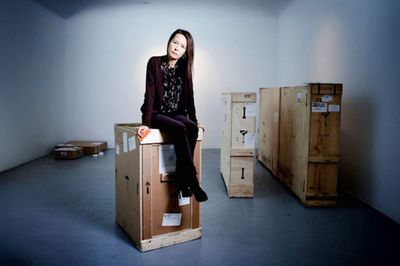
Image: © courtesy of Almine Rech Gallery and LEA CRESPI / Figarophoto.com
Almine Rech—the French art dealer and founder of her eponymous gallery—has recently expanded from Paris and Brussels to a third space in London’s Mayfair, inaugurated with Pittura Oggetto, a group show of Italian artists from the 1960s who turn painting into object. The exhibition reflects Rech’s long-standing interest in minimal and conceptual practices, and echoes her first gallery exhibition in 1989—a single light work by James Turrell in Paris, his first presentation in a European gallery—which set the tone for a programme that would go on to include artists such as Ugo Rondinone, Jeff Koons, Richard Prince, Jannis Kounellis and Joseph Kosuth, alongside a younger generation including Brent Wadden, Liu Wei and David Ostrowski.
In this interview, Rech speaks with Anna Dickie about the early encounters that shaped her eye, the risks of that debut Turrell show, and why London—and Pittura Oggetto—felt like the natural next step.
Was there a first artwork that triggered your passion for art?
I am originally a Parisian. I was going to the Louvre as a child, and the Rubens room, as well as Leonardo Da Vinci’s Saint Jean Baptiste, impressed me a lot.
Can you describe your initial entry point into contemporary art?
From the beginning, I was very intrigued by the Light and Space movement as well as Minimalism, and we started at Froment & Putman in November 1989 with a James Turrell show—the first light piece shown in a gallery in Europe.
That exhibition was the first time his work had been seen in Europe. For a young gallery to stage a solo show by James Turrell must have been both enormously exciting and very challenging. How do you think that initial experience shaped your approach to subsequent exhibitions?
It was a big risk but I was a beginner and quite unconscious of the risk. Just before the opening I had a press interview and the person asked me if I thought I was going to be bankrupt because of this first show and that second I realised—but then I knew taking risk and doing what I think is good was the right decision.
In 1997, you opened your own gallery—Almine Rech Gallery in Paris. What show did you open that space with, and why?
I started with a group show including artists that followed me after I decided to be on my own, Ugo Rondinone and others, and then I showed John McCracken.
You are about to open a new space in Mayfair in London. Can you tell me about that decision?
I must say I love London, my parents used to live there from 1989 to 2005 and my son is studying at King’s College, so it seemed very natural to me, especially as I have some close collectors living in London.
For the new London space, you have decided to present a group show, Pittura Oggetto, which features work by Agostino Bonalumi, Enrico Castellani, Dadamaino, Paolo Scheggi, Turi Simeti—all Italian artists who were working during the 1960s and who are described as heirs to Lucio Fontana‘s cut canvas. Why this particular group of artists, and why in London?
I have been working on this group show for a while because the spatialist movement is very interesting to me; it relates to the American artists such as James Turrell and John McCracken that I have been showing for many years and more recently DeWain Valentine. I have also presented group shows including works by Enrico Castellani and Agostino Bonalumi before. So, it became clear that this was a good project for the new London space where I could open it immediately.
Natacha Carron has curated this exhibition. Why was it important to work with Carron for this particular show?
It was important because she is an art historian that has great knowledge of Italian spatialists. Especially, she realised the Dadamaino retrospective and catalogue at Le Consortium in Dijon last year.
How would you define the gallery’s ethos, as it applies across all its spaces?
I want to remain very free in my programme, meaning I don’t have any formal restrictions and what is very important is that I feel strong engagement and authenticity in the artist and their work. My fundamental taste was related to minimalism but it is absolutely not a constraint to remain in this aesthetic.
Do you intend to take a different approach to the programme for the London space, compared to the approach taken in Brussels or Paris?
The approach will be different in the way that the space is a more intimate space and allows me to show sometimes a very small selection of work. A show with three very strong works is possible in this space when it would be impossible in the other spaces I have, maybe also works on paper would be adapted on some occasions.
What next?
We will soon unveil the content of the next show. —[O]
Main image: Image: © courtesy of Almine Rech Gallery and LEA CRESPI / Figarophoto.com






A respected voice in contemporary art discourse.
Focusing on ambitious storytelling and insightful art-world commentary. Ocula Magazine publishes in-depth interviews, critical essays and timely analysis on the artists, exhibitions and ideas driving the global art world.
Learn more about Ocula Magazine
Showcasing the best of the art world.
Ocula partners with galleries from around the world to highlight their artists, artworks and exhibitions. Gallery membership is by application and invitation, with each member vetted by an independent panel.
Learn more about Ocula Membership
Specialises in the sale of major artworks.
Led by a team with deep ties to the world’s leading auction houses, galleries and collectors. Ocula’s advisory team offers bespoke services to high-net-worth clients from around the world who are looking to acquire the best of contemporary and modern art.
Learn more about our team and services