The art world in focus
Subscribe to our newsletter for news and insights on artists, galleries and exhibitions.

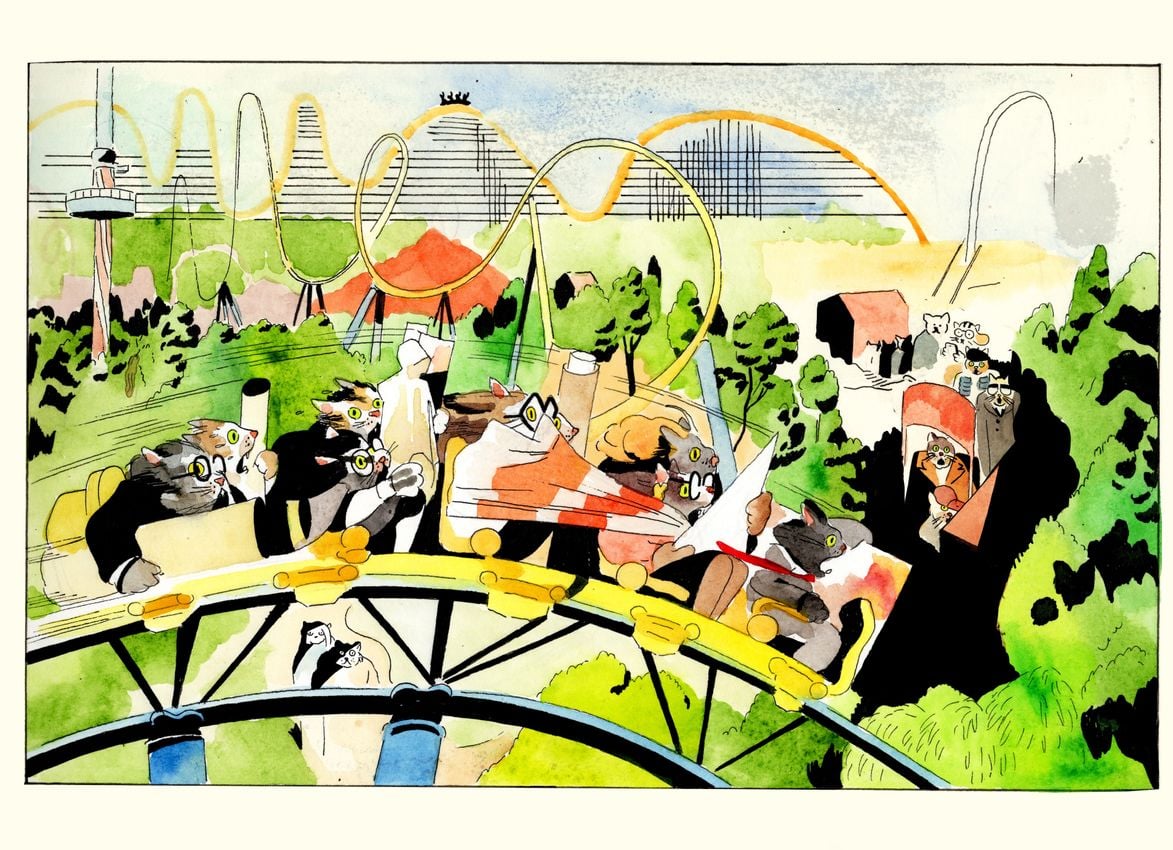
In May 2022, the Belgian artist Albert Willem made a storming auction debut. His painting The Beach Promenade (2019) sold for £100,800, beating its low estimate by a factor of 10. It was the first of 21 of his paintings to hit the block that year, 19 of which outperformed their estimates by an average of 879 percent. “This being the 21st century, a lot of crazy things happen in the world. I guess this is just another,” the artist told Artnet that year.
Two years later, Willem’s market was nowhere near as buoyant. Where had the bidders, who had pumped up his secondary market, disappeared to? “Just one of several investment pump and dumps,” opined one despairing collector on the Urban Art Association forum, referring to a mechanism by which a group of galleries deliberately inflate an artist’s prices by bidding them up at auction before pulling out of the market entirely, leaving their buyers with “worthless doorstops”, as he put it. This March, two of Willem’s canvases went to auction in Vienna with modest estimates of €2,000–€3,000 (£1,700–£2,600). Both failed to sell.
Contemporary art has always been a shaky investment. While all markets are fuelled by perception, most assets are backed by some credible source of value. The pitch for buying art as an asset class tends even further towards the tautological: this is only worth something because other people think it’s worth something. With nothing else to underlie its value, the market spirals when those people disappear. Even blue-chip artists’ markets can rely on a small number of collectors and dealers trading artworks to give the impression of volume.
“This is only worth something because other people think it’s worth something”
Headlines about outsized auction results and runaway market stars mask the reality that most artworks are destined to go down, not up, in price. As the art market reporter Scott Reyburn put it to me: “In the contemporary art world, most people don’t actually talk about art. They only talk about names and numbers.”
Many speak about treating art as an asset with something close to moral indignation. “Buy it because you love it” is the refrain of most artists and art-lovers. Today, as the contemporary art market finds itself at an existential impasse, its credibility as an investment prospect is on shaky ground. But what could a post-financialised art market look like in practice?
“Many speak about treating art as an asset with something close to moral indignation”
A straightforward answer is that people will simply buy art that they want to live with. Art collecting could be a purely decorative pursuit, or a form of conspicuous consumption. In an article for Business of Fashion last year, the former global director of Art Basel Marc Spiegler proposed that the art market would do well to pivot and begin marketing itself on cultural capital rather than possible financial reward. It could be reframed as an “Instagrammable, sapiosexy pleasure.”
But there’s another option. What if, rather than being staked on auction results or pure decorative value, an artwork’s significance was understood as something intrinsic? This might sound starry-eyed but it isn’t without precedent. In the early 20th century, Joseph Duveen sold art to JP Morgan, Andrew Mellon and John D Rockefeller Sr. In his 1953 biography of the dealer, SN Behrman wonders how Duveen managed to convince his financier and industrialist clients of the “simple, unworldly view that art was more important than money”. Perhaps, he writes, “Duveen had inculcated into them the idea that art was priceless and that when you pay for the infinite with the finite, you are indeed getting a bargain.”
The view that an artwork’s value exists outside of its resale prospects is less common today, but it hasn’t disappeared. Even looking beyond contemporary art to less inflated parts of the art market, connoisseurship often wins out over financialisation. Mattias Vendelmans, who specializes in late 19th and early 20th century art at his eponymous gallery, told me last year that his collectors’ motivations tend to be “more art-based and not so much five-year-return-on-the-investment-based.”
“The view that an artwork’s value exists outside of its resale prospects is less common today, but it hasn’t disappeared”
The same is true of most art and art-adjacent markets. Though they may not convene at the glitzy events afforded by the high prices commanded by contemporary art, those buying and selling rare books, antiques and the vast majority of fine art categories are in those markets out of genuine interest, not a desire to flip the work for a quick return. “Books are never going to be like contemporary art. They don’t go gangbusters,” Matthew Haley, who was then Bonhams’ UK head of Books & Manuscripts, told Reyburn for the New York Times in 2018. “It’s slow and steady.”
A certain kind of collector is more inclined to gift works rather than cash them in. The collectors Brian Kennedy and Peter Ting are currently in the process of giving their collection of 140 artworks, ceramics and objects away to 13 museums around the UK. “We’re in a lucky position where we don’t need to cash it in,” Kennedy tells me. “If we were going to buy and sell, we wouldn’t be collectors; we’d be dealers,” adds Ting. Instead, they explain that their collection has been built around what they love, rather than what might give a reliable return on their investment. This goes against an art market that has become “about the pursuit of the price tag rather than the purchase of something of interest”, as Kennedy puts it.
The dealer, print publisher and collector Charles Asprey recently gifted 67 works by artists including Wolfgang Tillmans and Marc Camille Chaimowicz, representing around 20 percent of his collection, to The Pier Arts Centre in Orkney, Scotland. In doing so, he’s resisting the more common temptation to “dispose of it via the auctions”. He describes auction houses as “vampiric organisations” but admits that they’re also “an essential part of the ecosystem”.
For Asprey, their alternative is much more appealing: “It would be so cool if, in 20, 30, 50 years, the UK was admired for contemporary art collections that were quietly assembled and gifted,” he says. “That would be an amazing legacy.” He describes Arts Council England’s Cultural Gifts Scheme, which enables UK taxpayers to receive tax reductions in return for museum donations, as “crucial for helping collectors find a way to make lifetime gifts”.
“In the contemporary art world, most people don’t actually talk about art. They only talk about names and numbers”

A more holistic approach to passing on works is certainly something that artists would welcome. Peter Doig, who left his long-time gallery Michael Werner in 2023, bemoaned collectors profiting by trading his work. “It’s all very clandestine,” he told the Observer the following year. The painter Loie Hollowell told The Art Newspaper in 2022 that she had “been really frustrated watching my work go up on the secondary market. It feels like a slight each time”.
Moving beyond seeing art as an asset class might also precipitate the contemplative approach to collecting that Duveen once championed. On the art market, just like anywhere else, what goes up must come down. Buyers left with loss-making artworks would do well to consider the more-than-financial significance of their holdings. As Reyburn puts it: “Once that balloon is pricked, you’re left with the art, so you might as well try to enjoy and understand it.” He is not hopeful, though, and remains doubtful that we’re nearing a tipping point, whereby the market would shift towards valuing connoisseurship over investment: “It’s a beautiful idea to strive for, but I think it’s romantic and unrealistic.” —[O]
A respected voice in contemporary art discourse.
Focusing on ambitious storytelling and insightful art-world commentary. Ocula Magazine publishes in-depth interviews, critical essays and timely analysis on the artists, exhibitions and ideas driving the global art world.
Learn more about Ocula Magazine
Showcasing the best of the art world.
Ocula partners with galleries from around the world to highlight their artists, artworks and exhibitions. Gallery membership is by application and invitation, with each member vetted by an independent panel.
Learn more about Ocula Membership
Specialises in the sale of major artworks.
Led by a team with deep ties to the world’s leading auction houses, galleries and collectors. Ocula’s advisory team offers bespoke services to high-net-worth clients from around the world who are looking to acquire the best of contemporary and modern art.
Learn more about our team and services