





Art Basel’s Online Viewing Rooms: Seven Advisory Selections
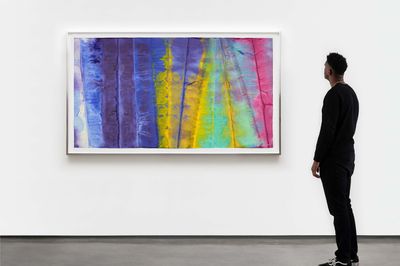
Sam Gilliam, Untitled (2020). Watercolour on washi paper. 100 x 181.9cm, framed: 109.9 x 191.8 x 5.1 cm. Courtesy David Kordansky Gallery, Los Angeles.
Sam Gilliam‘s large, vibrant, vital watercolour paintings on handmade washi paper are the sole subject of David Kordansky Gallery‘s booth at OVR:2020. This particular work sees bold expanses of indigos, yellows, and cyans interrupted by dalliances with azures and sea foam greens. Colour has been Gilliam’s primary medium ever since he came to the fore as a lyrical expressionist intent on adding his own innovations to the Colour School in Washington D.C. during the 1960s. Alongside Mark Bradford, Gilliam is one of the leading African-American practitioners of abstract art.
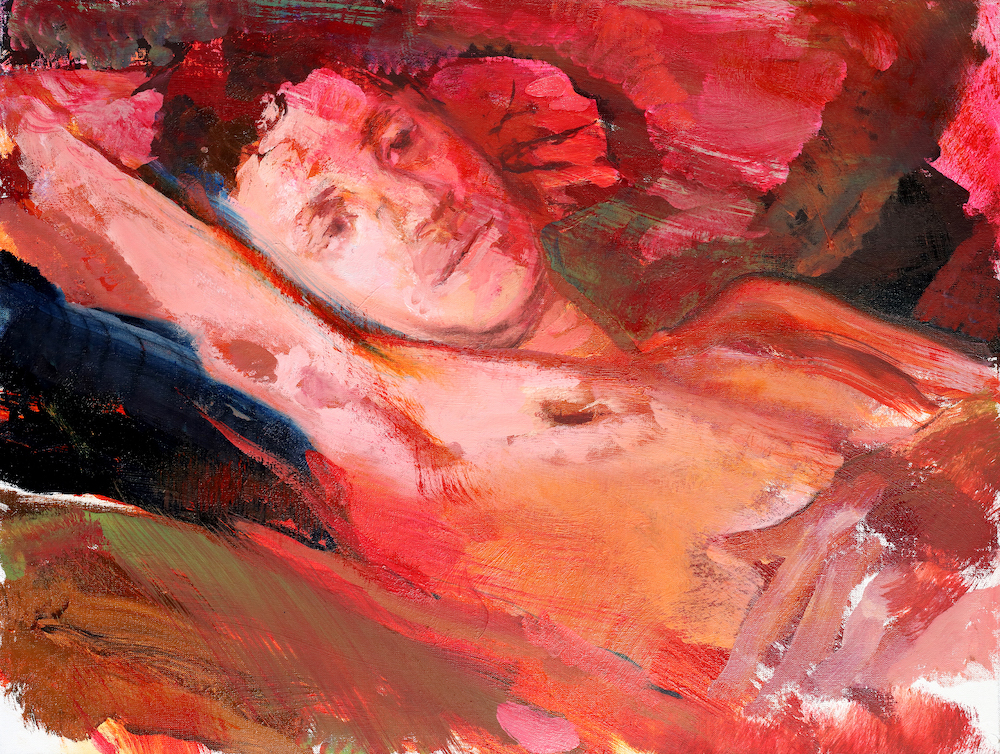
Doron Langberg, Resting (2020) at Victoria Miro
Capturing figures in varying states of repose, any suggestions of sleepiness in the paintings of Doron Langberg are snapped back to life through their vivid palettes. Light strokes of paint are masterfully accumulated to create a bright, airy feel, sometimes drawing attention to patterned textiles and other interior elements. The New York-based Israeli artist paints his friends, family, and husband, seeking to recreate feelings of closeness, focusing on themes of love and desire. Victoria Miro recently announced representation of the artist, and his first solo exhibition at the gallery will follow in 2021. Works by the artist will also appear in Intimacy: New Queer Art from Berlin and Beyond at the Schwules Museum, Berlin (27 November 2020–25 February 2021), along with Breakfast Under the Tree, curated by Russell Tovey and Robert Diament at Carl Freedman Gallery in Margate, Kent (8 November 2020–17 January 2021).
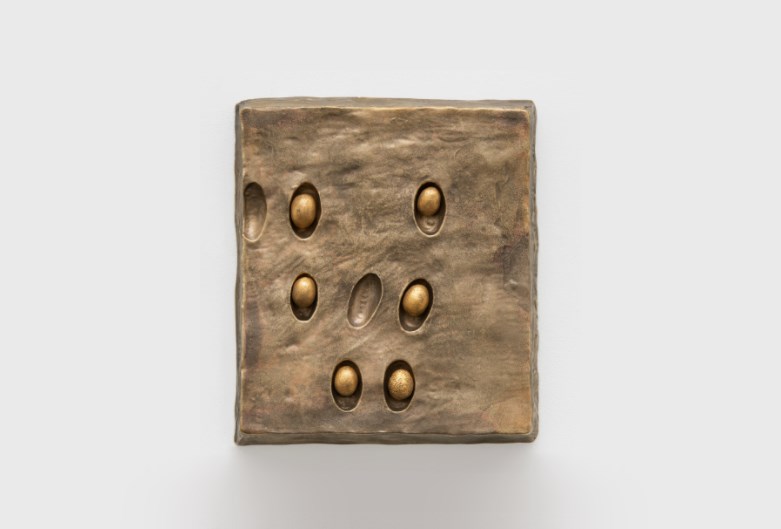
Erika Verzutti, Naked (2020) at Alison Jacques Gallery
Brazilian artist Erika Verzutti‘s biomorphic sculptures lay bare the process of their making, emphasising the tactile qualities of her materials. This relief, entitled Naked, features her recurring egg motif set within a concave, shell-like form. Shapes taken from nature are transformed through their rendering in bronze and clay, together with a playful arrangement that imbues the work with a surrealist quality. Verzutti’s sculptures seem to come alive through ambiguous allusions to body parts, teasing us with sexual innuendo.
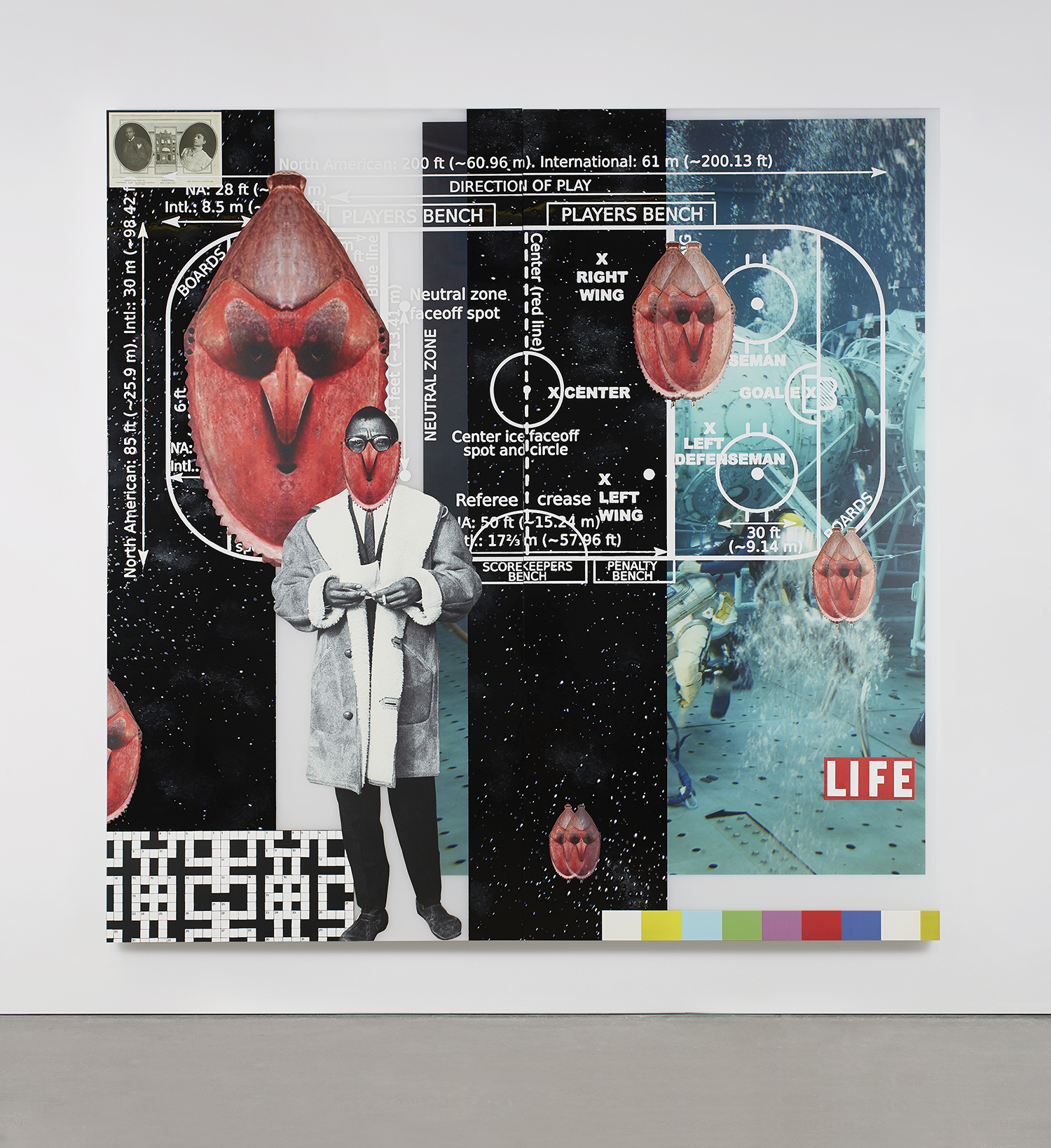
Tavares Strachan, Before the Fire (2020) at Marian Goodman Gallery
Cutting through art, politics, and science, Bahamian artist Tavares Strachan’s practice reintroduces marginalised objects and peoples into the cultural canon, inspiring a curiosity of the world in the process. The Encyclopedia of Invisibility (2018–ongoing) is an ongoing project that weaves through the artist’s initiatives, containing over 15,000 entries—from B-movies to mythological creatures and historical figures. It is the backbone to his current exhibition at Marian Goodman Gallery, In Plain Sight (8 September–24 October 2020), an immersive presentation of sculptures, explosive paintings, and other elements that bring figures swept from collective memory to the fore. In Before the Fire (2020), a labyrinth of references includes a photograph of American novelist, poet, and activist James Baldwin taken in 1963—the year his non-fiction work The Fire Next Time was published—in the foreground.
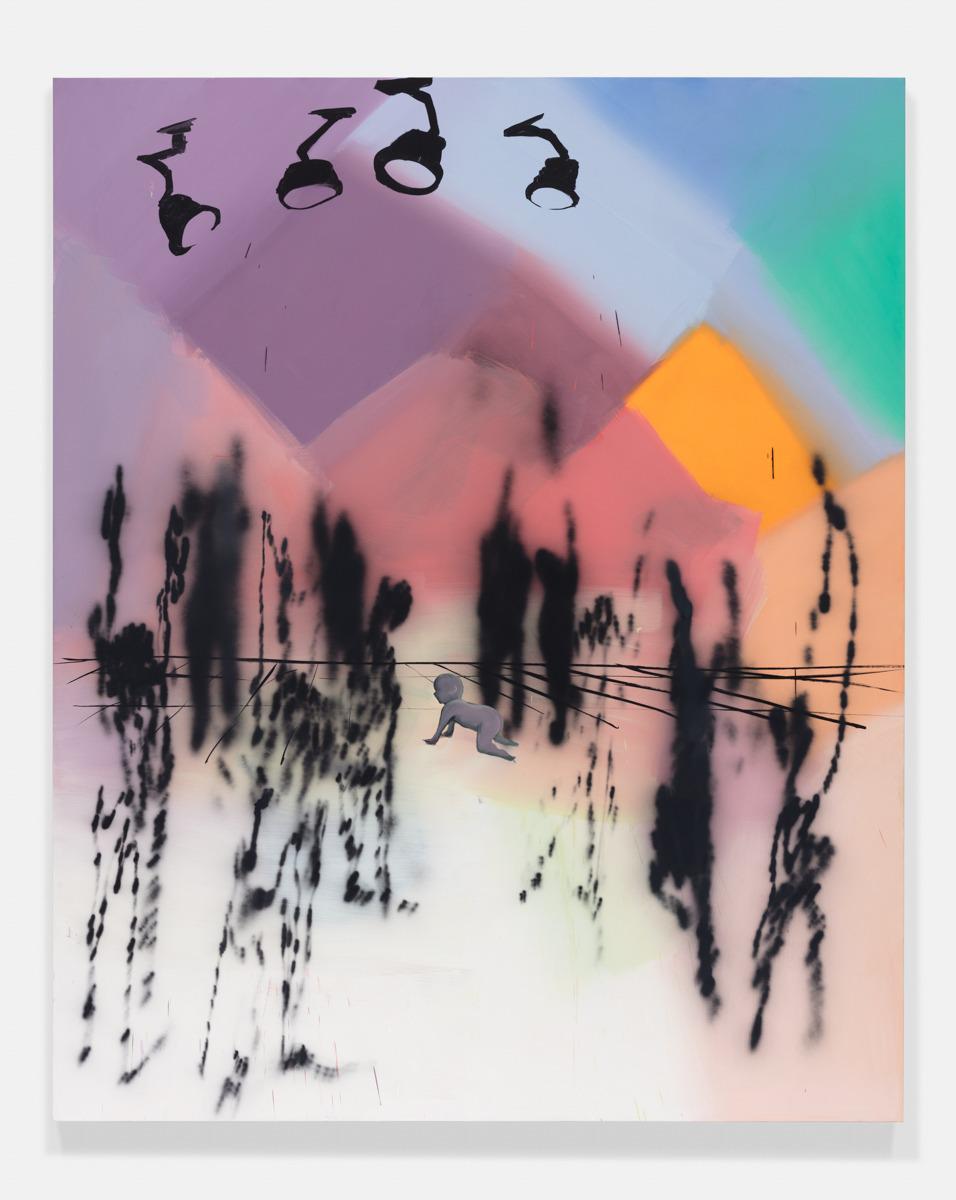
Tala Madani, Spectral Disco (2020) at Pilar Corrias
Tehran-born, Los Angeles-based artist Tala Madani‘s paintings often incorporate discos or stage sets within which figures play out absurd narratives. These humorous and intimate scenes become unsettling, though, as broader political themes and personal tensions reveal themselves. Madani has subverted preconceived notions of masculinity and the male gaze in much of her work but recently, babies have started to feature prominently, reflecting her daily life and anxieties as a mother. In Shit Mother I (2019), a mother made of excrement is being consumed by babies, a powerful, grotesque rendition of the fear, she told Ocula Magazine in 2019, that ‘at some point in our lives, we are dependent on a mother figure who might let us down.’ Madani grapples with the experience of growing up through the eyes of her baby but also from her perspective as a mother; this conflict of identity is deeply personal, while also resonating with the viewer, as parent or nostalgically looking back to childhood.
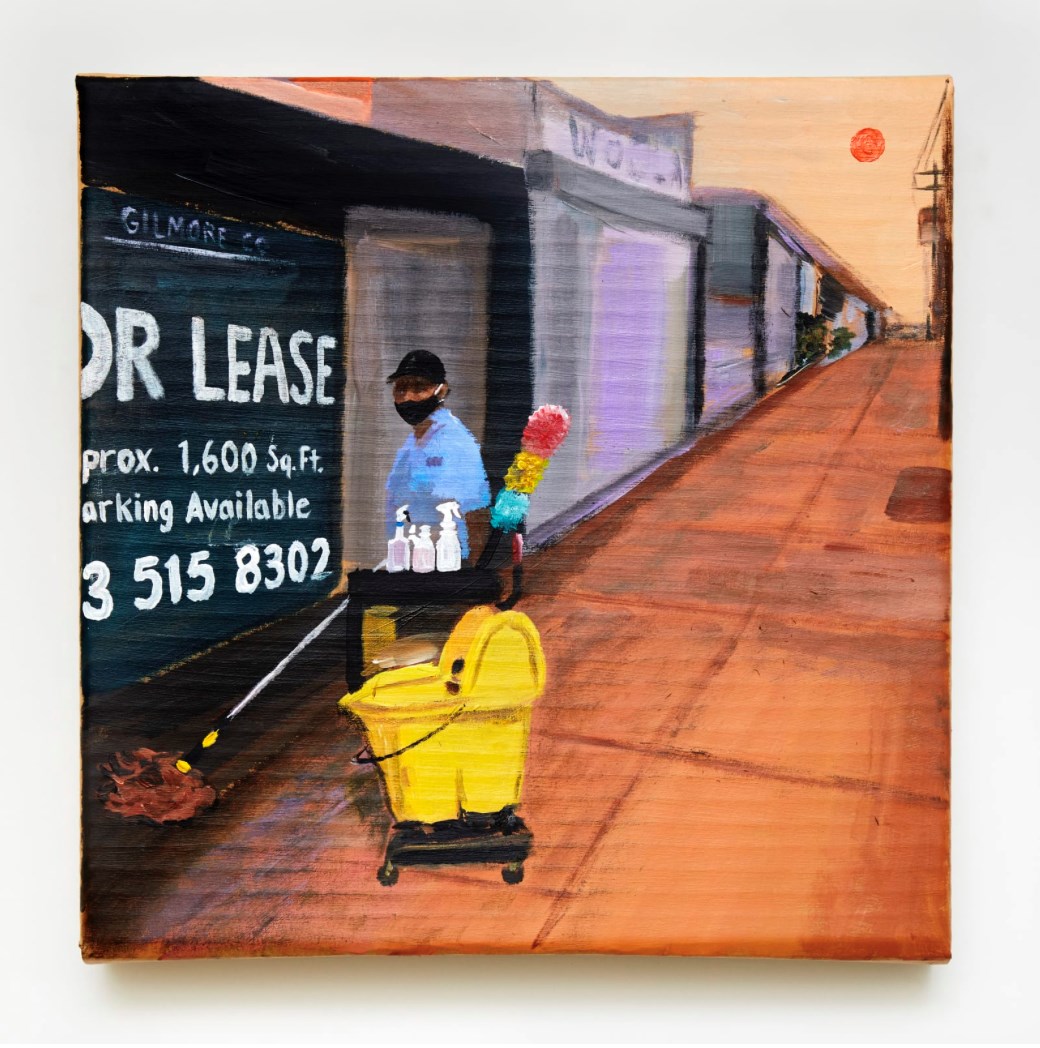
Ramiro Gomez, On 3rd Street (2020) at P·P·O·W Gallery
West Hollywood artist Ramiro Gomez‘s paintings on cardboard powerfully evoke the predicament of America’s Latinx workers, many of whom continue to work in the jobs other Americans don’t want to do. Only in his early thirties, the artist’s practice usually involves being out and about, shopping, going to restaurants and bars, and visiting art museums, but, he says, ‘always with an eye toward those maintaining everything.’ Gomez himself was a nanny for a Los Angeles family, while his father is a truck driver for Costco and his mother works as a janitor. The keenness of Gomez’s social observation has been acknowledged in articles by publications including The New York Times Magazine, and through his addition to the collection of the Smithsonian American Art Museum.
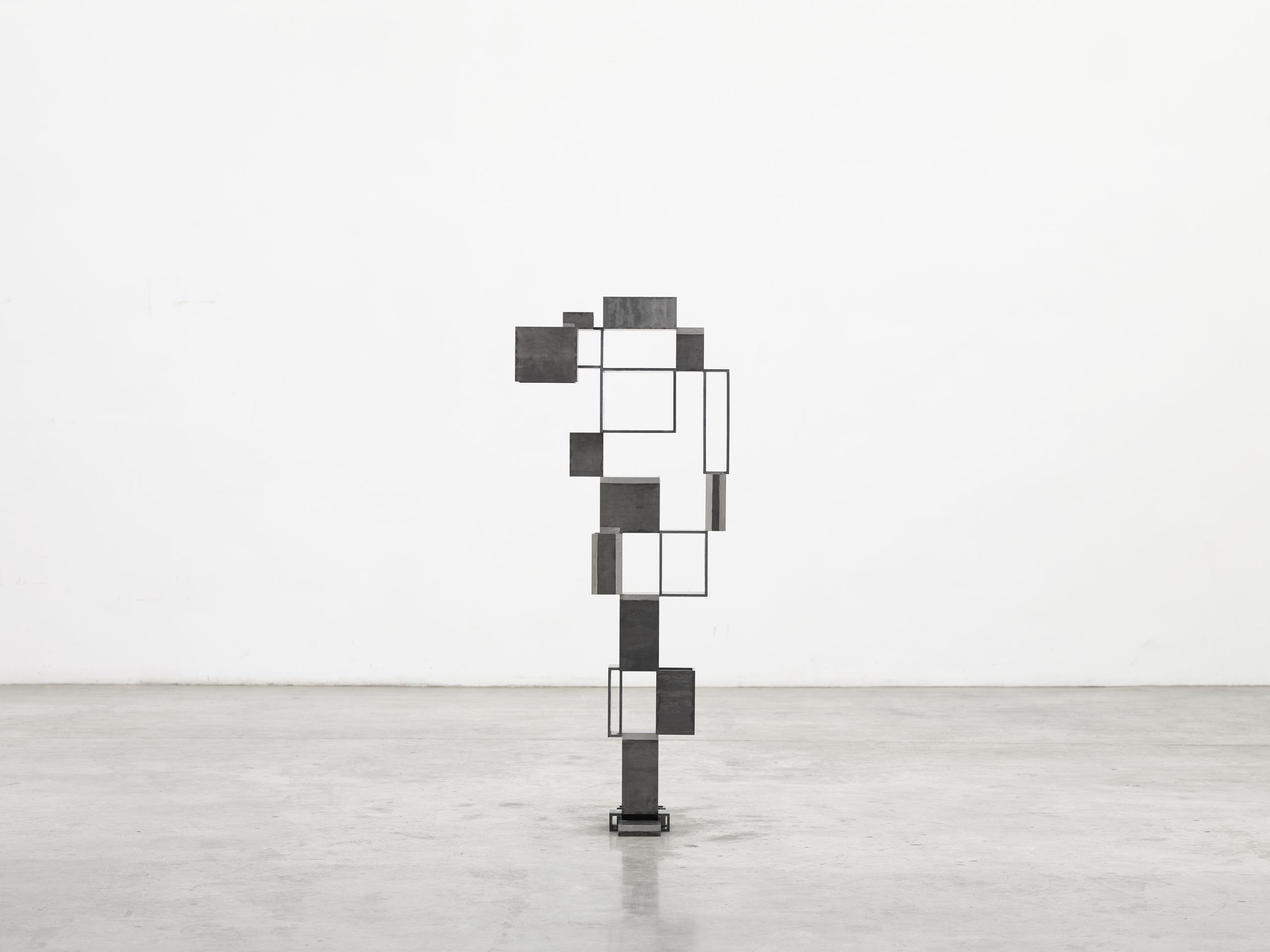
Antony Gormley, OPEN VEER II (2020) at White Cube
This new sculpture by Antony Gormley continues his quest to confront the viewer with their own transition through time and space. Geometric architectural forms are used as a language to describe the human figure. From some angles the body seems transparent, whereas others reveal the heaviness inherent to its material and form. The empty space between lines or blocks of steel becomes crucial in determining the viewer’s relationship with the body and indicates Gormley’s desire to disarm us on a physical level, reminding us of the brevity and fragility of existence. These themes are more unavoidable than ever in 2020, but Gormley’s work has always been socially engaged. Speaking to Ocula Magazine in 2015, Gormley said, ‘It was important to me, in talking about the victims of the twentieth century, to include not just those who have lost their lives—the body as refuse—but those still living bodies that are seemingly unable to play a part within a constructive human life.’ —[O]
Main image: Sam Gilliam, Untitled (2020). Watercolour on washi paper. 100 x 181.9cm, framed: 109.9 x 191.8 x 5.1 cm. Courtesy David Kordansky Gallery, Los Angeles.



A respected voice in contemporary art discourse.
Focusing on ambitious storytelling and insightful art-world commentary. Ocula Magazine publishes in-depth interviews, critical essays and timely analysis on the artists, exhibitions and ideas driving the global art world.
Learn more about Ocula Magazine
Showcasing the best of the art world.
Ocula partners with galleries from around the world to highlight their artists, artworks and exhibitions. Gallery membership is by application and invitation, with each member vetted by an independent panel.
Learn more about Ocula Membership
Specialises in the sale of major artworks.
Led by a team with deep ties to the world’s leading auction houses, galleries and collectors. Ocula’s advisory team offers bespoke services to high-net-worth clients from around the world who are looking to acquire the best of contemporary and modern art.
Learn more about our team and services