





Frieze Masters 2023 Artwork Highlights
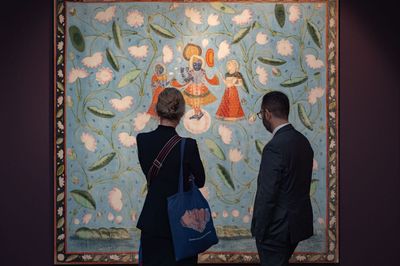
Exhibition view: Prahlad Bubbar, Frieze Masters, London (11–15 October 2023). Courtesy Frieze. Photo: Michael Adair.
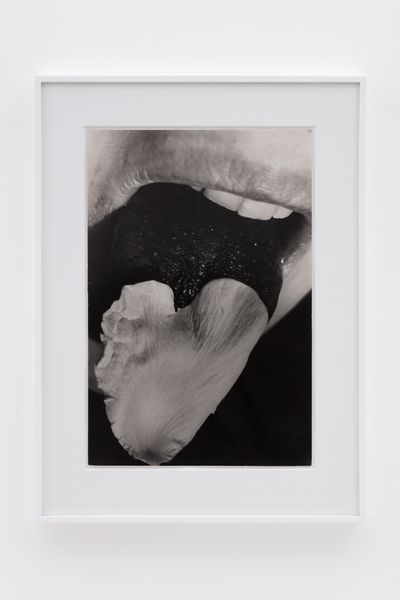
A rose petal covers the artist’s outstretched tongue, contrasting texture and tone in a closely cropped black-and-white photograph. It is a declarative and spontaneous gesture that embodies the spirit of late British artist Rose Finn-Kelcey, to whom Kate MacGarry dedicated a solo booth of photographs and performance archives at Frieze Masters.
Finn-Kelcey worked in London in the 1960s and 70s, involved not only in its feminist movements but the experimental spirit of the time. Early installations like Power for the People (1972) saw the artist plastering large flags bearing the titular inscription on Battersea Power Station in South London, while Steam Installation introduced the notion of a sensory artwork as early as 1992, presenting a cube of steam at Chisenhale Gallery.
Retained only as photographs, One for Sorrow, Two for Joy (1976/2012) was made as a response to Joseph Beuys’ I Like America and America Likes Me (1974), a performance in which Beuys lived with a coyote for three days. For her version, Finn-Kelcey lived with two magpies at Acme Gallery in Convent Garden for two days, with attempts at communication broadcast to audiences in the street.
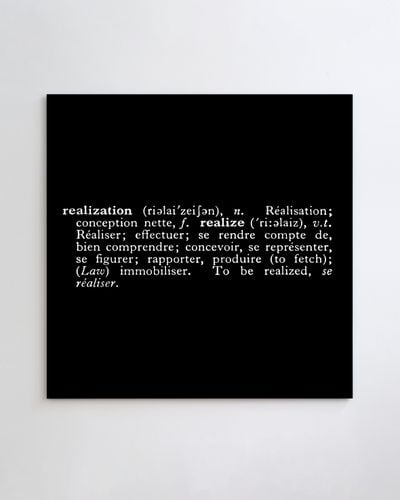
Joseph Kosuth, Titled (Art as Idea as Idea) [realization] (Eng.-Fr.) (1967) at Prahlad Bubbar, London
Prahlad Bubbar’s booth was an unexpected place to find a work by Joseph Kosuth that ponders the nature of art, surrounded by a beautiful 19th-century Tibetan decorative door, an evocative Indian pigment illustration on paper, and an ornate Chinese jug, among other historic objects.
Kosuth played a key role in the development of 20th-century U.S. Conceptual art, using language to investigate how art could create meaning. He paved a path for artistic practices to uptake a role previously attributed to philosophical discourse and away from traditional forms.
Kosuth’s black-and-white print, Titled (Art as Idea as Idea) realization (1967) asserts the role of an artist as a meaning-maker through the verb, to ‘realize’. The object of his creation takes on a form of meaning unto itself—though Kosuth notes the ambiguity of language in articulating truths, representations can only arrive at an approximation, like philosophy itself.
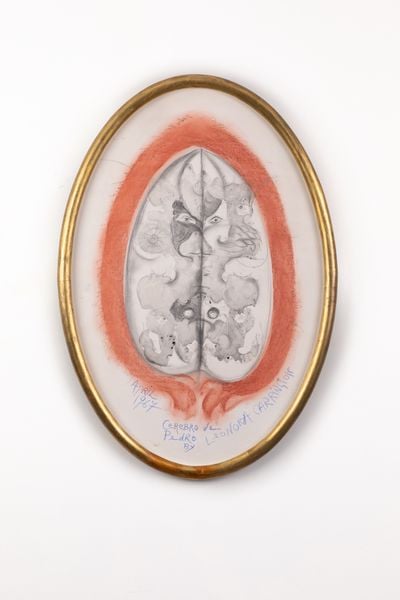
Leonora Carrington, Cerebro de Pedro (1967) at Gallery Wendi Norris, San Francisco
Made for the artist Pedro Friedeberg, this watercolour on paper by the English surrealist painter Leonora Carrington shows Friedeberg’s brain as Rorschach inkblots intertwined with mythical creatures, wrapped in an egg-shaped halo emitting soft red and framed by a golden disk.
It is a quieter work by the artist that nonetheless encompasses a range of concerns within her work, replete with symbolism and mythological iconography to explore the depths of the human mind—a realm that can never be fully understood, as emphasised by the indecipherable inscriptions that frame the oval form.
Nearby is Double Portrait (c. 1937–1940), which depicts Carrington herself with artist Max Ernst against a rough, parchment-coloured ground. Carrington looks to viewers as her body dissolves into the surface, while her partner, wrapped in a blue flame-like shroud, looks in her direction. A horse waits behind Carrington, alluding perhaps to a wish for independence and new creative directions.
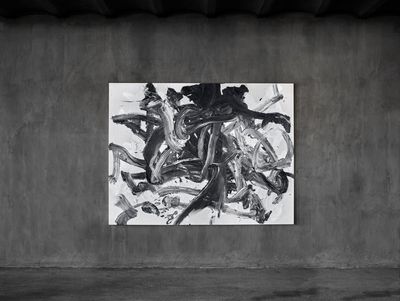
Kazuo Shiraga, Shungei (1990) at Axel Vervoordt, Antwerp/Hong Kong
The Japanese artist Kazuo Shiraga once stated his desire to ‘paint as though rushing around a battlefield, exerting [himself] to collapse from exhaustion’. He achieved this relentless expression in various ways, including by suspending himself from the ceiling and painting with his feet.
In 1954 Shiraga became a member of the avantgarde group Gutai Art Association, who sought new artistic expression in the aftermath of the war. Their dictate was to bring life to materials and support the newfound individual autonomy following totalitarian rule.
One of his rare monochrome works, Shungei (1990) shows similar arrangements of energetic, thick overlapping strokes often seen in the artist’s signature blood-red canvases. Executed in the artist’s later years, they appear calmer, more lucid.
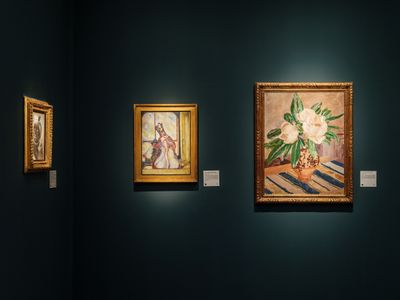
Henri Gaudier-Brzeska, A Study of The Plaster for Maria Carmi as Madonna, with Self Portrait (c. 1912) at Philip Mould & Company, London
One of three recorded oil paintings on canvas by Henri Gaudier-Brzeska, a crucial but short-lived French sculptor associated with Vorticism, this self-portrait was commissioned by his first patrons. It recalls a time of great creativity and hope for the artist who arrived in London in 1911 with empty pockets.
The original commission from patrons Thomas Leman Hare and Thérèse Hare was for a small statue of actress Maria Carmi, inspired by The Miracle (1911), a play by Karl Vollmöller and Max Reinhardt set inside a mediaeval church, with horses, processions, and vast crowd scenes. The artist was asked to see the production that had enticed his patrons and sketched some 60 scenes from which he would create the small bust.
In this later commission, Gaudier-Brzeska takes a backseat to bring attention to the figure he was painting. Impressionist strokes and soft, pastel-blue shades recall the lyrical, transcendental nature of artistic discovery. —[O]
Main image: Exhibition view: Prahlad Bubbar, Frieze Masters, London (11–15 October 2023). Courtesy Frieze. Photo: Michael Adair.


A respected voice in contemporary art discourse.
Focusing on ambitious storytelling and insightful art-world commentary. Ocula Magazine publishes in-depth interviews, critical essays and timely analysis on the artists, exhibitions and ideas driving the global art world.
Learn more about Ocula Magazine
Showcasing the best of the art world.
Ocula partners with galleries from around the world to highlight their artists, artworks and exhibitions. Gallery membership is by application and invitation, with each member vetted by an independent panel.
Learn more about Ocula Membership
Specialises in the sale of major artworks.
Led by a team with deep ties to the world’s leading auction houses, galleries and collectors. Ocula’s advisory team offers bespoke services to high-net-worth clients from around the world who are looking to acquire the best of contemporary and modern art.
Learn more about our team and services