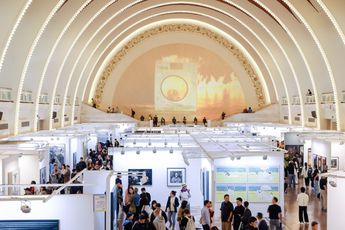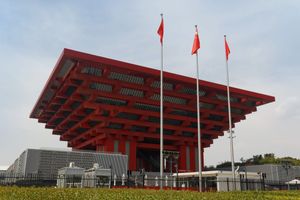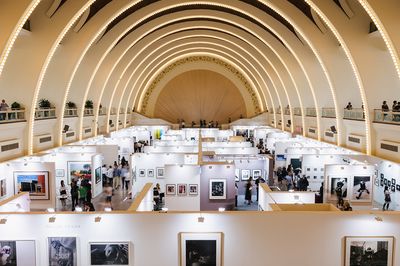
Shanghai Exhibition Center. Photo by James Ambrose. Courtesy of PHOTOFAIRS | Shanghai.
By Elliat Albrecht – 13 September 2016, Shanghai, China
The appeal of the commercial art fair model is obvious—whether one goes to speculate, buy, assess trends in contemporary art or just to cop some free champagne during the vernissage, it’s terrifically convenient to get it all done under one roof. Furthering this efficiency, PHOTOFAIRS | Shanghai does away with painting, sculpture and the rest of it to solely showcase photographic works. This singular focus is a refreshing antidote to the art-blindness experienced at more multifarious fairs, fending off that mid-day, over-stimulated shutdown by allowing visitors the mental space to consider each work and its relationship to others in its genre.
Formerly known as Photo Shanghai, PHOTOFAIRS | Shanghai's third edition was hosted in the Shanghai Exhibition Center from 9 - 11 September. While many exhibitors hailed from mainland China and the surrounding region, the 2016 edition of PHOTOFAIRS was its most international so far, with presentations by 50 galleries from 15 different countries including Iran, Israel, Denmark and Belgium. The fair aims to present photography as a collectable medium, which it does well, given that some buyers hesitate before forking over big sums for two-dimensional and easily reproducible objects. This is a longstanding struggle; photography has long fought to prove its legitimacy and thus purchasability as a fine art form. Yet, ‘the photography market in Asia has seen an unprecedented burst of activity in recent years,’ Christopher Philips, Curator, International Center of Photography, New York said in advance of the fair. ‘Regional institutions and private collectors, having finally recognised the significance of photography as a visual medium, are now making serious acquisitions of top-tier historic and contemporary work.’ Devotees recognise photography’s diverse artistic value: the last century has seen artists exploring the camera’s potential for research, documentation and conceptual experimentation, in addition to fuelling the primary practices of big-name artists such as Cindy Sherman, Richard Prince, Thomas Struth and Andreas Gursky. Let us also not forget how photography has comforted the mourning after all of painting’s many purported deaths.
Ocula was on the ground for the fair’s third edition in Shanghai to report on highlights from the booths.
Inside the exhibition centre, PHOTOFAIRS | Shanghai was organised by three categories: Main, Connected, and Platform. Main was dedicated to commercial galleries showing widely recognised artists, including Robert Mapplethorpe and Daidō Moriyama at Shanghai-based gallery BANK, and Yang Fudong at one of ShanghART’s two booths. Organised by Chinese curator Feng Boyi, Connected was devoted to the moving image, while the Platform sector supported emerging galleries who have yet to participate in an art fair in China. Included in this group was Hong Kong’s The Empty Gallery, whose entirely black exhibition space will reopen in Aberdeen this November after renovations. Taking centre stage in their booth was Ancestor Bone Hug, a series of monochrome photographs of bits of skulls by Indian artist Amit Desai. Desai’s project was inspired by the Hindu ritual of Kapala Kriya, a tradition in which a son smashes his father’s skull after the elder’s death in order to release his soul. With their minute bumps and crevices rendered in extreme detail, the bone fragments read as curious abstract forms or asteroids atop black backgrounds, far removed from their previous responsibilities of cradling brains.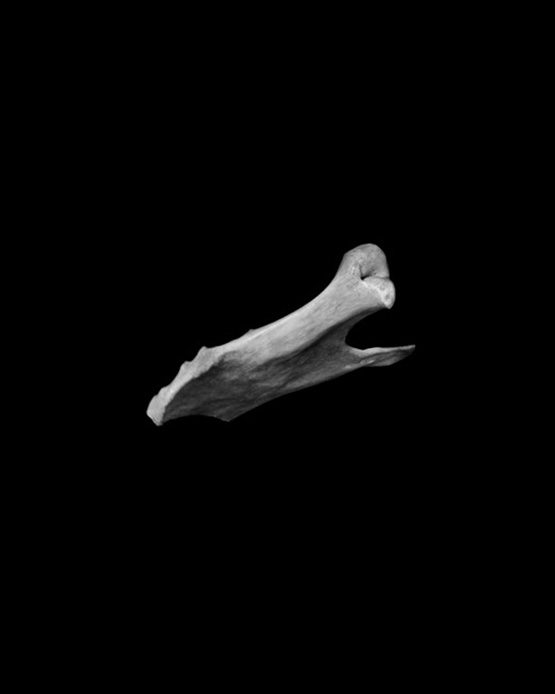
Amit Desai, BONE XI, 2013. Palladium print, 77 x 62 x 6.4 cm. Courtesy of The Empty Gallery.
Upstairs, another project addressing death was Alec Von Bargen’s solo presentation at Leo Gallery’s booth. While travelling through Halong Bay in Vietnam, Von Bargen photographed what he thought was a group of playful swimmers. He later realised what he witnessed was a crowd attempting to save a drowning woman. This traumatic experience recalled Virginia Woolf’s self-induced drowning 70 years earlier, a comparison which Von Bargen used to work through the incident in his work. Seeking to aestheticise the juxtaposition between the accidental and the desired, he presented the unframed image of the stranger’s drowning with its negative counterpart laid in front on the floor, both reading as tombstones or memorials to the lost women.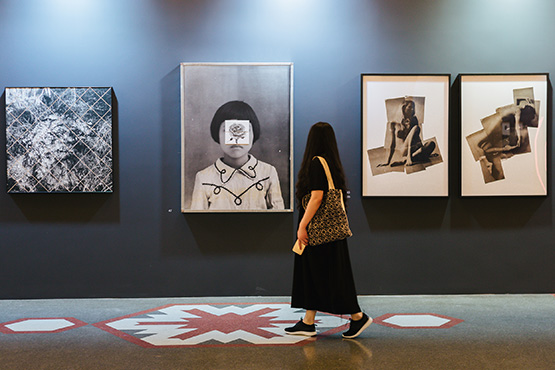
The inaugural edition of Insights: New Approaches to Photography Since 2000. Photo by James Ambrose. Courtesy of PHOTOFAIRS | Shanghai.
Upstairs in its own hall was the inaugural edition of Insights: New Approaches to Photography Since 2000. Dedicated to experimental works and curated by Biljana Ciric and PHOTOFAIRS’ artistic director Alexander Montague-Sparey, the sector included pieces by Lee Kit, Helmut Newton, Shao Wenhuan, and Peter Beard among others. This section was a good response to skeptics who brush off photography as unexciting: the grouping showed how artists stretch the boundaries of the medium with digital manipulation, text, unconventional materials and hybridised images, with many of the artists approaching photography as both a science and an art. Experimentation was seen in the standard booths as well, such as in the works of JinHee Kim at Seoul-based Gallery Koo, in which the Korean artist cuts holes in photographs and sews them with thread to explore rituals of healing. Yi Xin Tong’s gorgeous, light-soaked and hand-carved inkjet prints at Vanguard Gallery sold out early during the VIP opening, to no surprise. Bilingual contemporary Chinese art magazine LEAP’s booth, curated by Wu Jianru and titled ACTION! Imaged Bodies, featured works by nine artists including Chen Wei, Hao Jingban, Miao Ying, Song Ta. Hao Jungian’s images of atmospheric dance halls carried subtle visual signifiers of the last decades of the 20th century in Beijing, while Jiang Zhi’s video A Peace Unsettled (2013) depicted an unchanging view of an ornate dinnertable on a beach, set for a party of one. Wong Ping’s cheeky and vividly-toned single-channel animation Stop Peeping (2014) told the tale of a domestic snoop’s fascination with ice lollies and his neighbour’s sweat. Spoiler alert: the two became one in a cringeworthy series of events that is as humorous as it is obscene. The grouping of works was part of LEAP’s continuous art fair exhibition series initiated by the art platform Modern Art.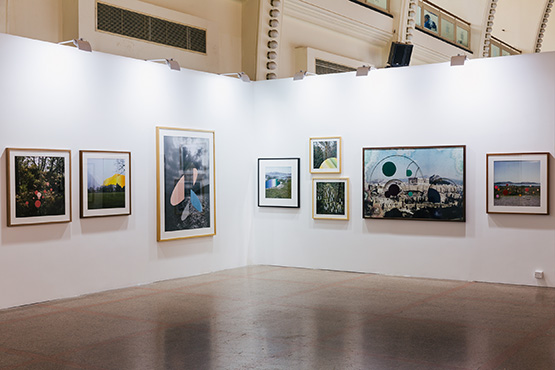
Gallery Koo at PHOTOFAIRS | Shanghai 2016. Photo by James Ambrose. Courtesy of PHOTOFAIRS | Shanghai.
Demonstrating the fair’s investment in Chinese photography, there was strong presence of historical Chinese works on view. Liu Heung Shing’s Farewell to an Era (1981) at HS Gallery’s booth showed a roller skater balancing wildly on one wheeled foot in front of a towering Communist era statue, while Weng NaiQiang’s Educated Youths in the Great Northern Wilderness (1968) series at Beijing’s Time Space Gallery offered a view of Chinese rural life. Shanghai-based gallery Nong Art’s booth was entirely monochrome, showcasing black and white works including Liu HeungShing’s Mourning newspaper announcement of the death of Chairman Mao (1976) and the touchingly humanist Newlyweds pose for a studio photo (1980), taken from an unusual angle so as to reveal all of the equipment and props behind the young couple. On the next wall, Liu’s Former US President Richard Nixon poses as a waiter aboard the train from Hangzhou to Shanghai (1982); the ousted American leader is shown serving bottles of Tsing Tao to Chinese passengers, possibly an act of post-Watergate PR damage control. An ode to technical proficiency and refinement was seen in a suite of works by UK-based artist duo Anderson & Low at Taipei’s Bluerider Gallery. The hyper-composed and formally impeccable images of male divers, dancers and synchronised swimmers exalted the beauty of well-muscled figures in action. Downstairs and complementing the works in the booths, the fair’s Conversations sector included panel discussions and talks by experts such as the director of Seoul Museum of Art, Jiyoon Lee and senior editor of LEAP, Wu Jianru, and collector Qiao Zhibing, who last week opened his gallery Qiao Space in the West Bund district with an exhibition featuring 12 of China’s most revered contemporary artists.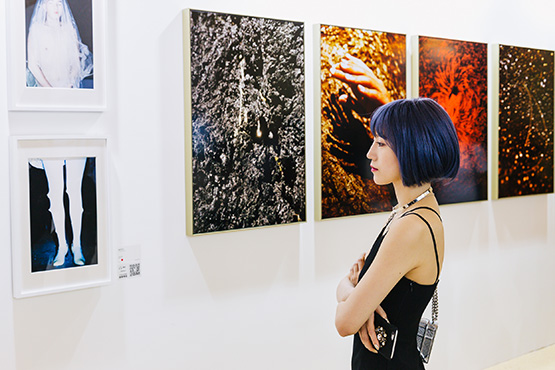
Photo by James Ambrose. Courtesy of PHOTOFAIRS | Shanghai.
It’s no longer news that the Chinese art market is booming after the country’s rapid economic expansion over the past decades, with the increase in museums, fairs and galleries in recent years being nothing short of a phenomenon. From 2000 to 2014, China jumped from dominating less than one percent to over 27 percent of the global art market share, with photography claiming a growing portion. Photography can be more affordable to collect than other types of artworks, and thus makes a fine entry point for buyers with a less-than-extravagant budget. That’s not to say there weren’t some very pricey works on view at PHOTOFAIRS: works offered ranged from $2,000 – 200,000 USD, with prices averaging around $5,000 - 15,000 USD. The fair closed on 11 September having received 27,000 visitors and announcing its strongest sales thus far.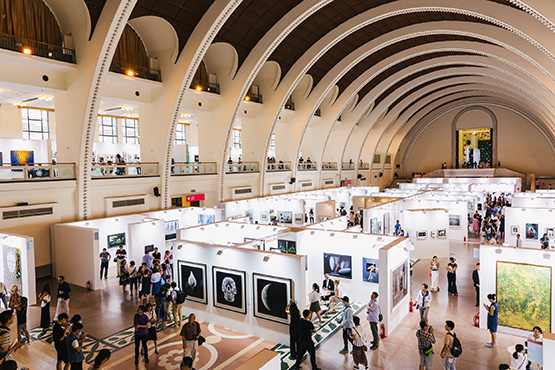
Photo by James Ambrose. Courtesy of PHOTOFAIRS | Shanghai.
The fair’s venue simply can’t go unmentioned. The palatial Shanghai Exhibition Center was built in 1955 as the Sino-Soviet Friendship Building, and thanks to all that Russian design influence and imperial money, the neoclassical architecture, grand halls and archways made for a stately setting. On opening day, a journalist remarked that the exhibition hall is filled with the ghosts of failed art fairs past (Shanghai has to date hosted more annual art fairs than Beijing, long seen as the artistic centre of China), yet a certain buzz in the air suggested a bright future for the fair with a focus.The next edition of PHOTOFAIRS will take place in San Francisco from 27 - 29 January, 2017. —[O]