The art world in focus
Subscribe to our newsletter for news and insights on artists, galleries and exhibitions.

Claes Oldenburg and Coosje van Bruggen in their studio with Standing Collar with Bow Tie (1992). Courtesy Trunk Archive. Courtesy Pace Gallery. Photo: Jesse Frohman.
At Pace Gallery, the final fruit of the artists’ collaborative labour is being presented for the first time. Titled Dropped Bouquet (2021), the sculpture resembles a falling garland of flowers, rendered to monumental scale for the first time after three years of fabrication, with the sculpture being conceived before van Bruggen’s death in 2009.
The artists first met in 1971 in Amsterdam, where van Bruggen was an assistant curator at the Stedelijk Museum, having completed her studies in art history at the Rijks University of Groningen in 1967. There, van Bruggen was involved in the first wave of Dutch conceptualism, inviting artists such as Jan Dibbets, who ‘dug up the foundations of the Stedelijk and Ger van Elk made a sidewalk out of bathroom tiles.’1
Such excavations continued in her work with environmental artists such as Doug Wheeler and Larry Bell, and would find form in her later collaboration with Oldenburg, with whom she worked towards expanding the boundaries of sculpture.
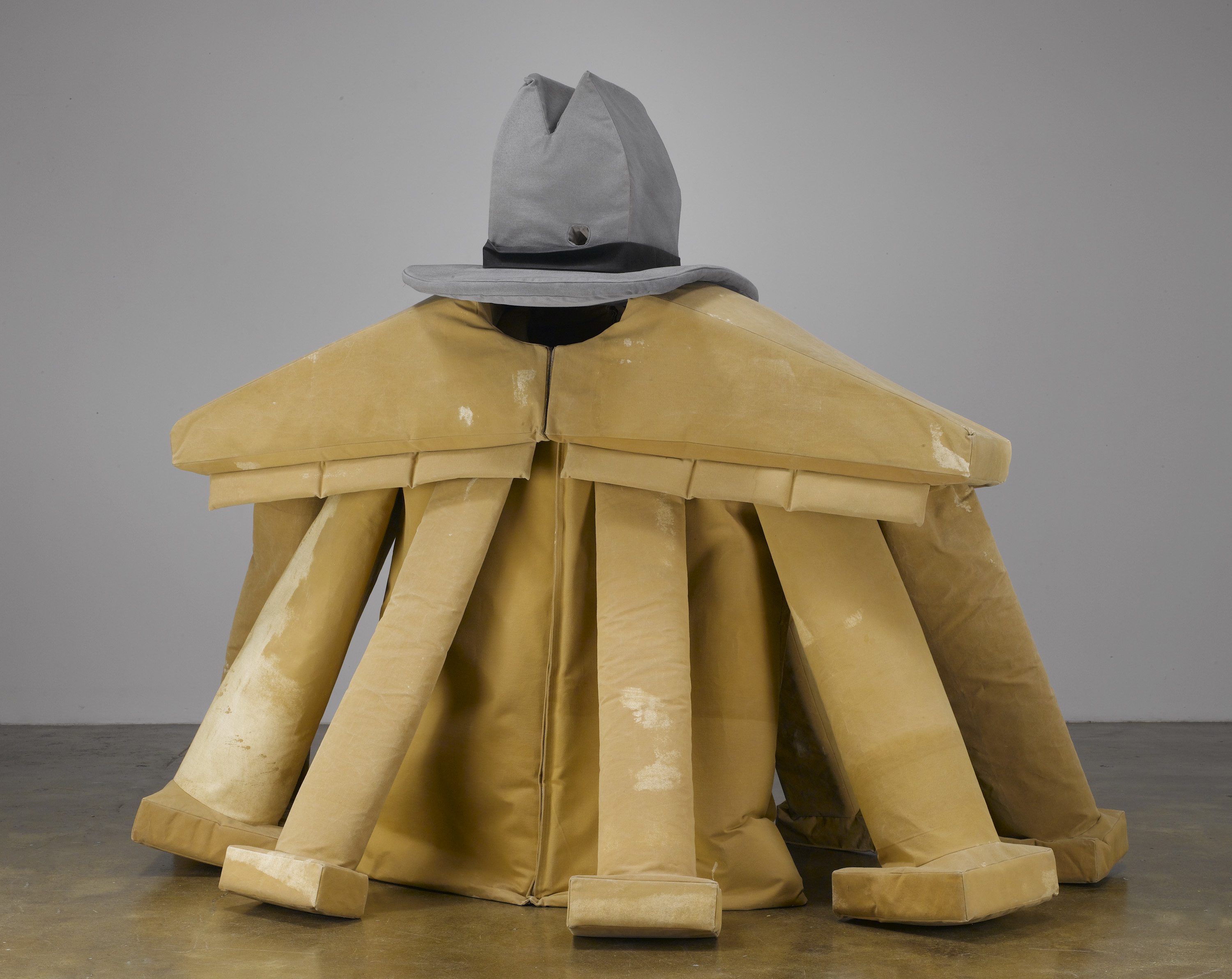
Prior to their marriage in 1977, Oldenburg had established himself in New York’s experimental art scene of the 1950s and 60s. Absorbing the language and iconography of advertising and consumer culture into his ‘happenings’ and sculptures, Oldenburg’s The Store (1961) was among his most iconic works, in which familiar consumer items, including cakes, cigarettes, and lingerie, were rendered as ersatz, painted objects filling a mock corner store.
The artwork positioned him as a pioneer of the Pop Art movement, while refuting the hard-edge aesthetic of the time. Oldenburg’s cartoonish sculptures took on an anarchic quality, whereby banal objects refused their habitual function through inverted textures, as seen in the drooping vinyl Giant Soft Fan (1966–1967).
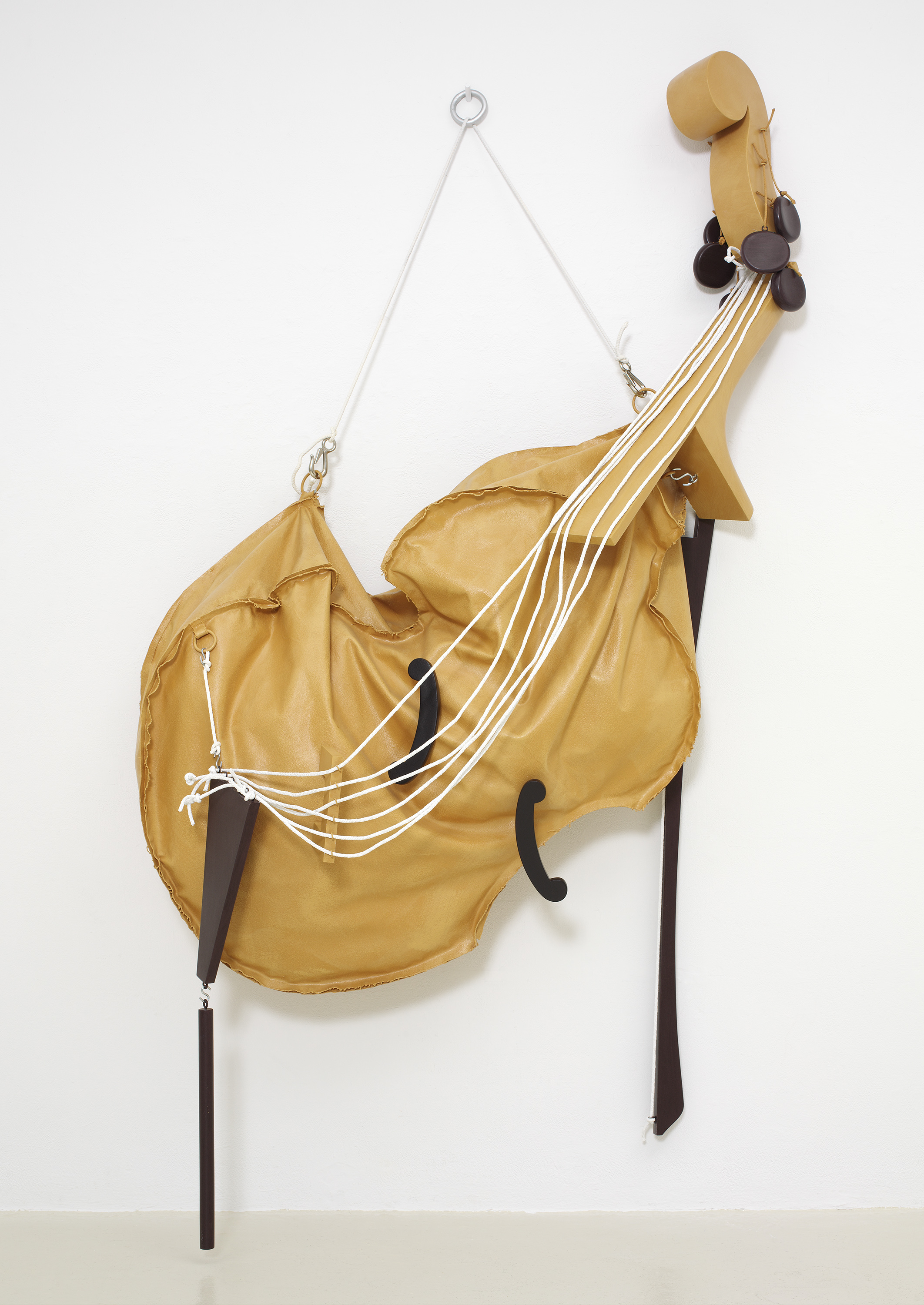
Claes Oldenburg’s first public sculpture was created in 1967, titled Placid Civic Monument, which took place behind the Metropolitan Museum of Art, New York. There, he enlisted two grave diggers two empty a rectangular hole, filling it up again after lunch. The anti-monument exists via a series of photographs and a short film.
“Such poetic explorations of objecthood were at the heart of van Bruggen and Oldenburg’s collaborative practice, with van Bruggen’s continued career as a curator and writer alongside their practice extending these boundaries yet further.
Scale and impact snowballed through collaborative practice. In 1976, Claes Oldenburg and Coosje van Bruggen’s first collaboration took the form of an oversized garden tool commissioned for the grounds of the Kröller-Müller Museum in Otterlo, the Netherlands, titled Trowel I (1971), for which van Bruggen suggested the colour blue, to represent the colour of Dutch workingmen’s overalls.
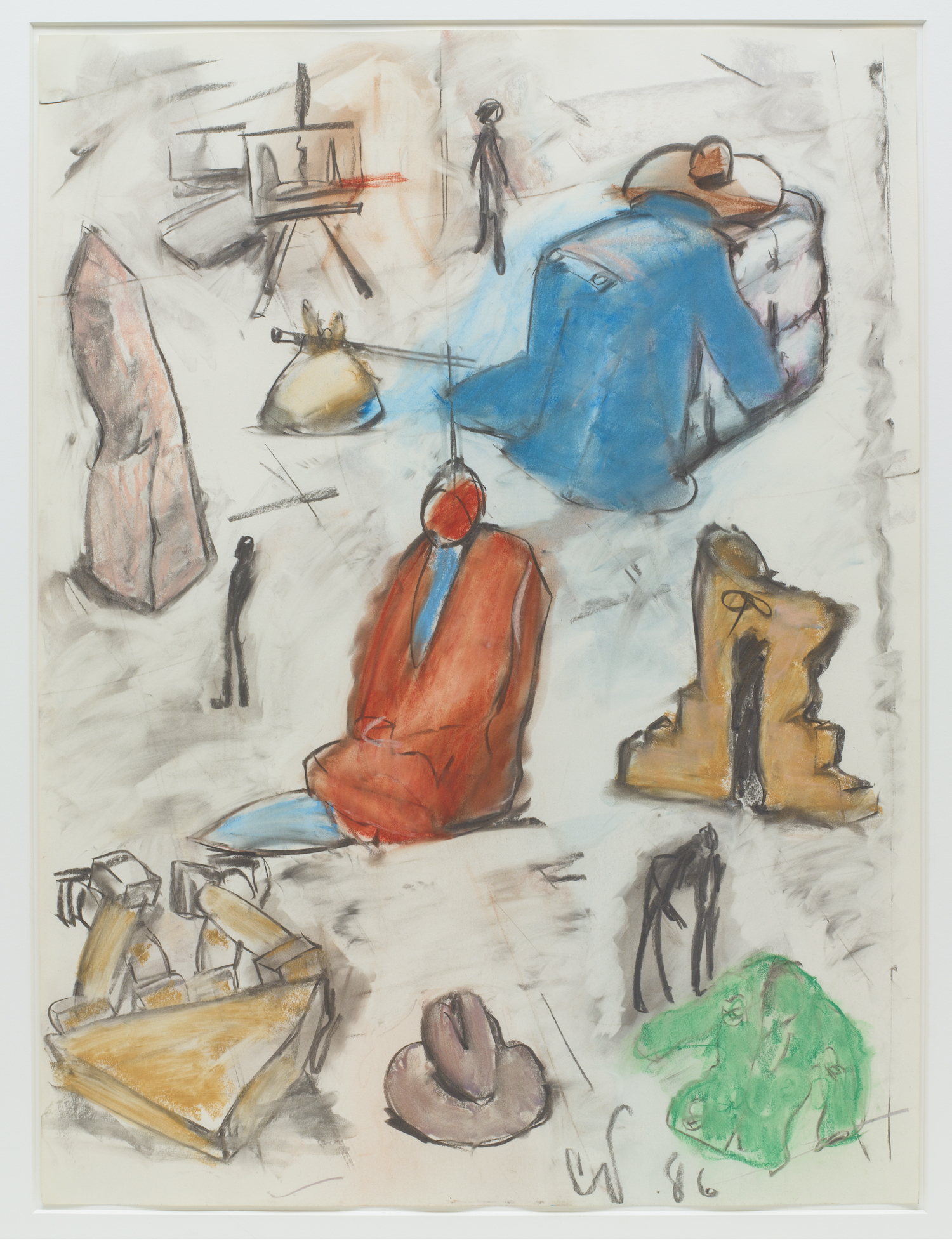
Married in 1977, they began working together on drawings, installations, and performances, with Coosje’s name being included on their work from 1981. Van Bruggen referenced Italo Calvino’s ‘field of analogies, symmetries, confrontations’ to describe their practice as ‘a unity of opposites’2. Whilst ideas were conceived jointly, it was van Bruggen who handled the colouring, fabrication, and siting of the works.
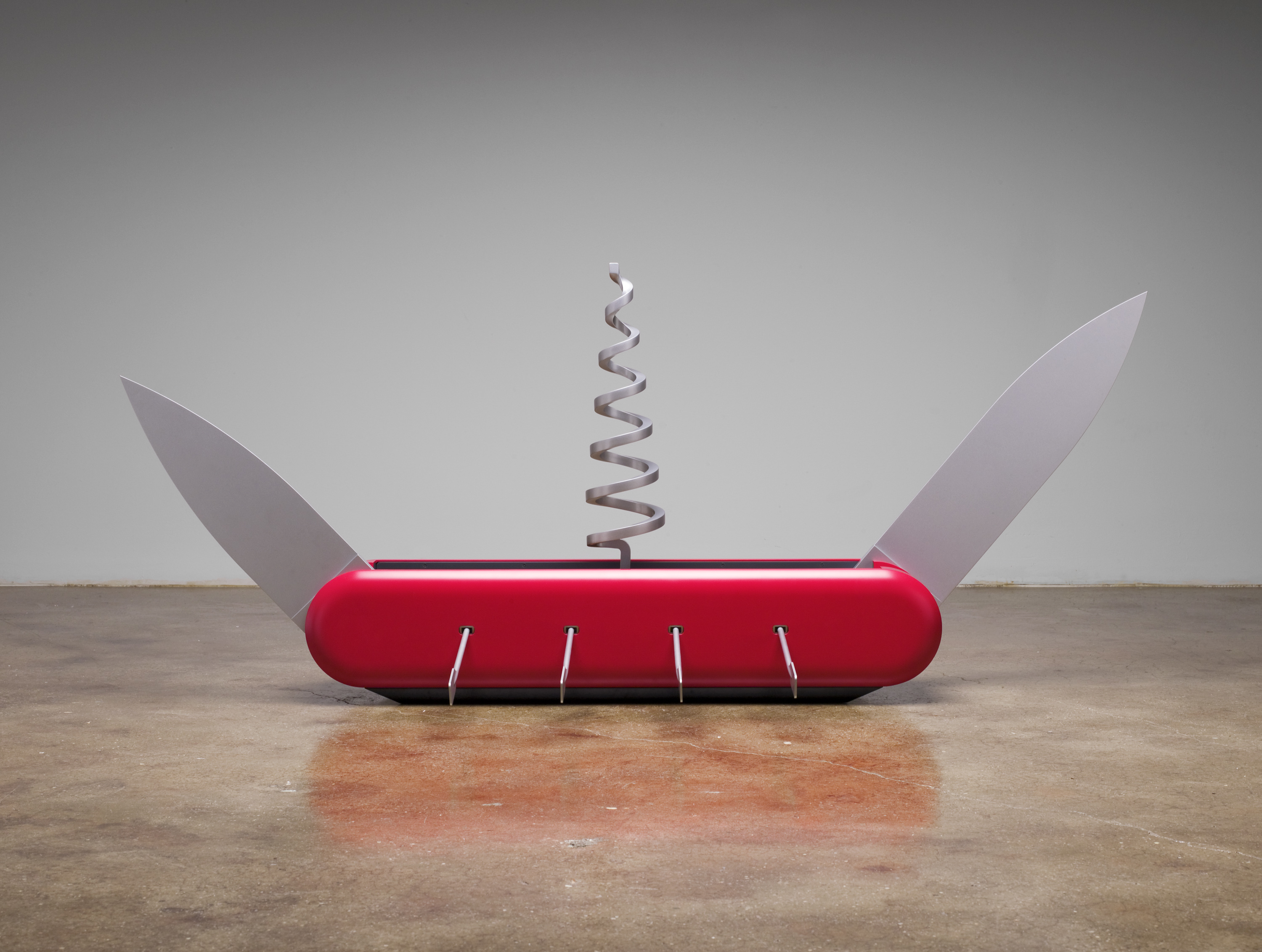
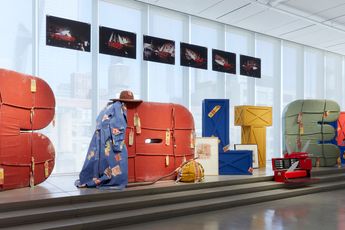
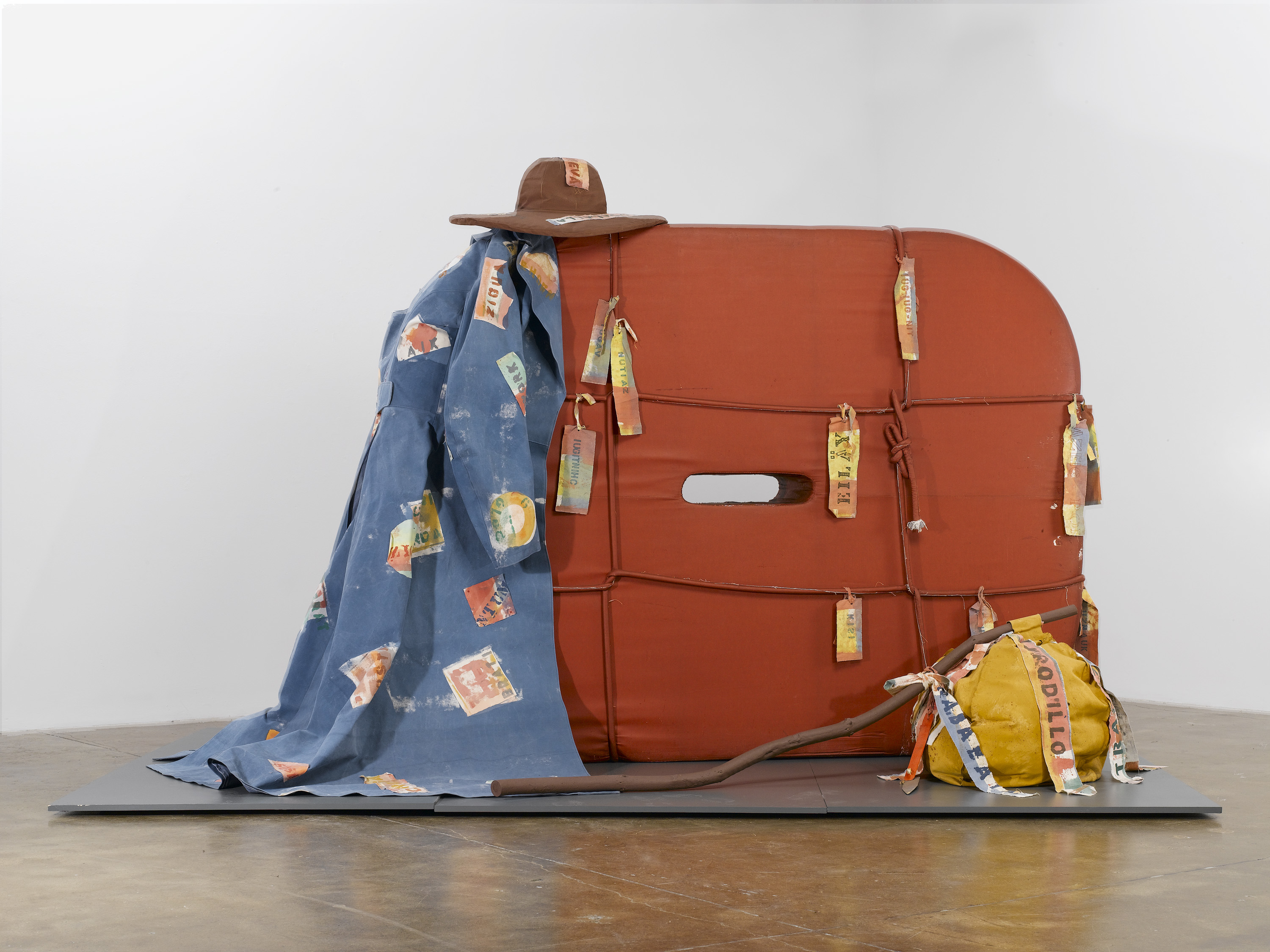
In 1984, the artists activated Il Corso del Coltello (The Course of the Knife) with architect Frank Gehry and art historian Germano Celant at that year’s Venice Biennale. The installation centred around a giant Swiss army knife floating on a Venetian canal, with performers interacting with objects—some of which are showing at Pace Gallery—in ‘an ongoing tug-of-war’, whilst the blades, screw, and oars of the knife moved in full motion, acting as a ‘paradigm for the ebullient process of discovering cultural and physical properties of a site’.3
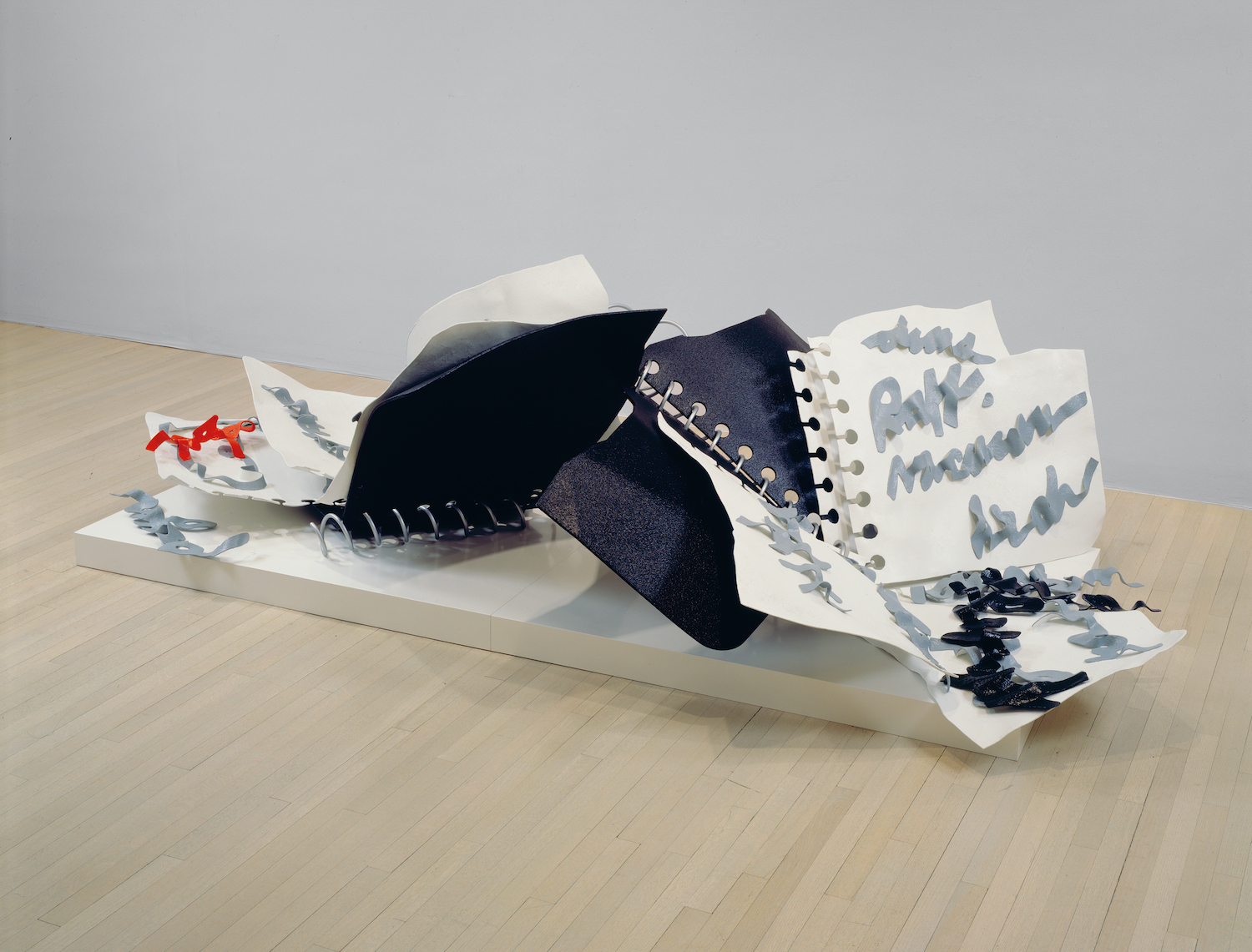
While resistance was embodied in scale, it was also expressed through an understanding of the consumer object’s short-lived sheen and inevitable decline. Sculptures such as The Entropic Library (1989), presented at documenta 7, expressed the ‘inevitable fragility of technology and human culture in the face of the processes of nature’4 through a row of large, decrepit books falling into one another.
Such poetic explorations of objecthood were at the heart of van Bruggen and Oldenburg’s collaborative practice, with van Bruggen’s continued career as a curator and writer alongside their practice extending these boundaries yet further. —[O]
1 Carol Kino, ‘Coosje van Bruggen, Sculptor, Dies at 66’, New York Times, 13 January 2009, https://www.nytimes.com/2009/01/13/arts/13vanbruggen.html
2 Artists’ website, ‘Biographies of Claes Oldenburg and Coosje van Bruggen’, Accessed 15 March 2021, http://oldenburgvanbruggen.com/biography/bios-team.htm.
3 Artists’ website, ‘Knife ship I’, Accessed 15 March 2021, http://oldenburgvanbruggen.com/largescaleprojects/knifeshipone.htm.
4 Exhibition press release, Claes Oldenburg Coosje van Bruggen: Sculpture by the way, Castello di Rivoli, 25 October 2006–25 February 2007, Accessed 15 March 2021, https://www.castellodirivoli.org/en/mostra/claes-oldenburg-e-coosje-van-bruggen-scultura-per-caso/.
A respected voice in contemporary art discourse.
Focusing on ambitious storytelling and insightful art-world commentary. Ocula Magazine publishes in-depth interviews, critical essays and timely analysis on the artists, exhibitions and ideas driving the global art world.
Learn more about Ocula Magazine
Showcasing the best of the art world.
Ocula partners with galleries from around the world to highlight their artists, artworks and exhibitions. Gallery membership is by application and invitation, with each member vetted by an independent panel.
Learn more about Ocula Membership
Specialises in the sale of major artworks.
Led by a team with deep ties to the world’s leading auction houses, galleries and collectors. Ocula’s advisory team offers bespoke services to high-net-worth clients from around the world who are looking to acquire the best of contemporary and modern art.
Learn more about our team and services