



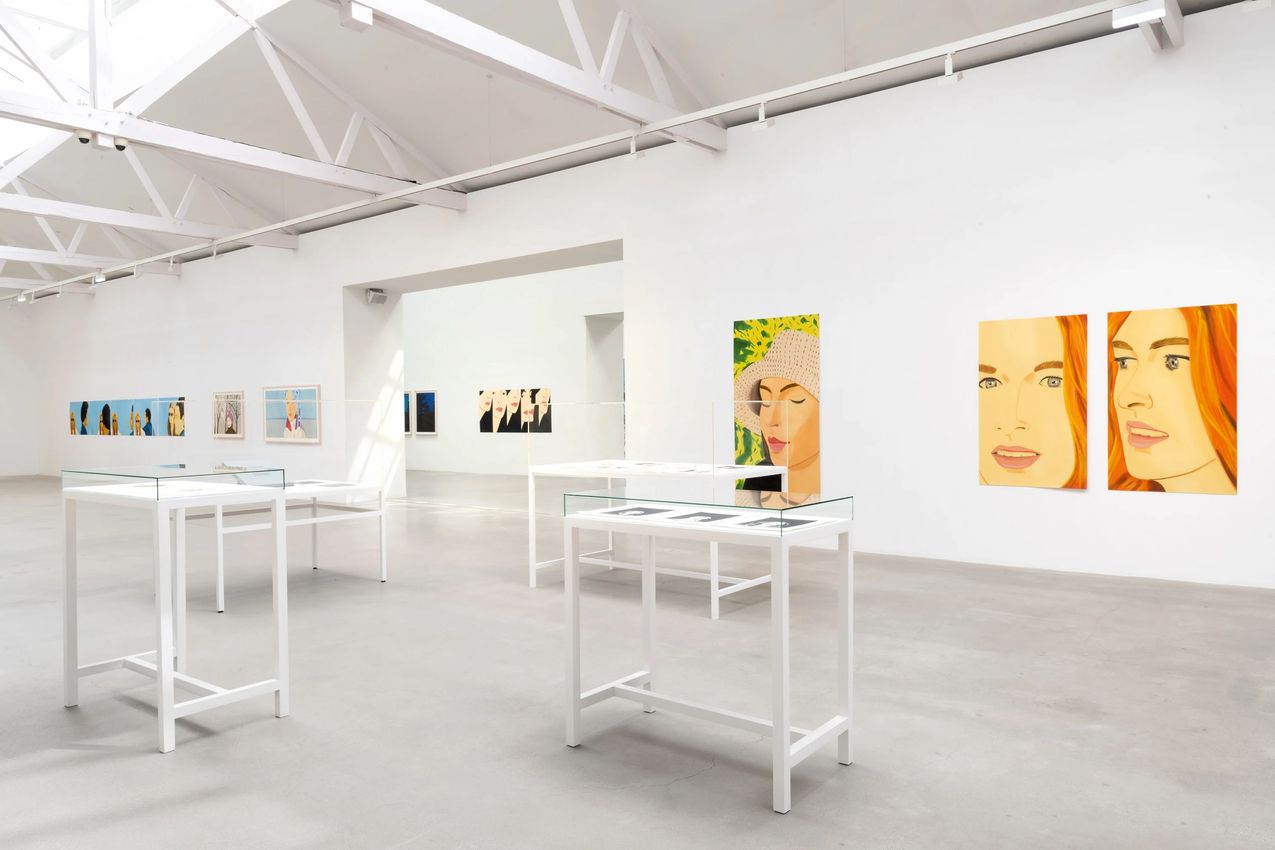
This exhibition at Thaddaeus Ropac Paris Marais brings together prints spanning 60 years of Alex Katz’s career. It is a continuation of the landmark show held at the Pantin gallery earlier this year: the first at the gallery dedicated to the American artist’s printmaking practice. Spanning Katz’s evocative landscapes, his closely cropped, cinematic portraits, as well as a group of early portfolios which testify to the technical experimentation of his printmaking, the exhibition gives visitors an unprecedented retrospective view on the artist’s printing practice. 60 Years of Printmaking coincides with an exhibition of Katz’s recent paintings at the Fondazione Giorgio Cini, Venice, as well as a solo presentation of four of his monumental paintings at the Museum of Modern Art, New York.
This survey of Katz’s printmaking is bookended by defining early prints that shaped the development of the artist’s practice and by arresting works made within the last decade that demonstrate his continuing desire to innovate more than six decades into his career. One of the works on view, Luna Park 1, was the very first print Katz made with a print house in 1965. The artist had begun experimenting sporadically with printmaking in the 1950s, making etchings, linoleum cuts and stencils, before abandoning the medium for a decade, only to return to it in the 1960s, when the Pop Art movement, to which Katz was an important precursor and contributor, was broadening definitions of artmaking to include mechanical reproduction and rendering techniques. As Katz puts it, ‘there was a place in the world for prints’.
Since 1965, printmaking has continuously held an important place at the heart of Katz’s practice, and reveals a more collected, measured side to his artmaking. In his canvases painted from life, often en plein air, in the manner of the Impressionists, he is known for his ability to encapsulate his fleeting impression of a scene through quick, syncopated brushwork and a wet-on-wet technique, where the entire composition must be finished before the first layer has time to dry. The process of making a print, on the other hand, requires more intention and calculation, making for compositions that the artist describes as more ‘stabilised’ than his paintings. As such, printmaking has often served, for the artist, as a means to develop, refine and reflect on the motifs in his paintings.
The works in the exhibition represent familiar imagery from across key facets of his practice, from his characteristic close-up portraits to glinting seascapes and leafy landscapes depicted with defined horizon lines and an extraordinary economy of means. Over the course of the artist’s career, printmaking has also served as a springboard for encountering new technical challenges and, by confronting them, achieving new results. His early experiments in silkscreening, which harnessed the medium’s predisposition to a crisp articulation of forms through two-dimensional expanses of single colours, influenced Katz’s use of planes of flat colour atop monochrome backgrounds in his paintings, which have become characteristic of his style.
From the mid-1960s onwards, Katz increasingly portrayed groups of figures from the social world that surrounded him in New York. Among the works on view is an important grouping of portfolios, dating back as far as the 1970s and 80s, which bear witness to his friendships and long-time collaborations with second-generation New York School artists, poets, choreographers and dancers. The portfolios function like vignettes, both in the graphic sense, with Katz experimenting with ways to dissimulate the hard edges of his aquatints like Francisco Goya before him, and the narrative sense, representing momentary observations of the people around him and demonstrating the artist’s lifelong devotion to depicting scenes of vernacular contemporary American life.
Emerging in the 1950s in New York at the height of Abstract Expressionism, Alex Katz developed a distinctive style that proposed a return to representational art. Katz’s portrait and landscape paintings, characterised by flattened subjects and a bright colour palette, capture the sense of now—a state of being in the moment.

Founded in 1983, Galerie Thaddaeus Ropac has galleries across Europe, in London, Paris and Salzburg, and an expanding team in Asia. Specialising in contemporary art and representing over 60 artists, the gallery supports and showcases the careers of some of the most influential artists today with a wide-ranging programme of over 40 exhibitions each year across its five extensive and historic gallery spaces.
A respected voice in contemporary art discourse.
Focusing on ambitious storytelling and insightful art-world commentary. Ocula Magazine publishes in-depth interviews, critical essays and timely analysis on the artists, exhibitions and ideas driving the global art world.
Learn more about Ocula Magazine
Showcasing the best of the art world.
Ocula partners with galleries from around the world to highlight their artists, artworks and exhibitions. Gallery membership is by application and invitation, with each member vetted by an independent panel.
Learn more about Ocula Membership

Specialises in the sale of major artworks.
Led by a team with deep ties to the world’s leading auction houses, galleries and collectors. Ocula’s advisory team offers bespoke services to high-net-worth clients from around the world who are looking to acquire the best of contemporary and modern art.
Learn more about our team and services