



MAN RAY
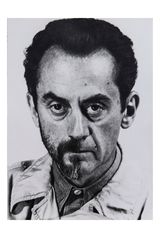
1890-1976, United StatesA trailblazer of modern and contemporary art, Man Ray was a pioneering artist whose radical approach to photography, painting, sculpture and film placed him at the centre of both the Dada and Surrealist movements.
Early Years
Born Emmanuel Radnitzky in Philadelphia and raised in Brooklyn, Man Ray studied drawing and architecture before committing to art full-time. In the early 1910s, he became immersed in New York‘s avant-garde circles, where he met Marcel Duchamp and co-founded the short-lived but influential Dada movement in the United States.
In 1921, Man Ray relocated to Paris, where he quickly became a central figure among the Surrealists and modernist artists, working alongside Duchamp, André Breton, and Lee Miller. He remained in Paris until World War II forced him to return to the United States, only resettling in France permanently in 1951.
Artworks
Man Ray’s artworks span photography, painting, sculpture and film. Known for his experimental approach and conceptual ingenuity, he revolutionised visual culture in the 20th century and remains a major influence in both historical and contemporary art.
Rayographs and Photographic Experiments
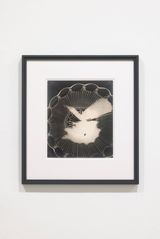
Man Ray’s rayographs—camera-less photographs made by placing objects directly onto light-sensitive paper—are among his most original contributions to contemporary art. First created in 1922, Rayograph (1922) exemplifies this technique, transforming scissors, coils, and other everyday materials into surreal compositions. These artworks embraced chance and abstraction, aligning with the artist’s Dada background while expanding photography beyond documentation into the realm of invention. By stripping away the lens, Man Ray elevated photography to a tool of conceptual play and visual poetry. His rayographs were not only technically innovative but also deeply influential for experimental photographers, galleries and artists working across media.
Iconic Surrealist Images
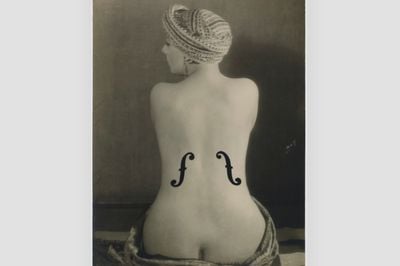
Man Ray’s Surrealist photography introduced radical new ways of seeing the human body and object relations. Le Violon d’Ingres (1924) famously juxtaposes the nude female back with violin f-holes, turning a figure into a musical instrument and referencing Ingres’ classicism with Surrealist wit. Similarly, Glass Tears (1932) presents a close-up of mannequin-like eyes and artificial tears, evoking emotion through fabrication. Noire et blanche (1926) contrasts a model’s pale face with an African mask, challenging Western beauty ideals and the colonial gaze. These artworks became iconic images of 20th-century art and exemplify Man Ray’s ability to fuse aesthetics, eroticism and concept.
Assemblage and Object-Based Art
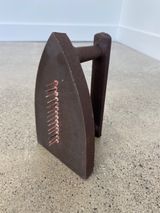
In sculpture, Man Ray subverted expectations through readymade-inspired assemblages that echoed his photographic irreverence. The Gift (1921), produced with Marcel Duchamp’s encouragement, is a flatiron with nails affixed to its base—rendering it unusable and absurd. Object to Be Destroyed (1923), a metronome with a photograph of an eye attached, was later destroyed and remade multiple times, underscoring themes of repetition and volatility. These objects challenged definitions of function, authorship and permanence in art. Their humour and conceptual rigour positioned Man Ray as a precursor to later developments in Pop and conceptual art, as well as installation and performance practices.
Awards and Accolades
- Chevalier de la Légion d’honneur (1975)
- German Photographic Society Cultural award (1966)
- Gold Medal for Photography at the Venice Biennale (1961)
- Prix de l’Académie des Beaux-Arts (1957)
Exhibitions
Man Ray has been the subject of both solo and group exhibitions at important institutions. A selection of important exhibitions are provided below.
Solo Exhibitions
- Man Ray: When Objects Dream, Metropolitan Museum of Art, New York (2025)
- Man Ray: Human Equations, The Phillips Collection, Washington DC (2015)
- Man Ray, National Portrait Gallery, London (2013)
- Man Ray: Unconcerned But Not Indifferent, Jewish Museum, New York (2008)
- Man Ray Retrospective, Centre Pompidou, Paris (1998)
Group Exhibitions
- Inventing Abstraction, Museum of Modern Art, New York (2012–2013)
- Surrealism Beyond Borders, Tate Modern, London and The Met, New York (2021–2022)
- Dada, National Gallery of Art, Washington DC (2006)
- The Art of Assemblage, Museum of Modern Art, New York (1961)
- Cubism and Abstract Art, Museum of Modern Art, New York (1936)
Critical Reception
Man Ray’s practice has been widely covered in leading publications such as Apollo, Artnet News, and Wallpaper*.
Man Ray FAQs
What is Man Ray best known for?
Man Ray is best known for his groundbreaking work in Surrealist and Dada photography, particularly his rayographs—camera-less images that transformed mundane objects into abstract, dreamlike forms. Iconic photographs such as Le Violon d’Ingres (1924) and Glass Tears (1932) established him as a key figure in 20th-century art. His ability to merge conceptual innovation with visual elegance reshaped how photography was understood, moving it beyond documentation into the realm of fine art and influencing generations of artists and photographers.
Did Man Ray only work with photography?
Although photography made him internationally famous, Man Ray’s artistic practice extended far beyond it. He also created paintings, experimental films, assemblage sculptures, and graphic design. Deeply influenced by Dada and Surrealism, he explored ideas of transformation, chance and humour across all media. Works such as The Gift (1921) and Object to Be Destroyed (1923) reflect his contributions to object-based art, while his experimental films such as Le Retour à la Raison (1923) helped expand the language of avant-garde cinema. His multi-disciplinary approach remains central to contemporary art discourse.
What were Man Ray’s influences?
Man Ray’s influences were wide-ranging, combining formal experimentation with intellectual curiosity. He was deeply impacted by the Dada movement’s anti-establishment ethos and the dreamlike logic of Surrealism. Key artistic peers such as Marcel Duchamp, André Breton and Francis Picabia shaped his thinking, as did the poetry of Arthur Rimbaud and the visual innovations of Cubism. He also drew on scientific imagery, African art, and modern fashion. This synthesis of cultural, philosophical, and visual sources gave Man Ray’s work its unique position at the intersection of art, design, photography and contemporary thought.
Ocula | 2025

















Explore and Follow Artists Shaping Contemporary Art
A respected voice in contemporary art discourse.
Focusing on ambitious storytelling and insightful art-world commentary. Ocula Magazine publishes in-depth interviews, critical essays and timely analysis on the artists, exhibitions and ideas driving the global art world.
Learn more about Ocula Magazine
Showcasing the best of the art world.
Ocula partners with galleries from around the world to highlight their artists, artworks and exhibitions. Gallery membership is by application and invitation, with each member vetted by an independent panel.
Learn more about Ocula Membership
Specialises in the sale of major artworks.
Led by a team with deep ties to the world’s leading auction houses, galleries and collectors. Ocula’s advisory team offers bespoke services to high-net-worth clients from around the world who are looking to acquire the best of contemporary and modern art.
Learn more about our team and services