_quase mapa, quase mancha _****___****[almost map, almost stain]_
Anna Bella Geiger’s oeuvre is vast. It is a body of work permeated by pioneering processes and experiences in the field of art that have led the way, building and consolidating powerful artistic poetics over 75 years.
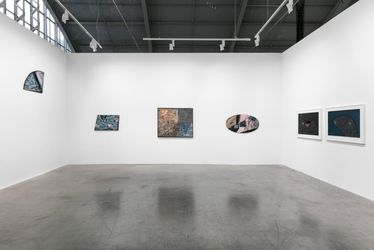
_Quase****mapa, quase****mancha__[AlmostMap, Almost Stain]_ focuses on a daring and little-publicised period within her production developed in the 1980s, which includes works in the media of painting, engraving, and video installation, the latter originally presented at the 16th****Bienalde São Paulo__ in 1981. Historically, this decade is marked in art by a return to painting, which was the hallmark of a generation and was driven by the ideology of the construction of a new concept of the nation after the long years of military dictatorship in the country.
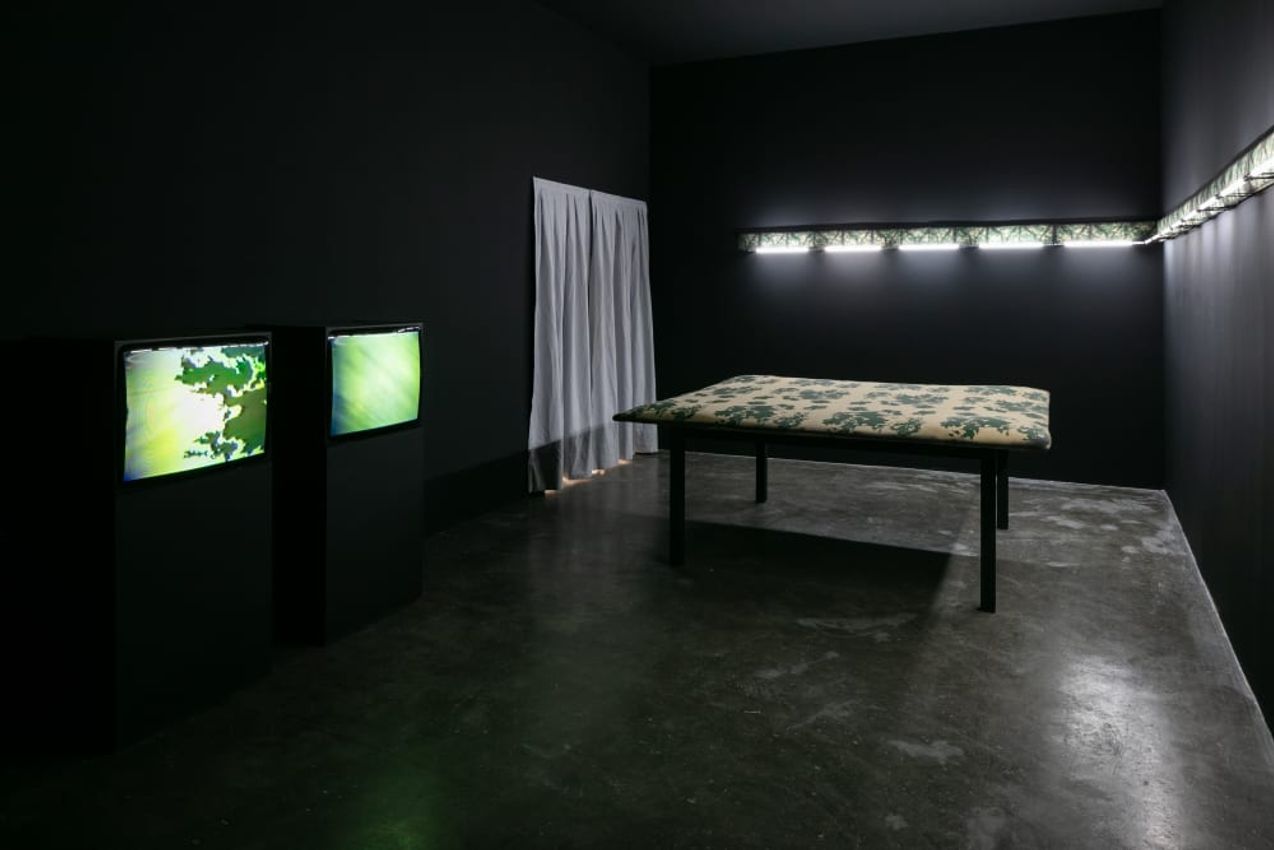
In this period, her work is precisely situated in a fascinating fluctuation between the idea of form and another meaning of representation. This can be seen in the presence of elements in her compositions, often incomprehensible, which play with the relationship between figuration in its most tenuous form, bordering on its absence, a kind of “half map, half camouflagenon-place”¹. The video installation that opens the exhibition already raises these questions: titled _Mesa, frisoe vídeomacios __[Soft Table, Frieze,and Video] _(1981), it is a variant of the artist’s previous work, ___O **PãoNossode cadadia[Our Daily Bread]_(1980), at the** 39thVenice Biennale. Conceived with similar elements, it was developed for the so-called Bienal da Abertura __[Opening Biennial]__, as the _16th Bienalde São Paulo___ became known, after the military dictatorship and the boycott that artists– including Geiger – had carried out since 1969 against Institutional Act No. 5 (AI-5), which strengthened censorship in Brazil.
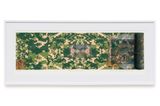
In her installation works, the artist introduces the idea of using upholstery in her production, where we can glimpse a kind of indecipherable territory through the stains and camouflage used in the composition of its surface. We find ourselves in a monothematic space where friezes, tables, and videos are represented by the same pattern of silkscreened and painted shapes on the fabric. We also see silhouettes of clouds, which the artist has transformed into silkscreen clichés, previously used in series of prints and drawings from the 1970s, reflecting on another type of territory that could be freely occupied, or dreamed of being freely occupied, in that historical period, when Brazil was under strong political repression.
Anna Bella Geiger’s work has a history of its own, it speaks for itself and feeds back into experimentation with mediums, elements, materials, and even topics of inquiry. Geiger experienced modern art and its transition to contemporary art in Brazil. She became interested in art at a very young age, at 16 years old, and began her abstract training in engraving and drawing at the studio of Fayga Ostrower in Rio de Janeiro. She lived there with Lygia Pape and Décio Vieira, who also became abstract artists in the 1950s. The artist has a complete body of work that has not lost its essence or inventiveness but has strengthened its experimental character over time, and the installation aspect of her work in this exhibition will penetrate the foundations of her production in this period while inaugurating the space of three-dimensionality in a unique and punctual way.
_Mesa, frisoe vídeo****macios__ (1981) creates the atmosphere of a “secret chamber” similar to Hollywood noir_ films, with its low lighting, friezes that refer to architectural elements from another era in a sinuous territory that can be observed when looking at this table from above, as if it were necessary to create a strategy, with suspense hanging in the air. The videos, on the other hand, are nothing more than records of these camouflages that give body to the other elements, filmed from one side to the other in a close and sinuous way, shaking the camera, taking short breaks, going back and forth in rhythmic movements, with disturbing and unintelligible sounds that remind us of a battlefield as seen from above by an airplane or a satellite. The space puts us, or, rather, provokes us into a state of suspension in which the whole scene produced by the patterns still revolves in the suggestion that they present themselves almost as a map or almost as a stain.
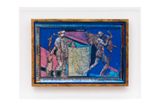
The same will be repeated in other works in the exhibition, such as _NuvensI**_ and Nuvens II (Clouds I & II), from 1978, when she was beginning to develop what would become her iconic** Macios__series – a series of upholstered canvas works mounted on frames of various formats that lose the notion of the vertical and horizontal of traditional canvases – characterising her first experiments developed in a mixture of silkscreen and the use of painting simultaneously on canvas. The need for “speculative, unsettling painting that has reflections of experimentation” ² as a means of production was noticeable among Brazilian artists throughout the 1980s, and Geiger was no different. Since then, the artist has developed a series of paintings in acrylic and oil on canvas and macios (soft surfaces).
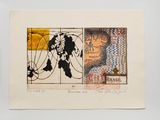
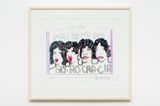
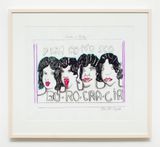
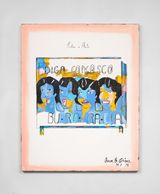
In her paintings, macios, and prints, we can see an aesthetic and chromatic compositional relationship that involves fragmentation to arrive at the whole, the use of stains, camouflage, the overlapping of layers, colours, textures, and volumes, both through the brushstrokes on the canvases and the graphic printing on the prints, which establishes a different perception of abstraction in her work. A production that takes place in “chunks” because if we look at some of the paintings, such as Pier & Ocean III (1985) and Dilúvio__[Deluge]__ (1987), it becomes clear that the artist has faced the blank canvas by dividing it, creating sections within its own surface to develop them or even “solve” them one by one, part by part, culminating in the whole that is presented to us. An attempt to put the fragments in order and question how they fit together in their entirety ³, as the American art critic Dore Ashton would say.
The dilution of the idea of figuration hovers over this proposed selection of works. While there is no abstraction in the traditional sense, there is also no geographical representation, which she continued to explore in her work throughout the 1970s. The works presented here are not based on the guiding principles of her prolific and pioneering work in the so-called Geometric and Informal Abstractionism of the Brazilian avant-garde, which she was able to develop at a very young age in the 1950s and 1960s. Therefore, her composition is based on a different assumption, one that equates both her formal and narrative sides. It is precisely the collision with the pictorial construction of the work in forms, masses of colour, and proportions that are thought in an analytical and sectional way, inviting the viewer to observe the work as a whole.

Anna Bella Geiger is widely acknowledged as one of the most important artists working in Brazil today. A pioneer of video art in the country, she was also one the great exponents of first generation Latin-American conceptual artists. Her trajectory, continuously marked by ruptures and a multiplicity of themes and methods, began in the 1950’s and early 1960’s; chiefly linked to informal abstractionism, these early works prompted an improvised and spontaneous practice, with a rigorous concern for form.


Intellectually rigorous, politically active, and highly conceptual, the programme of contemporary art gallery Mendes Wood DM places an emphasis on critical conversation, working to embrace the individuality of each artist while also supporting the discovery of intersections between practices that might initially seem disparate.

A respected voice in contemporary art discourse.
Focusing on ambitious storytelling and insightful art-world commentary. Ocula Magazine publishes in-depth interviews, critical essays and timely analysis on the artists, exhibitions and ideas driving the global art world.
Learn more about Ocula Magazine
Showcasing the best of the art world.
Ocula partners with galleries from around the world to highlight their artists, artworks and exhibitions. Gallery membership is by application and invitation, with each member vetted by an independent panel.
Learn more about Ocula Membership

Specialises in the sale of major artworks.
Led by a team with deep ties to the world’s leading auction houses, galleries and collectors. Ocula’s advisory team offers bespoke services to high-net-worth clients from around the world who are looking to acquire the best of contemporary and modern art.
Learn more about our team and services