




YAYOI KUSAMA
b. 1930, JapanYayoi Kusama’s body of work draws on highly personal themes and dark inspirations, yet her recurring motifs—polka dots, flowers, pumpkins—are highly accessible, attracting children and families. While early rejection took its toll on Kusama’s mental health, she is now one of the world’s top-selling contemporary artists.
Early Years
Yayoi Kusama was born in Matsumoto, Japan in 1929. Aged 10, she hallucinated that violets in a field were speaking to her—terrified, Kusama turned to drawing as a means of calm. However, her parents were unsupportive of her aims to forge a career in art, preferring that she married and had children. She studied at the Kyoto Municipal School of Arts and Crafts between 1948–1949 but did not envisage a career in Japan, so moved to New York City in 1957.
Yayoi Kusama: Artworks
Kusama’s practice spans painting, drawing, printmaking, installation, film and more, exploring the idea of how treating art as an immersive experience breaks down boundaries between inner and outer worlds, exploring the idea of existence.
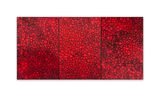
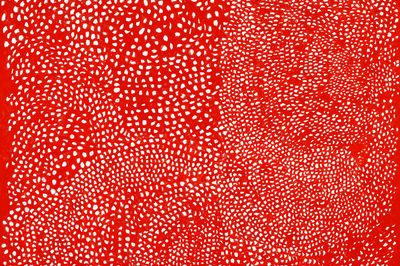
- Kusama began her Infinity Net canvases during the 1950s, whose surfaces are covered by an intricate lattice of paint and where the negative spaces between the patterns can be seen as polka dots.
- Expanding the idea of infinity, Kusama first exhibited an infinity mirror room (Phalli’s Field) in 1965. She progressed this into larger immersive environments, such as Infinity Mirrored Room—Filled with the Brilliance of Life (2012), in which viewers walked on a floating platform above a reflecting pool, and Chandelier of Grief_ (2016), where rotating crystal chandeliers create the idea of a boundless universe.
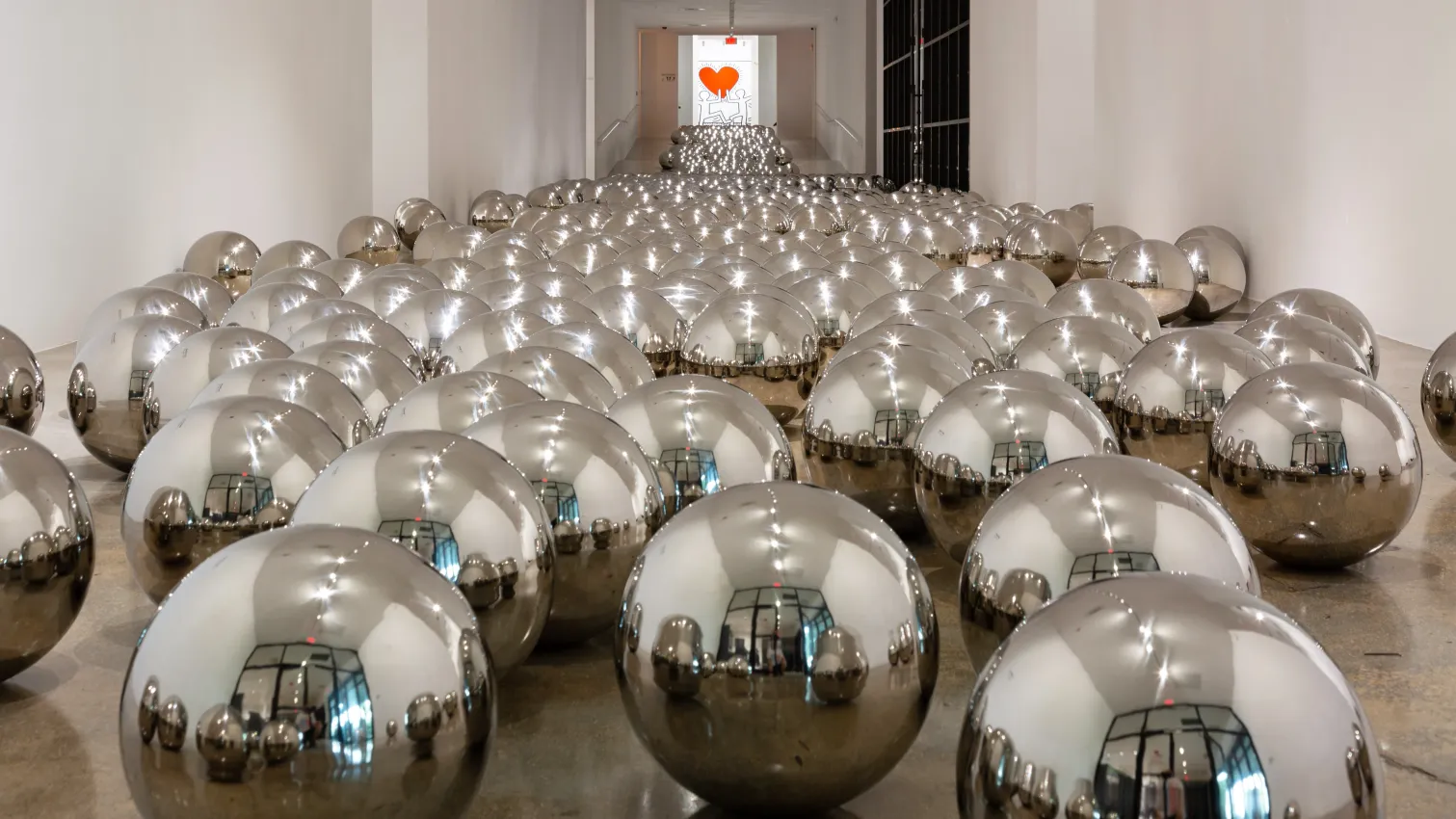
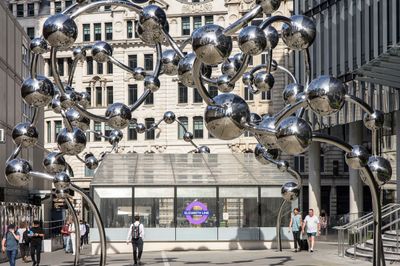
- Kusama suffered at the hands of a male-dominated art world but, in a show of extreme determination, took herself to the 1966 Venice Biennale (she hadn’t been invited) to show Narcissus Garden, 1,500 mirrored balls that she sold off for a few dollars each, highlighting the commercialisation of the art world. The balls’ reflective surfaces distorted the surrounding landscape and reflected viewers’ faces back at them. Although Venice officials stopped her selling the balls, Narcissus Garden has been recreated in installations around the globe.
- Kusama became disillusioned with the US and returned to Japan in 1973, electing to live in a hospital offering art therapy in 1977. She began to make art again, beginning with a darker palette, spraying enamel on to paper (although continuing to feature polka dots)—1978’s Fires on the Beach is just one example.
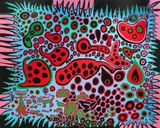
- The My Eternal Soul series (2009–) features more than 800 paintings, bringing cosmic imagery to the fore via a vibrant colour palette.
Yayoi Kusama: Select Awards
- Asahi Prize (2001)
- Ordre des Arts et des Lettres, France (2003)
- Praemium Imperiale, Japan (2006)
- Person of Cultural Merit, Japan (2009)
- Order of Culture, Japan (2016)
Yayoi Kusama: Select Exhibitions
Select Solo Exhibitions
- Yayoi Kusama’s Pop, Yayoi Kusama Museum, Toyko (2026)
- Return to Infinity: Yayoi Kusama, Dallas Museum of Art (2025)
- Yayoi Kusama, National Gallery of Victoria, Melbourne (2024)
- Yayoi Kusama. The Dutch Years 1965–1970, Stedelijk Museum Schiedam (2023)
- Yayoi Kusama: Love is Calling, Institute of Contemporary Art, Boston (2019)
- Yayoi Kusama: Infinity Mirrors, Hirshhorn Museum and Sculpture Garden, Washington DC (and touring) (2017)
- Yayoi Kusama: Infinity Theory, Garage Museum of Contemporary Art, Moscow (2015)
- Yayoi Kusama: I Love Kusama, Ayala Museum, Philippines (2013)
- Yayoi Kusama, Gagosian Gallery, Rome (2011)
- Yayoi Kusama: Solitude of the Earth, Robert Miller Gallery, New York City (2002)
- Yayoi Kusama, Jean Art Gallery, Seoul (2000)
- Yayoi Kusama, Victoria Miro, London (1998)
- Yayoi Kusama, YU Contemporary Art, Yokohama (1995)
- Yayoi Kusama, Galerie Christian Chenau, Paris (1986)
- Yayoi Kusama, Box Gallery, Nagoya (1982)
- Yayoi Kusama: Cage/Painting/Woman, Internationale Galerij Orez, The Hague (1971)
- Yayoi Kusama, Gres Gallery, Washington DC (1960)
- Yayoi Kusama: Recent Works, First Community Center, Matsumoto (1952)
Select Group Exhibitions
- Sixties Surreal, Whitney Museum of American Art, New York City (2025) Miniature Worlds: Joseph Cornell, Ray Jonhson, Yayoi Kusama, Katonah Museum of Art, New York City (2023)
- From the Mundane World: Inaugural Exhibition of He Art Museum, He Art Museum, Guangdong (2020)
- Zero: Let Us Explore the Stars, Stedelijk Museum, Amsterdam (2015)
- Liverpool Biennial (2008)
- Summer of Love, Schirn Kunsthalle, Frankfurt (2005)
- International Triennial of Contemporary Art, Yokohama (2001)
- Taipei Biennial (1998)
- Japanese Culture: the 50 post-war years, Meguro Museum of Art, Tokyo (and touring) (1995) Aeronart (hot air balloon exhibition), Grand Palais, Paris (1990)
- Blam! The Explosion of Pop, Minimalism and Performance 1958–1964, Whitney Museum of American Art, New York City (1984)
- The 1960s—A Decade of Change in Contemporary Japanese Art, National Museum of Modern Art, Tokyo (1981)
- Moscow International Biennale (1977)
Further Reading
- Yayoi Kusama official website
- 2018 interview with BBC News
- Yayoi Kusama’s Instagram
Yayoi Kusama FAQs
Did Yayoi Kusama write to Georgia O’Keeffe?
Yes, during the mid-1950s, Kusama wrote to Georgia O’Keeffe, an artist she admired for advice about becoming an artist in New York City. While O’Keeffe explained that making a living as an artist in the US wasn’t easy, she advised Kusama to come to the States and show her work. It was forbidden to send money from Japan to the USA in 1957, but Kusama sewed dollar bills into her kimono and headed for New York.
Did other artists steal Yayoi Kusama’s ideas?
In New York City in the late 1950s and early 1960s, the art scene (including Pop Art) was incredibly male-dominated. Although Donald Judd and Frank Stella admired her work, other artists gained recognition for ideas inspired by Kusama’s pieces, while she did not. For example, in Accumulation II (1962), Kusama covered a couch with fabric phallic projections she painted with plaster. Claes Oldenburg was inspired by the couch and became famous for soft sculpture. Her 1963 installation Aggregation: One Thousand Boats Show featured wallpaper containing a repeated pattern of her exhibit—Andy Warhol’s cow wallpaper debuted in 1966. In 1965, Kusama’s mirrored-room environment, Phalli’s First was a world’s first in 1965. Only a few months later, Lucas Samaras exhibited a mirrored installation at a more prestigious gallery. Kusama threw herself from the window of her flat.
How does Yayoi Kusama use pumpkins in her work?
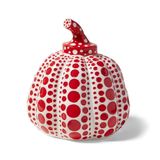
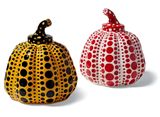
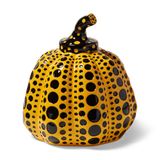
Kusama has painted and sculpted pumpkins, a demonstration of a love that began with a childhood fascination for the plant (she won a prize for a Nihonga painting of pumpkins). 2009’s Imagined Scenery Dotted With Pumpkins acrylic painting sees bright green-and-red forms popping from a pink-and-blue background. Yellow Pumpkin a two-metre sculpture in Naoshima, was rebuilt following typhoon damage in 2021. Pumpkin, her tallest pumpkin to date, was a six-metre-high bronze that stood in London’s Kensington Gardens in 2024.
Does Yayoi Kusama have her own museum?
Yes, the Yayoi Kusama Museum opened in Tokyo in 2017. One floor is dedicated to an infinity-rooom installation called Pumpkins Screaming About Love Beyond Infinity.
Ocula

Explore Yayoi Kusama's Exhibitions On Now






















Yayoi Kusama in Ocula Magazine









Explore and Follow Artists Shaping Contemporary Art
A respected voice in contemporary art discourse.
Focusing on ambitious storytelling and insightful art-world commentary. Ocula Magazine publishes in-depth interviews, critical essays and timely analysis on the artists, exhibitions and ideas driving the global art world.
Learn more about Ocula Magazine
Showcasing the best of the art world.
Ocula partners with galleries from around the world to highlight their artists, artworks and exhibitions. Gallery membership is by application and invitation, with each member vetted by an independent panel.
Learn more about Ocula Membership
Specialises in the sale of major artworks.
Led by a team with deep ties to the world’s leading auction houses, galleries and collectors. Ocula’s advisory team offers bespoke services to high-net-worth clients from around the world who are looking to acquire the best of contemporary and modern art.
Learn more about our team and services