Press Release

Resisting a fixed style, Michel François’s practice unfolds through a sustained engagement with process, material behaviour, and transformation. Spanning sculpture, installation, and—more recently—painting, the works in this exhibition are formally diverse yet connected by recurring concerns: the tension between control and spontaneity, the experience of time and duration, and processes of change, repetition, and contingency.

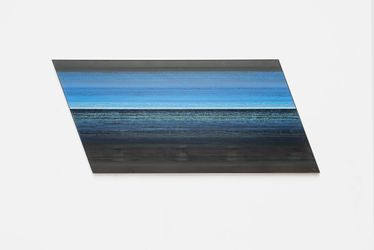
Often emerging from simple gestures—folding, cutting, casting, dripping or bending—François allows chance, instability and impermanence to actively shape his work. He frequently works with utilitarian or industrial materials, including sand, rubber, metal, paper, glass, wax and found objects. In François’s practice, small interventions or adjustments will trigger significant—often transformative —effects that can generate complex meanings. Painting is a relatively new pursuit, one that connects to his late father, an amateur artist who repeatedly painted the same landscape. Reflecting on this act of repetition over time led François to develop his ‘roto’ technique as a reverse response to the endeavour: fast, mechanical, and non-observational, with a horizon endlessly replicated—always the same, yet subtly different; mechanical in process, yet still guided by the artist’s hand.

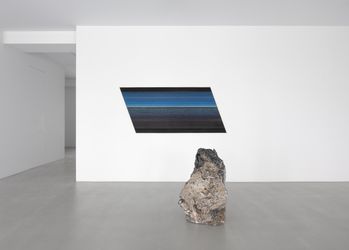
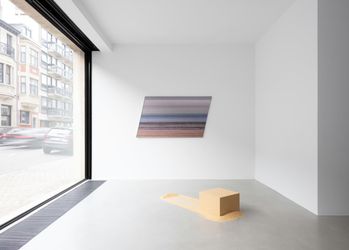
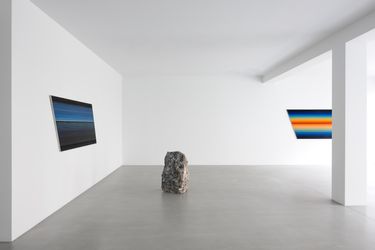
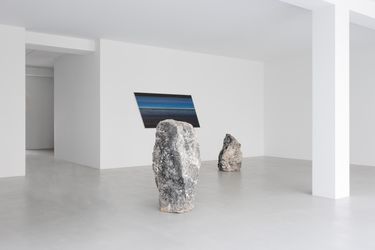
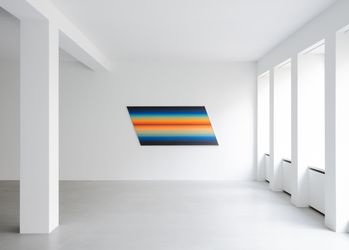
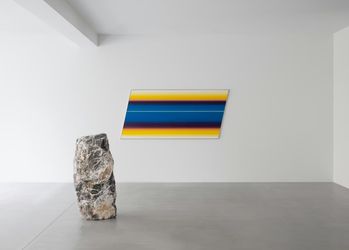
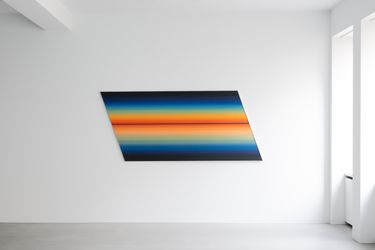
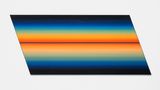
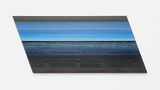
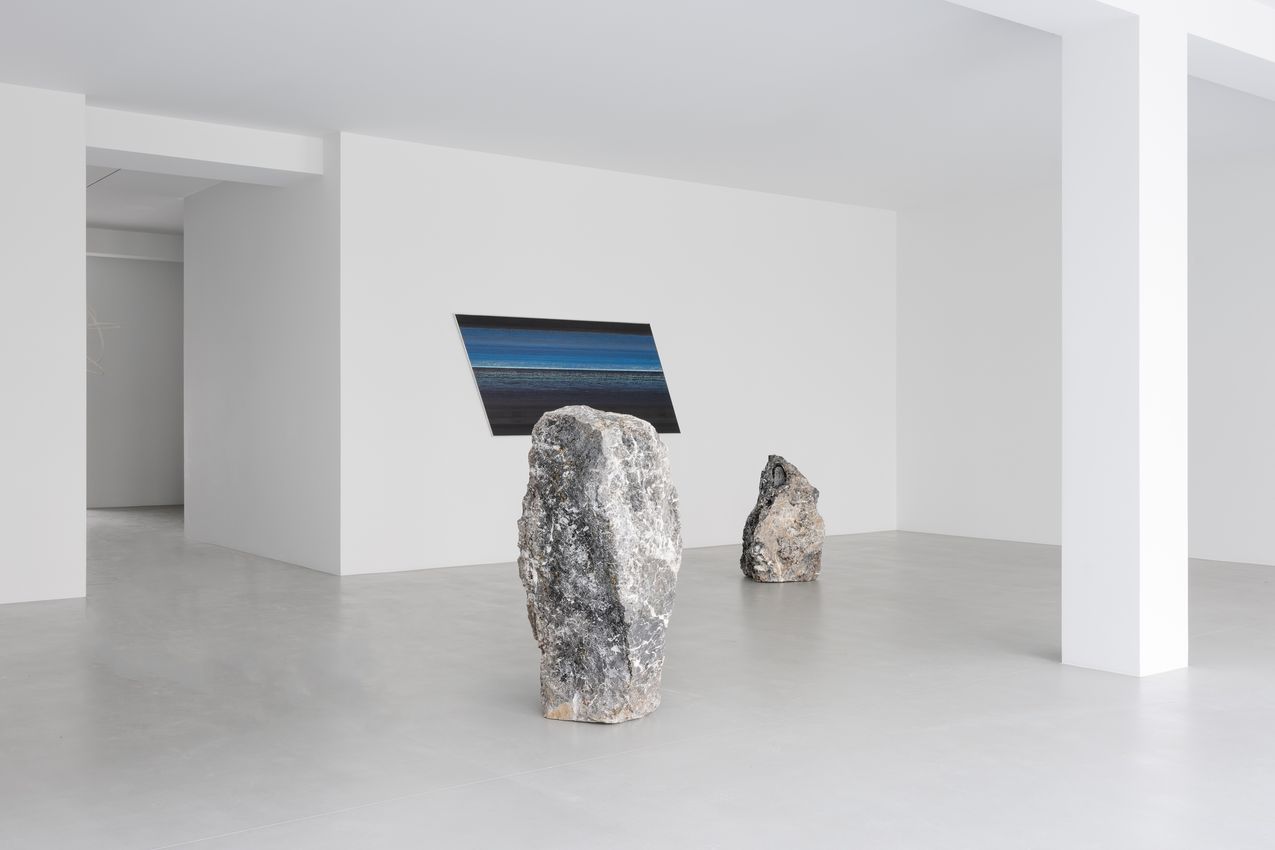
The Rotopaintings are created using a fast-moving machine of the artist’s own design, fitted with industrial sandpaper belts. Unlike conventional painting, where the canvas is static and the artist moves, here the opposite occurs: the surface rotates at high speed, while François remains largely still, briefly touching a stick of oil pigment to the moving surface. Friction produces horizontal bands of colour that accumulate in strata, evoking landscapes and distant horizons, but also bands of static interference. Classical in appearance, the works are generated through relentless motion and erosion: the sandpaper rapidly grinds down the oil stick, visibly consuming the pigment as the image comes into being. Trimmed diagonally along the cutting lines of the industrial sheets, the paintings take the form of parallelograms. Lines—both controlled and uncontrolled—recur throughout François’s oeuvre, and the title Rotopaintings subtly situates the works within a tradition of artists who have used mechanical processes to question authorship, perception and the primacy of the hand, such as Marcel Duchamp’s Rotoreliefs or Piero Manzoni’s Linee.

The Rotopaintings find a material counterpart in To erode (Sand) (2013-2026), the latest iteration in a series of works in which form emerges through erosion and loss. Through a minimal intervention—pushing a compacted cube of sand (itself an anomaly) across the ground—François activates erosion as an inevitable process. Edges soften, matter diminishes, and the geometric, three-dimensional block gradually disintegrates into flat, organic patterns on the floor.

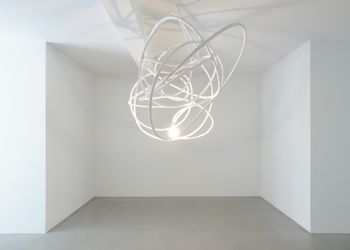
The Scribble (lamp)—an example of an uncontrolled line—transforms an involuntary form into spatial presence: electrical cabling that spools and coils as it falls, evoking both speed and movement, as well as off-the-cuff drawings or scribbles. Its capricious shape stands in sharp contrast to the geometry of the cube and the parallelogram. Here, the arrest of motion creates a subtle doubling: the cable is both the source of the form and literally at its core, running through the hollow plaster from power source to bulb.

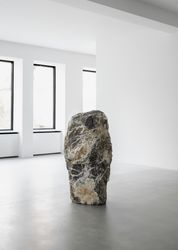
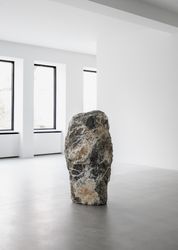
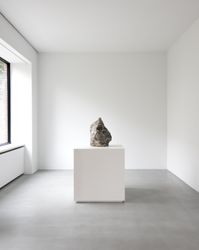
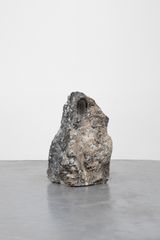
Involuntary forces are also at play in the Yawning Stones (2025), a collaboration between Michel François and the Brussels-based British artist Douglas Eynon (b. 1989). These sculptures take the form of boulders with gaping, mouth-like openings. Partly inspired by Yawning Man (c. 1563), a painting attributed to Pieter Bruegel the Elder in the collection of the Royal Museums of Fine Arts of Belgium (KMSKB), the works also resonate with a long art-historical lineage of yawners, from Messerschmidt and Joseph Ducreux’s Self-Portrait, Yawning (1783) to Degas’s Women Ironing (1884-86). Here, a physiological automatism—the yawn—is translated into an enduring mineral form. Typically lasting only a few seconds, the involuntary gesture is petrified, quite literally, as if arrested mid-motion. Stripped of expression, the yawn becomes a void: an opening that suggests fatigue, boredom and a momentary collapse of agency. The motif has long preoccupied François, who also explored it in the early 1990s in a black-and-white photographic wallpaper. Still not fully understood scientifically, yawning is also cloaked in superstition, largely because it is reflexive, contagious and momentarily unsettling—a brief loss of control that cultures have sought to explain, ward off or ritualise.

Across the exhibition, François consistently draws attention to moments where agency gives way to automatism, form emerges through loss, and images arise from contact rather than control. Movement operates as both a visible and invisible force—simultaneously method and result. It may be fast and vital, as in the _Rotopainting_s and the Scribble (lamp), or slow, as in a yawn or a block of sand pushed across the floor. A subtle irony ripples throughout the exhibition, particularly where speed or stillness generate opposing dynamics. Stone yawns, sand erodes, pigment disappears. Through these processes, the artist invites contemplation of vitality and enervation, duration, and the transformations—both fleeting and protracted—that shape bodies and matter alike.

Michel François (b. 1956, Saint-Trond, Belgium) lives and works in Brussels. In 1999, he represented Belgium at the 48th Venice Biennale with Ann Veronica Janssens. Recent museum exhibitions include Contre Nature, BOZAR, Brussels (2023); Panopticon, Yarat Contemporary Art Centre, Baku (2022); Pièce à conviction, Middelheim Museum, Antwerp (2016); Nineteen thousand posters. 1994-2016, Mac’s Grand Hornu (2011) and Frac île-de-France (2016); Plans d’évasion, SMAK, Ghent and Iac Vileurbanne (2009-10); Salon Intermédiaire, Centre Pompidou, Paris (2002); La Plante en nous, Haus der Kunst, Munich (2000); Kunsthalle Bern (2000) and Documenta IX (1992).

Read More

Installation Views

Exhibition view: Michel François, Rotopaintings And Yawning Stones, Xavier Hufkens (12 February–25 April 2026). Courtesy Xavier Hufkens.
Exhibition view: Michel François, Rotopaintings And Yawning Stones, Xavier Hufkens, Brussels (12 February–25 April 2026). Courtesy Xavier Hufkens.
Exhibition view: Michel François, Rotopaintings And Yawning Stones, Xavier Hufkens (12 February–25 April 2026). Courtesy Xavier Hufkens.
Exhibition view: Michel François, Rotopaintings And Yawning Stones, Xavier Hufkens, Brussels (12 February–25 April 2026). Courtesy Xavier Hufkens.
Exhibition view: Michel François, Rotopaintings And Yawning Stones, Xavier Hufkens (12 February–25 April 2026). Courtesy Xavier Hufkens.
Exhibition view: Michel François, Rotopaintings And Yawning Stones, Xavier Hufkens, Brussels (12 February–25 April 2026). Courtesy Xavier Hufkens.
Exhibition view: Michel François, Rotopaintings And Yawning Stones, Xavier Hufkens (12 February–25 April 2026). Courtesy Xavier Hufkens.
Exhibition view: Michel François, Rotopaintings And Yawning Stones, Xavier Hufkens, Brussels (12 February–25 April 2026). Courtesy Xavier Hufkens.
Exhibition view: Michel François, Rotopaintings And Yawning Stones, Xavier Hufkens (12 February–25 April 2026). Courtesy Xavier Hufkens.
Exhibition view: Michel François, Rotopaintings And Yawning Stones, Xavier Hufkens, Brussels (12 February–25 April 2026). Courtesy Xavier Hufkens.
About the Artist

Michel François is a conceptual artist and makes sculptures, videos, photographs, printed matter (posters and newspapers), paintings and installations. He claims no signature style but creates a web of shifting connections between his works and in each different exhibition. The titles of his solo exhibitions often point to his interest in contemporary reality, offices, domestic environments, surveillance, psychology and the police state. To cite just a few: State of Being, Urban Placarding, Expanded Bureau, Déjà vu, Theatre of Operations and Pieces of Evidence. The meanings in his works accumulate over time and vary according to their disposition in space, or the context. In a manner similar to that of the Arte Povera artists, François uses great economy of means to transform seemingly uncomplicated objects and materials, or traces of past events, into deeply resonant carriers of meaning. His work can be seen as exploration of cause and effect, and the ways in which simple gestures can change the status of an object or have important consequences. A number of recent sculptural works, without immediately revealing their origins or the way they were made, invite the viewer to consider the degree to which the hand of the artist, or chance, played a role in their formation. His lace-like wall sculptures, for example, are the result of the thermic shock provoked by pouring molten bronze onto a cold floor. He also collects drawings and transforms them into sculptures known as Scribbles.

View Artist Profile

Also Exhibiting at Xavier Hufkens

About the Gallery
Xavier Hufkens is one of Europe’s leading galleries for contemporary art. Located in Brussels, the gallery maintains a diverse exhibition programme with solo exhibitions of the gallery artists as well as group exhibitions and special projects. The gallery deals in a distinctive combination of painting, drawing, sculpture, photography, video and installation-based work.

The origins of the gallery date back to 1987, when Xavier Hufkens opened a gallery space in an un-refurbished warehouse in the neighbourhood of the South Station (Midi) in Brussels. During the early years, the focus of the gallery was upon mid-career and emerging artists and the gallery is known for having introduced some of the most influential contemporary artists to Brussels at a time when they were still relatively unknown. British sculptor Antony Gormley, who is still affiliated with the gallery, Felix Gonzalez-Torres and Rosemarie Trockel all showed in Belgium for the first time with Xavier Hufkens (Gormley in 1987; Gonzalez-Torres in 1991 and Trockel in 1993).

In 1992, the gallery moved to a 19th-century townhouse at 6 rue Saint-Georges, close to the Avenue Louise. Completely renovated by Belgian architects Paul Robbrecht, Hilde Daem and Marie-José Van Hee, the house quickly gained a reputation for being not just one of the most beautiful contemporary art spaces in the Belgian capital, but also one of the most interesting. The expanded exhibition programme coincided with the additional representation of a number of established artists from Belgium and abroad, including Richard Artschwager, Thierry De Cordier and Jan Vercruysse. In 1997, Hufkens expanded the gallery further by annexing the adjacent building and a number of new artists joined the gallery, including Louise Bourgeois, Roni Horn and Thomas Houseago.

A second space in the same street, at 107 rue Saint-Georges, opened in spring 2013. Located in the Galerie Rivoli, a mixed-use commercial development from the 1970s, the new gallery space was designed by Swiss architect Harry Gugger, who was previously in partnership with Herzog and De Meuron. Slegten & Toegemann, Brussels, managed the project.

An eclectic but very clear vision underpins all of the gallery’s activities: ‘The definition of the gallery was established from the start. The common thread, then and now, is quality over and above everything else, which I find more intellectually challenging than a forced definition. From the early days I juxtaposed established artists such as Michelangelo Pistoletto with someone like Felix Gonzalez-Torres when he was totally unknown. Today I still mix my work: I have no problem showing Malcolm Morley … alongside Robert Ryman, or Willem de Kooning.’ [Xavier Hufkens in The Art Newspaper, Issue 220, January 2011, published online: 20 January 2011]

Xavier Hufkens represents some thirty artists from different generations. He was part of the six-member selection committee for Art Basel during seven years and also participates in up to five international Arts Fairs annually. The gallery has partnerships with the estates of Louise Bourgeois, Willem de Kooning, Robert Mapplethorpe and Alice Neel.
View Gallery Profile
Address
44 rue Van Eyck
Van Eyckstraat
Brussels
Belgium
Opening Hours
Tuesday – Saturday
11am – 6pm
(1)
Brussels 44 rue Van Eyck, Van Eyckstraat
Xavier Hufkens
44 rue Van Eyck, Van Eyckstraat, Brussels, Belgium

Opening hours
Tuesday – Saturday
11am – 6pm
The art world in focus