





PIERRE HUYGHE
b. 1962, FrancePierre Huyghe is a pioneering French contemporary artist whose transformative installations have redefined the possibilities of contemporary art, earning him major accolades such as the Hugo Boss Prize at the Guggenheim Museum. His practice, which explores the semiotics of images, and the intersection of fiction and reality through film, sculpture and public interventions, is celebrated for its integration of living systems, technology and speculative forms.
Huyghe has held major retrospectives at important institutions, such as Centre Pompidou and Los Angeles County Museum of Art, and in 2024, he received the esteemed Grand Prix Artistique by the Fondation Simone et Cino Del Duca.
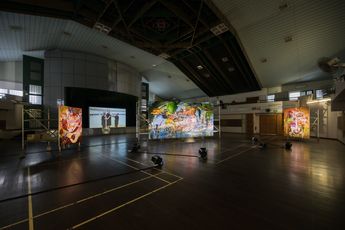
In 2019, Huyghe was the artistic director for the Okayama Summit. In an interview in Ocula Magazine with Stephanie Bailey discussing his approach, Huyghe explained that he chose ‘artists who construct worlds that have the capacity to endlessly change, rather than as makers of things’.
Early Years
Pierre Huyghe was born in Paris in 1962 and studied at the École nationale supérieure des Arts décoratifs, graduating in 1985. Early in his life, he began experimenting with conceptual art, exploring cinematic structures and the boundaries between reality and artifice. Huyghe lives and works between New York, Paris, and Santiago de Chile. His innovative approach was evident by the 1990s, as he became recognised for his challenging of conventional exhibition formats and art forms.
Pierre Huyghe Artworks
Pierre Huyghe’s artworks blur the lines between fiction and reality, incorporating film, sculpture, living organisms, and technology to create dynamic, often self-regulating environments. His practice probes how social rituals, memory, and spectacle shape contemporary experience. Huyghe is especially known for ‘the innovation of the ‘post-production’ technique”, wherein he manipulates and re-contextualises pre-existing material from mass media to interrogate meaning and narrative’.
Early Film Works and ‘Post-Production’ (1990s–2000s)
Notable early projects include L’Ellipse (1998), which reconstructs a narrative gap in Wim Wenders’ The American Friend, and The Third Memory (2000), blending fact and fiction by re-enacting and reframing a scene from the film Dog Day Afternoon. These works use cinema as a tool to question our processes of remembering and interpreting reality.
Living Systems, Public Interventions, and Performances
From the 2000s, Huyghe delved further into ‘living systems’ — installations intentionally open to change, incorporating plants, insects, animals and humans, often indifferent to the presence of witnesses. A Journey That Wasn’t (2005–06), commissioned by Public Art Fund, combined an Antarctic expedition, a Central Park performance, and a Whitney Biennial video installation, highlighting Huyghe’s signature hybridisation of real and staged events.
The Host and the Cloud (2009–2010) is a feature-length film and installation centring on a Parisian museum closed to the public, in which actors embody a range of social rituals within a living scenario—exploring psychological states, collective memory, and role-play.
Major Exhibitions and Site-Specific Projects
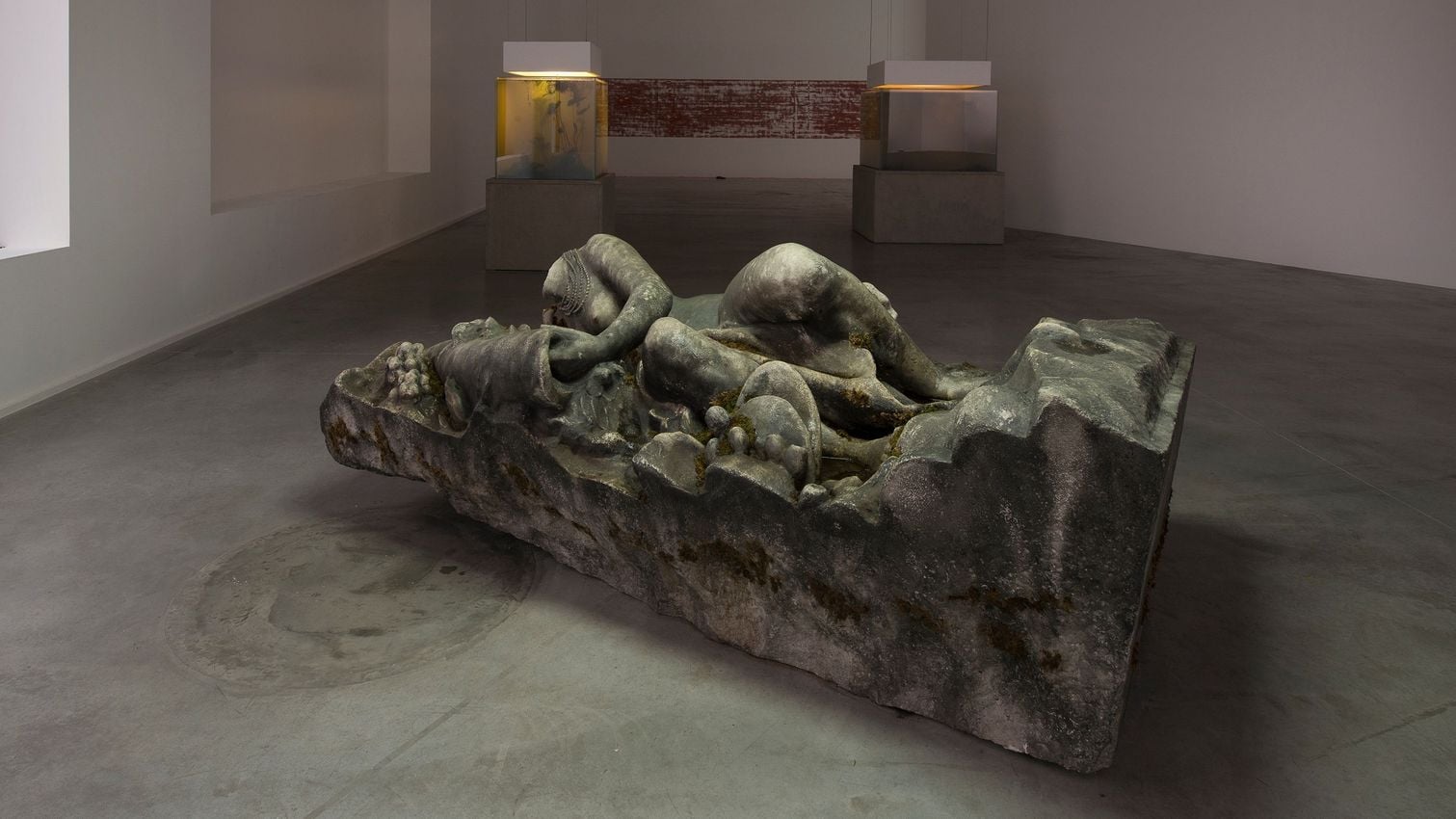
A major retrospective, Pierre Huyghe, travelled from Centre Pompidou, Paris to Museum Ludwig, Cologne, and Los Angeles County Museum of Art (2014–15), solidifying his international reputation. In 2015, the Metropolitan Museum of Art, New York, commissioned Rite Passage for its Roof Garden—a complex landscape integrating living organisms with sculptural fragments and architecture. Huyghe’s practice has continued to evolve with UUmwelt (Serpentine Gallery, 2018), a collaboration between artificial intelligence and organic life, and the aquarium-centred Variants (Kistefos Museum, 2022).
In 2025, Huyghe’s major solo exhibition Liminal at Leeum Museum of Art, Seoul, his first in Asia, foregrounded his ‘continuously evolving systems’ and collaborative works with machines and biological entities. The exhibition highlighted Huyghe’s artistic exploration over the past decade, including works co-commissioned with Punta della Dogana of the Pinault Collection. Presenting a total of 12 works, including new pieces such as Liminal (2024-ongoing), Camata (2024-ongoing), and Idiom (2024-ongoing), as well as the artist’s renown works Human Mask (2014), Offspring (2018), and the aquarium series, the exhibition also introduced other works generated through collaboration between humans and machines, such as UUmwelt-Annlee (2016-2025) and Cancer Variator (2016).
Select Public Commissions, Awards and Other Accolades
- Grand Prix Artistique, Fondation Simone et Cino Del Duca, 2024
- Artistic Director, Okayama Art Summit, 2019
- Nasher Prize, Nasher Sculpture Center, Dallas, 2017
- Kurt Schwitters Prize, Sprengel Museum Hannover, 2015
- Rite Passage (2015), Roof Garden Commission, Metropolitan Museum of Art, New York
- Roswitha Haftmann Award, Switzerland, 2013
- Smithsonian Museum’s Contemporary Artist Award, 2010
- A Journey That Wasn’t (2005–06), Public Art Fund and Whitney Biennial, New York
- Hugo Boss Prize, Solomon R. Guggenheim Museum, 2002
- Special Award, Jury of the 49th Venice Biennale, 2001 (representing France)
- DAAD Artist-in-Berlin Grant, 1999–2000
Exhibitions
Pierre Huyghe has been the subject of both solo and group exhibitions at leading galleries and institutions. Below is a selection of important exhibitions.
Solo Exhibitions
- 2025 — Liminal, Leeum Museum of Art, Seoul
- 2024 — Liminal, Punta della Dogana – Pinault Collection, Venice
- 2023 — Chimeras, EMMA – Espoo Museum of Modern Art
- 2022 — Variants, Kistefos Museum, Jevnaker
- 2018 — UUmwelt, Serpentine Gallery, London
- 2015 — Rite Passage, Roof Garden Commission, Metropolitan Museum of Art, New York
- 2014–2015 — Pierre Huyghe, Los Angeles County Museum of Art; Museum Ludwig, Cologne; Centre Pompidou, Paris
- 2010–2012 — After ALife Ahead, various institutions
- 2006 — Tate Modern, London
Group Exhibitions
- Baltic Triennial 13, Kim? Contemporary Art Centre, Riga and Contemporary Art Centre, Vilnius, 2018
- Documenta 11, Kassel, 2002
- The Whitney Biennial, New York, multiple years
- Centre Georges Pompidou, Paris
More Reading
Ocula Magazine interviewed the artist in 2019.
Pierre Huyghe FAQs
Where can I see Pierre Huyghe’s artworks?
Pierre Huyghe’s artworks are included in major international collections such as the Museum of Modern Art (New York), Art Institute of Chicago, Los Angeles County Museum of Art, Carnegie Museum of Art (Pittsburgh), and Glenstone (Potomac, Maryland). Notable institutional displays and retrospectives have been held at Centre Pompidou, Museum Ludwig, LACMA, Metropolitan Museum of Art (New York), and at Leeum Museum of Art, Seoul.
What is distinctive about Pierre Huyghe’s art?
Pierre Huyghe’s work stands out for its complex, evolving ecosystems. His art frequently integrates biological, technological, and inanimate elements in hybrid installations that react and change over time, inviting viewers to encounter art as a living, open-ended process rather than a static object.
What are Pierre Huyghe’s most important works or series?
Significant projects include L’Ellipse (1998), The Third Memory (2000), A Journey That Wasn’t (2005–06), The Host and the Cloud (2009–2010), Untitled (Human Mask) (2014), UUmwelt (2018), and Liminal (2024–ongoing).
How did Pierre Huyghe start his career as an artist?
After graduating from École nationale supérieure des Arts décoratifs in 1985, Huyghe began to question the construction of narrative and the authority of images in contemporary art, leading to early recognition in the 1990s and participation in high-profile exhibitions across Europe and the United States.
What awards has Pierre Huyghe received?
Pierre Huyghe has won numerous prestigious awards including the Grand Prix Artistique (Fondation Simone et Cino Del Duca), Nasher Prize, Hugo Boss Prize, Roswitha Haftmann Award, and a Special Award at the Venice Biennale.
Are there any interesting facts about Pierre Huyghe?
Huyghe is recognised as a leading influence in the development of post-production art, and often introduces living animals or biological systems as core components of his installations. He has also served as the Artistic Director of the Okayama Art Summit. Huyghe’s work has inspired new directions in the development of exhibition as a living, mutable entity
How do you pronounce Pierre Huyghe’s name?
Pierre Huyghe is pronounced ‘Pierre Hweeg’
Ocula | 2025


















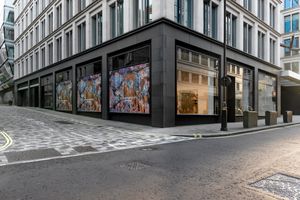
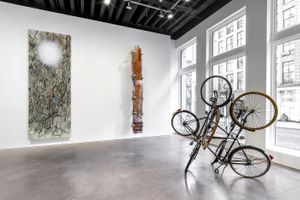
Explore Pierre Huyghe's Exhibitions





Pierre Huyghe in Ocula Magazine







Explore and Follow Artists Shaping Contemporary Art
A respected voice in contemporary art discourse.
Focusing on ambitious storytelling and insightful art-world commentary. Ocula Magazine publishes in-depth interviews, critical essays and timely analysis on the artists, exhibitions and ideas driving the global art world.
Learn more about Ocula Magazine
Showcasing the best of the art world.
Ocula partners with galleries from around the world to highlight their artists, artworks and exhibitions. Gallery membership is by application and invitation, with each member vetted by an independent panel.
Learn more about Ocula Membership
Specialises in the sale of major artworks.
Led by a team with deep ties to the world’s leading auction houses, galleries and collectors. Ocula’s advisory team offers bespoke services to high-net-worth clients from around the world who are looking to acquire the best of contemporary and modern art.
Learn more about our team and services