






SAÂDANE AFIF
b. 1970, FranceSaâdane Afif is a Berlin-based conceptual artist whose installations, performances, and ongoing text-and-music projects probe authorship, interpretation, and the circulation of artworks through institutions and popular culture. In 2026, influential gallerist Esther Schipper announced her representation of Afif, who joined a roster that includes artists such as Pierre Huyghe, Philippe Parreno, Dominique Gonzalez-Foerster, Angela Bulloch, and Ryan Gander, consolidating his position at the centre of European conceptual and post-conceptual art; he is represented by Esther Schipper in collaboration with Mehdi Chouakri.
Opening in 2025 and running into 2026, Saâdane Afif: Five Preludes at Hamburger Bahnhof — Nationalgalerie der Gegenwart in Berlin marks the artist’s first institutional solo exhibition in the city, foregrounding his long-term archival project alongside works that scrutinise the museum and the idea of authorship. In 2009, Afif received the Prix Marcel Duchamp for his contribution to contemporary conceptual art, cementing his reputation as one of the leading French artists of his generation.
Early years and Background
Saâdane Afif was born in 1970 in Vendôme, France, and studied at the École nationale supérieure d’art de Bourges, where he received his diploma in 1995. He completed a postgraduate degree at the École supérieure des beaux-arts de Nantes in 1998, before undertaking residencies at Villa Arson, Nice, and the French Academy in Glasgow in the early 2000s.
Since 2003, Afif has lived and worked in Berlin, where he has developed a practice that moves fluidly between installation, sculpture, performance, text, and sound. His Franco-Algerian background and mobility between France and Germany underpin an interest in how artworks travel between contexts such as museums, biennials, record sleeves, posters, and printed matter.
Saâdane Afif Artworks
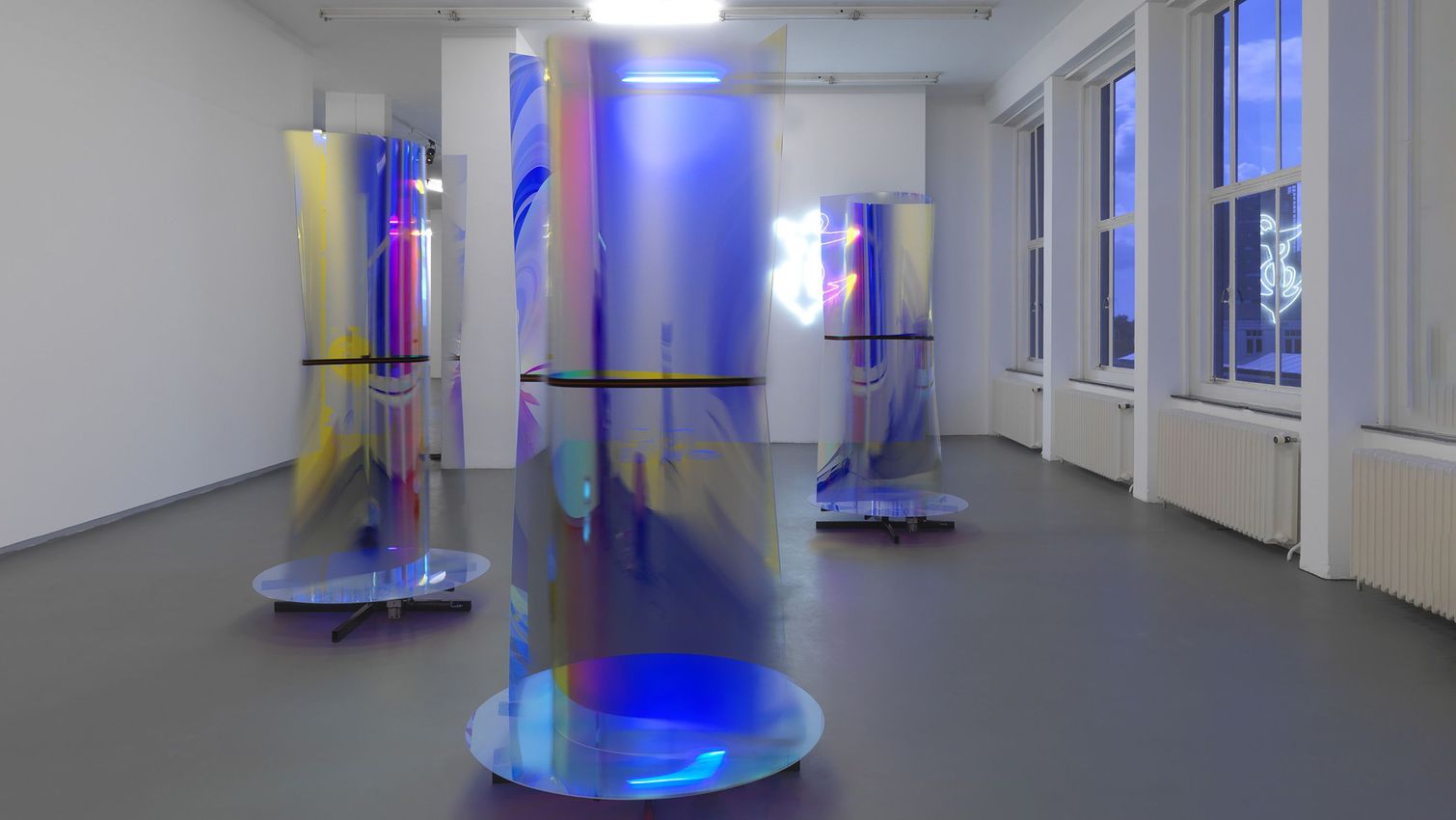
Saâdane Afif is often described as a post-conceptual artist whose work centres on interpretation, exchange, and circulation, using diverse media including objects, neon, posters, lyrics, and live music. He frequently collaborates with writers, musicians, and designers, commissioning song lyrics and other responses to his works to question the notion of the singular artwork and the individual author in contemporary art.
Saâdane Afif’s ‘Lyrics’, songs, and delegation
Since the mid-2000s, Afif has systematically invited authors to write lyrics based on his artworks, providing them with detailed descriptions—titles, forms, contexts, and intentions—and asking that the songs retain the original titles. These lyrics are exhibited in place of conventional wall labels and are subsequently handed to musicians, who compose songs that are played in the gallery or released on CD, extending the work into music culture.
This strategy of delegation allows Afif to construct expansive networks of collaborators while undermining fixed ideas of authorship and originality, as each artwork generates further interpretations, performances, and recordings. Critics have linked his approach to post-conceptual practices and institutional critique, noting how his projects stage the circulation of images, objects, and texts across different cultural formats.
Saâdane Afif’s ‘The Fountain Archives’
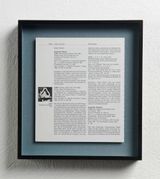
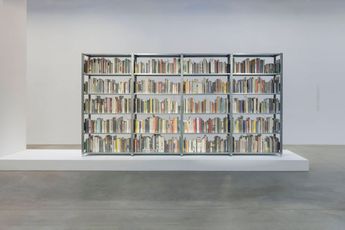
One of Afif’s most significant long-term works is The Fountain Archives (initiated 2008), an evolving project built around reproductions of Marcel Duchamp‘s Fountain (1917) in books, catalogues, and magazines, which he collects, annotates, and reframes as a vast image archive. From each publication he tears out the page containing the reproduction, frames it as a work, and keeps the amputated books on shelves, turning them into a silent archive that mirrors the life of the image in print.
In 2025, Hamburger Bahnhof — Nationalgalerie der Gegenwart in Berlin opened the exhibition Saâdane Afif: Five Preludes, the artist’s first institutional solo exhibition in the city, bringing together this project alongside other works that scrutinise the museum and the concept of authorship. The core installation of The Fountain Archives at Hamburger Bahnhof was made possible by a major gift from collector Paul Maenz in 2023, underscoring the work’s status within recent art-historical debates on Duchamp’s legacy.
Afif’s institutional exhibition history also includes solo shows at Centre Pompidou, Paris (2010), Museum für Moderne Kunst, Frankfurt am Main (2012), WIELS, Brussels (2018), and Kunsthalle Wien (2018), as well as participation in the 56th Venice Biennale in 2015 and the 8th Berlin Biennale in 2014.
Select Public Commissions
While Afif often works with existing institutional frameworks, publications, and music labels rather than conventional outdoor commissions, his projects regularly unfold in public contexts such as biennials and large-scale institutional exhibitions that reach broad audiences.
Select Awards and Accolades
- 2009 — Prix Marcel Duchamp, Paris, awarded to Saâdane Afif for his contribution to contemporary conceptual art.
- 2012 — ARTE Prize for a European Artist, honouring his interdisciplinary practice.
- 2022 — Artistic Director of the Bergen Assembly triennial in Norway, invited to curate and shape the international exhibition and programme.
To be kept up to date with news relating to Saâdane Afif, follow him on Ocula.
Saâdane Afif Exhibitions
Saâdane Afif has been the subject of numerous solo and group exhibitions at major museums, biennials, and galleries in Europe and beyond. To be kept up to date with upcoming exhibitions featuring Afif, follow him on Ocula; you can also view his exhibitions on Ocula.
Select solo exhibitions
- 2025—2026 — Saâdane Afif. Five Preludes, Hamburger Bahnhof — Nationalgalerie der Gegenwart, Berlin.
- 2018 — Paroles and related projects, WIELS Contemporary Art Centre & Kunsthalle Wien, Brussels and Vienna.
- 2013 — Blue Time, Blue Time, Blue Time..., Institut d’art contemporain, Villeurbanne/Lyon.
- 2012 — Solo exhibition, Museum für Moderne Kunst (MMK), Frankfurt am Main.
- 2010 — Solo exhibition, Centre Pompidou, Paris.
Select group exhibitions and Biennials
- 2026 — Winter 2026, group exhibition including Saâdane Afif, Esther Schipper, Berlin.
- 2016 — Scores, concert and exhibition project, Hamburger Bahnhof, Berlin.
- 2015 — All the World’s Futures, 56th International Art Exhibition, Venice Biennale, Venice.
- 2015 — 6th Moscow Biennale of Contemporary Art, various venues, Moscow.
- 2014 — 8th Berlin Biennale, Là-bas, various venues, Berlin.
- 2013 — Sharjah Biennial 11, Sharjah Art Foundation, Sharjah.
Sign up to Ocula to follow Saâdane Afif and learn more about Saâdane Afif’s art for sale.
Saâdane Afif FAQs
Who is Saâdane Afif?
Saâdane Afif is a French conceptual and installation artist, born in 1970 in Vendôme and based in Berlin, whose work combines visual art with text, music, and performance to question authorship and the institutional circulation of artworks. His practice is driven by ideas of interpretation, authorship, and how artworks circulate through language, music, and institutions.
You can follow Saâdane Afif on Ocula to learn more about his work, find out about art for sale, contact his galleries, and keep up to date with upcoming exhibitions.
What ideas underpin Saâdane Afif’s work?
Saâdane Afif’s practice is grounded in a post-conceptual approach that treats artworks as starting points for new texts, songs, and performances rather than fixed objects. He frequently delegates production to writers, musicians, and performers, inviting them to create lyrics or texts based on his works, which are then shown instead of conventional labels, unsettling the notion of a single, authoritative author. His projects often explore how meaning is produced collectively as artworks move through different formats—books, records, posters, performances, and institutional displays—highlighting the systems and infrastructures that shape what art is, how it is narrated, and who gets to speak about it.
Describe Saâdane Afif’s work ‘The Fountain Archives’?
Saâdane Afif’s The Fountain Archives (initiated 2008) is a long-running project in which he collects publications that reproduce Marcel Duchamp’s 1917 readymade Fountain. From each book, catalogue, or magazine, he carefully tears out the page containing the reproduction, frames it as a work (each titled FA plus an inventory number), and stores the ‘ruined’ books on shelves in his studio and installations. The project has grown into a monumental archive comprising hundreds of framed pages and over a thousand publications, which are displayed on industrial bookshelves that themselves read as a kind of sculptural readymade; as the project develops, some pages reappear in new catalogues as reproductions of Afif’s work, creating a recursive ‘archive within the archive’ in which Fountain and its copies feed into Afif’s own oeuvre.
What ideas does Saâdane Afif’s ‘The Fountain Archives’ explore?
Saâdane Afif’s The Fountain Archives examines how a canonical artwork like Marcel Duchamp’s Fountain is kept alive through endless reproduction, commentary, and debate, shifting attention from Duchamp’s object to the vast narrative that has grown around it. By isolating and reframing reproduced images of Fountain, Afif reveals the multiplicity of viewpoints—curatorial, academic, journalistic—that together sustain the work as a cornerstone of art history and theory.
The project also tests where authorship resides: each framed page is both Duchamp and not-Duchamp, both documentary illustration and autonomous artwork, both archive item and exhibition object. Through this double status, Afif shows how art can generate multiple stories, with The Fountain Archives acting as a mould that captures the otherwise invisible life an artwork leads in print and discourse.
How does ‘The Fountain Archives’ relate to Saâdane Afif’s wider practice?
Like Saâdane Afif’s ‘lyrics’ projects, The Fountain Archives turns secondary material—reproductions and commentary—into primary artistic content, continuing his interest in delegation and translation between media. The archive extends his broader strategy of working through existing cultural forms such as books, records, and posters, showing how meaning is co-produced by a network of writers, designers, photographers, editors, curators, and viewers.
What is Saâdane Afif best known for?
Saâdane Afif is best known for conceptually driven installations and performances that rely on collaboration with writers and musicians, turning artworks into starting points for lyrics, songs, and other texts. He has gained recognition for long-term projects such as The Fountain Archives, which reworks reproductions of Marcel Duchamp’s Fountain into an expansive archive and series of artworks.
How does music function in Saâdane Afif’s work?
Music is central to Saâdane Afif’s practice, not just as sound but as a structure for collaboration and circulation. He often commissions musicians to transform song lyrics derived from his artworks into recordings or live performances, allowing the work to move beyond the gallery into concerts, albums, and radio.
What is Saâdane Afif’s ‘Lyrics’ project about?
In his ongoing Lyrics project, Afif invites writers to compose song texts based on detailed descriptions of his artworks, including their titles, forms, and display contexts. These lyrics are exhibited instead of conventional wall labels and then passed to musicians, who produce songs that become additional ‘versions’ of the work, complicating ideas of authorship and originality.
Why does Saâdane Afif call himself a ‘talkative conceptual artist’?
Saâdane Afif has described himself as a ‘talkative conceptual artist’ to emphasise that language, discussion, and storytelling are active materials in his work rather than mere commentary. By commissioning texts, lyrics, and interviews around his pieces, he lets multiple voices shape the meaning of each project, challenging the notion that the artist alone controls interpretation.
Which major museums and biennials have shown Saâdane Afif’s work?
Saâdane Afif has presented solo or large-scale projects at institutions including Centre Pompidou in Paris, Museum für Moderne Kunst in Frankfurt, WIELS in Brussels, Kunsthalle Wien, Museu d’Art Contemporani de Barcelona, Museo Jumex in Mexico City, and Hamburger Bahnhof in Berlin. His work has also featured in international biennials such as the Venice Biennale, the Berlin Biennale, the Moscow Biennale, the Lyon Biennale, and the Sharjah Biennial, affirming his position in global contemporary art discourse.
Where can I see work by Saâdane Afif?
You can see work by Saâdane Afif in exhibitions such as Five Preludes at Hamburger Bahnhof in Berlin (12 December 2025–13 September 2026), as well as in museum and gallery shows across Europe and beyond. You can follow him on Ocula to receive alerts on upcoming exhibitions.
Where does Saâdane Afif live?
Saâdane Afif lives and works in Berlin, Germany, where he has been based since 2003.
How is Saâdane Afif’s name pronounced?
Saâdane Afif’s name is typically pronounced ‘Sah-AH-dahn Ah-FEEF’, approximating the French pronunciation of ‘Saâdane’ and ‘Afif’.
Where can I buy Saâdane Afif’s work?
Saâdane Afif is represented by leading contemporary art galleries that present his installations, editions, and related works; in 2026, Esther Schipper announced her representation of the artist in collaboration with Mehdi Chouakri. You can explore Ocula to find out which Ocula galleries represent Saâdane Afif, enquire directly about acquiring his work, and contact Ocula’s art advisory team to learn more about buying or selling pieces by the artist.
Ocula | 2026








Explore and Follow Artists Shaping Contemporary Art
A respected voice in contemporary art discourse.
Focusing on ambitious storytelling and insightful art-world commentary. Ocula Magazine publishes in-depth interviews, critical essays and timely analysis on the artists, exhibitions and ideas driving the global art world.
Learn more about Ocula Magazine
Showcasing the best of the art world.
Ocula partners with galleries from around the world to highlight their artists, artworks and exhibitions. Gallery membership is by application and invitation, with each member vetted by an independent panel.
Learn more about Ocula Membership
Specialises in the sale of major artworks.
Led by a team with deep ties to the world’s leading auction houses, galleries and collectors. Ocula’s advisory team offers bespoke services to high-net-worth clients from around the world who are looking to acquire the best of contemporary and modern art.
Learn more about our team and services