





Womb with a View
Does the isolation of gaming spark intrauterine memories? In her monthly cinema column, Catherine Liu explores the imagery, meaning and production of indie sci‑fi Iron Lung. Save to My OculaWho doesn’t love a one-set film with protagonists on doomed missions, trapped in a faulty piece of technology? When my son was aged around six or seven and I was shuttling him around Southern California’s child hotspots, I played the David Bowie song Space Oddity so often that my boy knew almost all the lyrics to a ballad about a junkie floating around in a space capsule, losing touch with “ground control” even as he merges with the cosmos in a drug-induced fever dream.
For here
Am I sitting in a tin can
Far above the world
Planet Earth is blue
And there’s nothing I can do
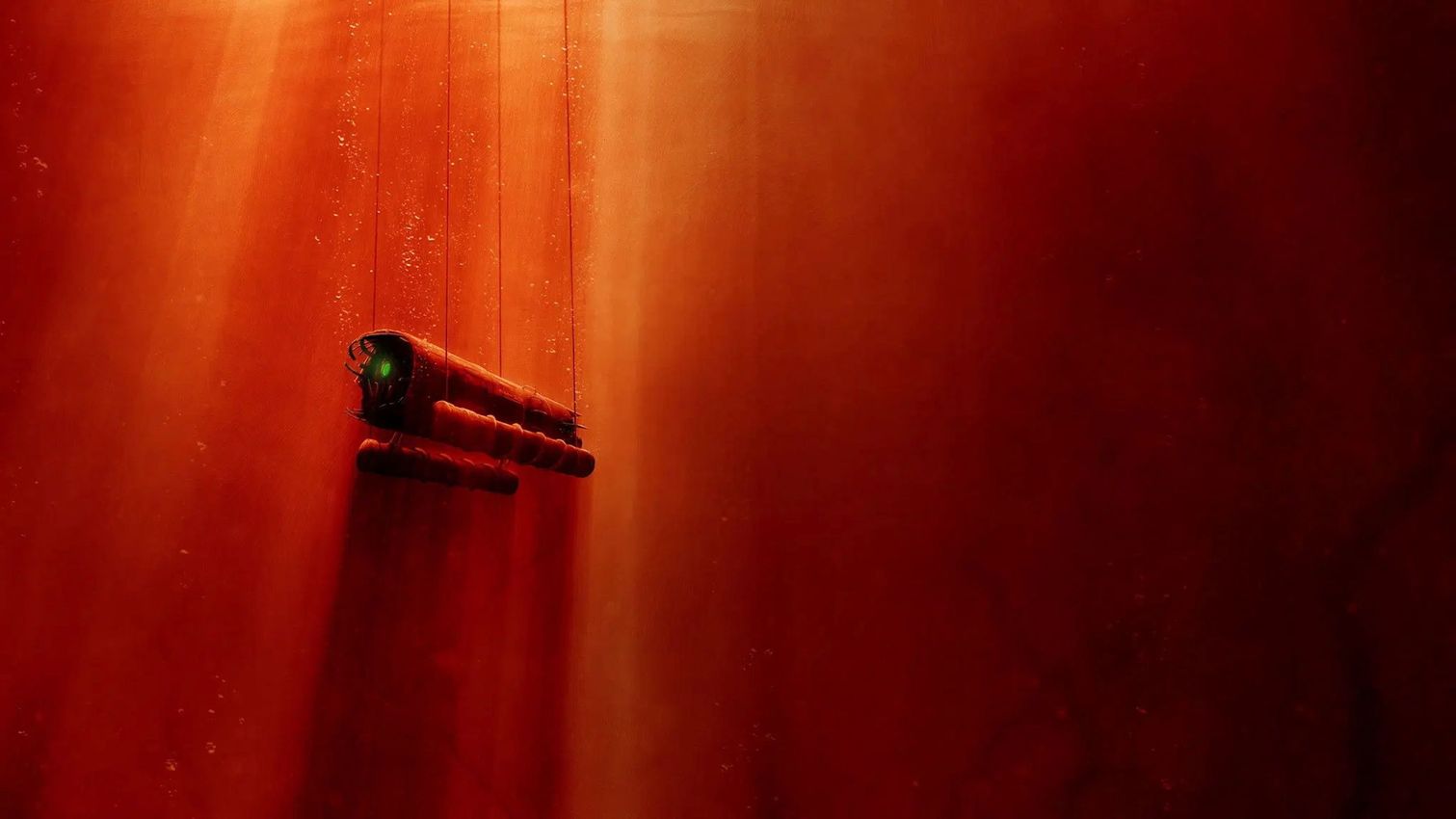
The 1972 music video for the song, directed by British photographer Mick Rock and featuring a spiky-mulleted young Bowie playing acoustic guitar (he was in Aladdin Sane mode by this time), is bathed in a lurid red light. That hue also dominates the mise-en-scene of Iron Lung (2026), an independent science fiction/horror film written, directed and produced by Mark Fischbach. Fischbach is better known as Markiplier, a streamer and gamer with 38.5 million YouTube subscribers. After experimenting with a short-format, genre-savvy YouTube series, In Space with Markiplier, Fischbach decided to make a feature-length film based on David Syzmanski’s video game Iron Lung (Syzmanski also collaborated on the making of this film).
I loved Das Boot (1981) and Gravity (2013)—even though I am no fan of Sandra Bullock. The fantasy of being isolated and disconnected, in an amniotic sac of unstable tech, evokes powerful intrauterine memories in which most of us are sometimes trapped. The birthing of the subject is visualised as ejection and the liberation from a capsule, a bloody process that can represent both parturition and death.

In the Iron Lung game, one exclusively plays as the character Simon (sometimes referred to as “The Player” or “The Convict”), who is forced to navigate a makeshift one-person submarine (his own amniotic sac, the SM-13) through an ocean composed of blood on the moon AT-5. Simon is a former Brother of Eden, an anarcho-terrorist group blamed for blowing up a space station, and is now conscripted to manning this windowless submersible. To earn his freedom, his task is to photograph points of interest using only a map, co-ordinates, and a camera system that takes several seconds to process the images he captures.
The premise is frankly irresistible to me, even though I am not a gamer by any stretch of the imagination and had no idea who Markiplier was before I saw the film. I am not in his demographic. But I am a fan of post-apocalyptic science fiction settings, so I wanted to see the film based on its trailer alone.
“The horror soundbath of Hulshut’s soundtrack creates the sonic environment of uterine resonance”
Fischbach is Korean American, bearing a striking resemblance to American actor Keanu Reeves. He is a more charismatic, more intentionally comical, and more articulate version of French Canadian streamer xQc. After watching the film, I began to get to know his online persona: Fischbach is very funny, and plays to the webcam well. He has physical skills in comedy and can effortlessly move from macho space soldier to cringeworthy, fanny pack-wearing white Dad. The YouTuber spent $3 million of his own money to make Iron Lung, and it has—as of this writing—grossed $50 million. With all the depressing news about culture industry consolidation, Iron Lung represents a different model of independent filmmaking, one that draws upon an audience that doesn’t go to the movies anymore: young people who watch a lot of YouTube and who may or may not be gamers.
As a post-apocalyptic narrative, Iron Lung sets up a peculiar premise: the stars have gone dark. There is a moon with oceans of blood that might contain a secret to the “Quiet Rapture”, a catastrophe that extinguished all the stars of the cosmos, leaving a barely viable human population alive to try to figure out what happened to the world. Inside the SM-13, like the interiors of the Alien franchise, the exposed pipes are sweaty; in this case, the liquid that leaks is blood. The science fiction interiors here represent industrial ruin and failure, in direct contrast to Apple products’ smooth design tributes to the hermetically sealed vessel from 2001: A Space Odyssey (1968).
The plot of Iron Lung is not as important as the feeling of claustrophobia and rising hysteria around a mystery that the lone central convict must solve in order to save himself, and life in the universe. As the film unfolds and Fischbach plots with a compass, a grid, and paper and pen his progress on the blood ocean floor and into the caves and crannies that it contains, it becomes increasingly clear that there will not be a way to escape from this world, despite promises of protection from the “mothership”. The apertures of the capsule are not stable. Radioactive “flashes” capture grainy, X-ray-like images which reveal a sea monster that at first seems dead; eventually, through the convict’s mapping, we find that the creature appears to be on the move.
“The science-fiction interiors here represent industrial ruin and failure”

Fischbach’s comedic talents are not utilised in Iron Lung. The light-hearted, genre-shifting, self-reflexivity of Markiplier is nowhere to be found. As Simon, he plays a desperate, adenoidally challenged man with an extremely limited tonal range. His acting has been roundly criticised in reviews but, to give Fischbach credit, he is in almost every shot of a feature-length film. Ava (played by Caroline Kaplan), the officer giving him orders from the mothership, is not well acted, either. The human voice has enormous potential for expression and oppression. It is unfortunate that Fischbach did not follow Kubrick’s cue: vocal softness, as in the sinister AI-driven computer HAL 9000’s dulcet tones, can spike our cortisol levels more effectively than drama school emoting when it announces horrible things. In contrast, the percussive and occasionally atonal soundtrack of the film, composed by Andrew Hulshut, is fantastic.
Early 20th-century accounts of psychosis, such as Daniel Paul Schreber’s Memoirs of My Nervous Illness (1903) describe a descent into mental illness that, in Sigmund Freud’s analysis, represented the universal human itinerary of psychological regression. Today, schizophrenia and psychosis are treated as psycho-chemical disorders. Psychiatry has made only limited efforts to understand the meaning of delusions themselves, because analysis doesn’t mitigate their deleterious effects or provide easy cures. What psychoanalysis does do, with psychotic ideation, is give us an idea of everybody’s unconscious impulses and tendencies.

Antisocial narcissism in extreme forms makes the subject’s world ever smaller: the isolated chamber to which players glued to their game consoles retreat is attractive because it invites regression into the self-sufficiency of intrauterine states of being. The umbilical cord is the apparatus that connects the player/infant to a world that feeds them a steady stream of nutrients and resonant maternal voice stimulation. Psychotic delusions evoke a state of infantile grandiosity from which all human beings suffer. Schreber, at the height of his delusional states, believed that only he could save the world from an angry deity, by becoming a woman who could please God.
A psychotic messianic fantasy is fully present in Iron Lung, as in so many post-apocalyptic games and narratives. Simon can “save humanity” by discovering an undersea secret: the significance of his act comes into question many times, but Simon is trapped in the submersible, as he is in the narrative provided by Ava. Furthermore, the regressive, psychotic subject experiences new outside stimulation as persecutory: the horror soundbath of Hulshut’s soundtrack creates the sonic environment of uterine resonance.

Simon knows that the submersible is breaking down. He knows that there is a monster outside that will kill him if the blood ocean does not. He also realises that Ava has been lying to him, but he is unable to disobey Ava’s final order that he save something in the submersible’s crawlspace. Simon climbs into the birth canal-like space, finds the object he is supposed to retrieve and attaches it to a life jacket. The final shot of the film is of the orange vest with its glowing emergency light turned on, attached to the black box, floating on a sea of blood. In Iron Lung, the game, there is no winning move: the quiet rapture is never reversed. The end of Szymanski’s game is the deliverance of the player back into the “real” world. The narrative lifeblood of the horror and mystery is simply exhausted.
“Iron Lung represents a different model of independent filmmaking, one that draws upon an audience that doesn’t go to the movies anymore”
Gaming and regression are enjoyable states of being. Being born, and being torn from the self-sustaining capsule that is the amniotic sac, is an extremely painful process. In Iron Lung, the bubbling, bloody surfaces of the ship, the analogue dials being filled with blood, and even the oxygen level readers that create gamer-induced anxieties, all contribute to the feeling of intrauterine anxiety and fear. In the film (as in the game, I imagine), death is experienced as a kind of deliverance: literally being removed from the containment of the capsule and into the painful condition of existing in something we call the “real” world.
Genre films and games that are aware of their generic predecessors’ limitations are places where political and psychological allegories can be played out against the dominant ideology of the culture industry. Markiplier is not a politically subversive figure by any means, but his collaboration with David Szymanski on Iron Lung represents a fascinating union between streamer and independent game developer, making a film that is both auteur-driven and genre-based. YouTube is currently throttling its new creators, so Fischbach’s own platform is undergoing rapid consolidation, but I hope that this cinematic outing can provide a model of content production that will mature and grow.
More than anything coming out of the major studios today, independent horror and science fiction content can speak directly to the ordinary anxieties, fears and contradictions produced by our contemporary reality. These new products will not save the world, but the process of their making might generate creative ways of engaging with the tools that platforms rely upon. They tie us to the umbilical cord of content delivery while simultaneously pointing the way down a path that leads to the biological and political necessity of violently overcoming the resistance to being born. —[O]
Main image: Iron Lung (2026). Courtesy Markiplier Studios.








A respected voice in contemporary art discourse.
Focusing on ambitious storytelling and insightful art-world commentary. Ocula Magazine publishes in-depth interviews, critical essays and timely analysis on the artists, exhibitions and ideas driving the global art world.
Learn more about Ocula Magazine
Showcasing the best of the art world.
Ocula partners with galleries from around the world to highlight their artists, artworks and exhibitions. Gallery membership is by application and invitation, with each member vetted by an independent panel.
Learn more about Ocula Membership
Specialises in the sale of major artworks.
Led by a team with deep ties to the world’s leading auction houses, galleries and collectors. Ocula’s advisory team offers bespoke services to high-net-worth clients from around the world who are looking to acquire the best of contemporary and modern art.
Learn more about our team and services