





The art world in focus
Subscribe to our newsletter for news and insights on artists, galleries and exhibitions.

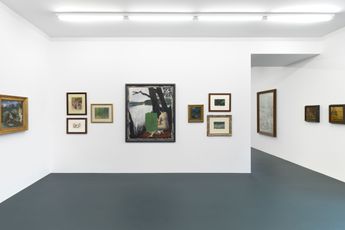
Exhibition view: Markus Lüpertz – Pierre Puvis de Chavannes, Michael Werner Gallery, Beverly Hills (22 June–7 September 2024). Courtesy Michael Werner Gallery.
East Coast and European galleries seem always to be opening secondary (or tertiary) spaces in Los Angeles—most recently David Zwirner, Marian Goodman, and Perrotin. When they do, they must choose their angle: do they foreground the Los Angeles artists in their roster, or do they introduce names from further afield, who may be unknown on the West Coast?

Michael Werner Gallery, which opened a space on North Camden Drive in Beverly Hills on 21 June, has brought to Los Angeles an exhibition—and a gallery—unlike anything else in the region in recent memory. For better or worse, its inaugural show, Markus Lüpertz – Pierre Puvis de Chavannes—which brings together the work of an 83-year-old German Neo-Expressionist painter with a lesser-known 19th-century French romantic symbolist—seems out of step with current trends and local sensibilities. In a city that often appears concerned only with the now and the near-future, this focus on art ‘out of time’ feels paradoxically fresh and invigorating.

To walk into the gallery, one must first pass through a fashion boutique called Mameg, run by Sonia Eram. The store—which moved from a previous location nearby—is uniquely revered among members of the Los Angeles art world, and indeed Hammer Museum director Annie Philbin introduced Michael Werner Gallery co-owner Gordon VeneKlasen to Eram, encouraging them to collaborate on a space. The partnership between high fashion and somewhat unfashionable art is nevertheless unexpected, even if the two businesses lend each other some cultural clout.
Mameg and Michael Werner Gallery share a pretty, two-storey brick building formerly occupied by a nail salon. Its redesign and renovation was overseen by respected local architects Johnston Marklee (who also designed Mameg’s previous shop), while the enchanting courtyard garden was conceived by landscape architect Eric Nagelmann. The modest rooms of the gallery are finished rather austerely with grey-green linoleum floors and strip lighting.

What of the exhibition itself? Prepare to be transported. It is clear that Lüpertz is looking back not only at the paintings of Puvis, but that both artists are fully immersed in the Classical tradition. Plentiful are the naked bodies in landscapes, as are allegorical scenes: Lüpertz’s Amor + Psyche (2020), for instance, which features figures that might actually be statues, or Puvis’ Esquisse pour Le Sommeil (Study for Sleep) (1867).
Plentiful, too, in this densely hung exhibition, are Puvis’ sketches, sometimes in oil on canvas, though more often done in pencil, chalk, and pastel on paper. One ethereal picture of two bathers in a landscape, Esquisse pour L’Été (Sketch for Summer) (1891) is executed, atmospherically, in charcoal on canvas.

Some of the best—and most complex—paintings are those by Lüpertz, in which he paints the frames of his pictures as well. The powerful Orpheus (2014), for instance, includes an expressively brushed grey and black frame which echoes the rocky impression of Orpheus’ grey and black muscular torso.
In addition to these premises in Beverly Hills, Michael Werner Gallery also opened a new space earlier this spring in Athens, Greece, not far from the Museum of Cycladic Art. Their inaugural exhibition, Accrochage, aligns historical figures—including Joseph Beuys, Jörg Immendorff, and Francis Picabia—with younger trendsetters, such as Issy Wood and Raphaela Simon. The gallery continues to distinguish itself by connecting the present with the past. —[O]


A respected voice in contemporary art discourse.
Focusing on ambitious storytelling and insightful art-world commentary. Ocula Magazine publishes in-depth interviews, critical essays and timely analysis on the artists, exhibitions and ideas driving the global art world.
Learn more about Ocula Magazine
Showcasing the best of the art world.
Ocula partners with galleries from around the world to highlight their artists, artworks and exhibitions. Gallery membership is by application and invitation, with each member vetted by an independent panel.
Learn more about Ocula Membership
Specialises in the sale of major artworks.
Led by a team with deep ties to the world’s leading auction houses, galleries and collectors. Ocula’s advisory team offers bespoke services to high-net-worth clients from around the world who are looking to acquire the best of contemporary and modern art.
Learn more about our team and services


