





BARBARA KRUGER
b. 1945, United StatesBarbara Kruger is an American artist well known for her provocative text-and-image collages that confront power, consumerism, and identity.
Merging bold typography with mass media aesthetics, her iconic works blur art and activism, dismantling societal narratives with searing clarity. Among the many accolades she has received, Kruger received the Golden Lion for Lifetime Achievement at the 51st Venice Biennale in 2005.
Early Years and Education
Kruger was born in 1945, her working-class upbringing in Newark gave her an intimate understanding of capitalism’s hierarchies that would later underpin her critiques of power and consumer culture. In 1965, she enrolled at Parsons School of Design in New York, studying under photographer Diane Arbus and graphic designer Marvin Israel. Their mentorship revealed to her the subversive potential of juxtaposing text and image, a technique central to her future work.
Leaving Parson’s after only a semester, Kruger began her career as a graphic designer at Condé Nast and later Mademoiselle magazine, where she became chief designer at 22. This commercial experience immersed her in the mechanics of persuasion, teaching her to distil complex ideas into concise, arresting visuals. She later reflected that her time in graphic design was ‘the biggest influence on my work...(it) became, with a few adjustments, my “work” as an artist’.
Barbara Kruger Artworks
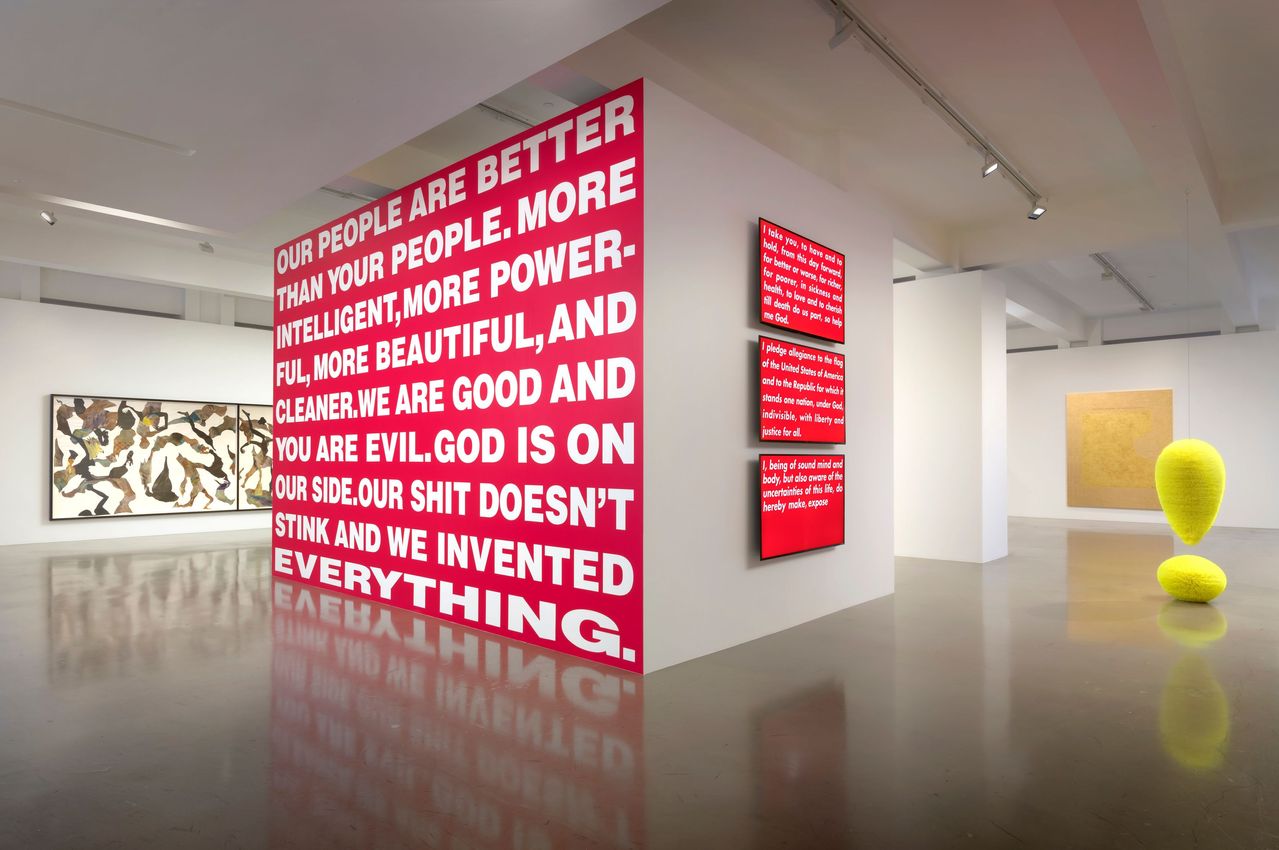
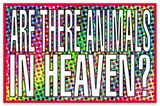
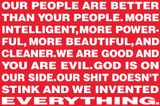
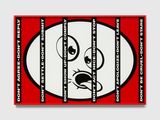
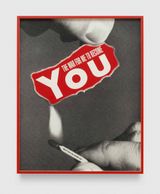
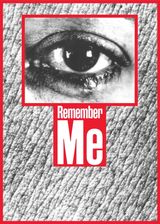
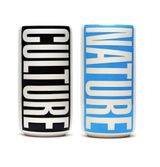
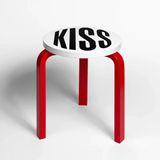
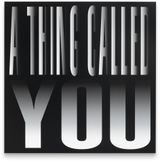
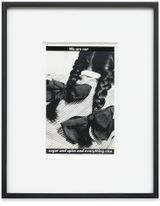
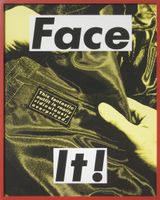
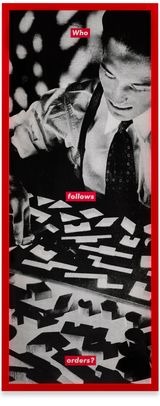
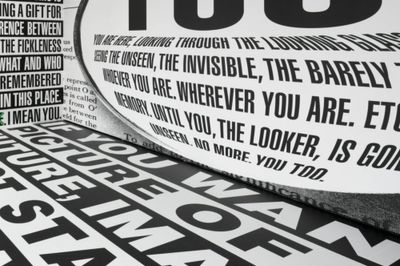
Barbara Kruger’s art often overlays bold text on stark imagery to interrogate power dynamics, deploying pronouns like ‘you’, ‘we’, and ‘they’ to dissect collective and individual identity. By appropriating mass media’s visual language, she weaponises its persuasive tactics to critique societal hierarchies.
Textiles and Photography
Barbara Kruger’s artistic journey began in 1969, her earliest works being large-scale textile pieces. Woven wall hangings crafted from ribbons, feathers, and beads reclaimed feminist craft traditions by elevating domestic materials into gallery critiques of gendered labour.
By 1976, disillusioned with abstraction (which she dismissed as ‘meaningless and mindless’), Kruger paused her practice and relocated to teach at the University of California, Berkeley. This exposed her to critical theory from Roland Barthes and Walter Benjamin that reshaped her practice, solidifying her shift from textiles to confrontational text-image works.
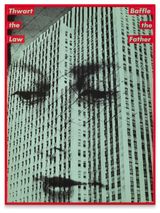
In 1977, she returned with photographs of architectural exteriors paired with incisive textual commentary on their inhabitants, culminating in her 1979 artist book Picture/Readings. Kruger’s pre-digital monochrome images of this period, commonly referred to as her ‘paste-ups’, display the impact of her editorial design background.
Collage
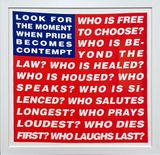
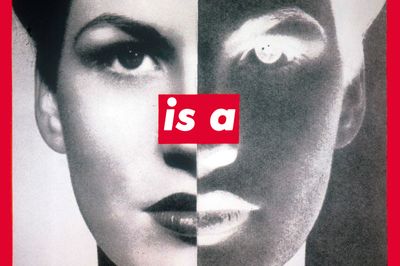
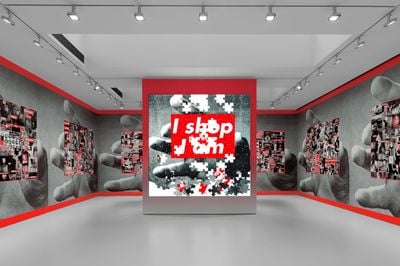
Kruger’s mature style emerged during the 1980s as she developed her iconic collage method: digitally composed monochrome 1940s adverts, overlaid with declarative captions in white-on-red captions. This style was first seen in works like Untitled (Your Gaze Hits the Side of My Face) (1981) which juxtaposed a classical female bust with bold, accusatory text, challenging viewers to confront objectification and societal control over women’s bodies. Arguably Kruger’s most famous work Untitled (I Shop Therefore I Am) (1987) parodied philosopher Rene Descartes’ famous statement ‘I think, therefore I am’ (Cogito, ergo sum), as a critique of consumer culture’s reduction of identity to commodified acts of purchasing. These works established Kruger’s voice as a sharp observer of how patriarchy and capitalism shape identity and gained her increasing recognition.
Expanding Artistic Practice
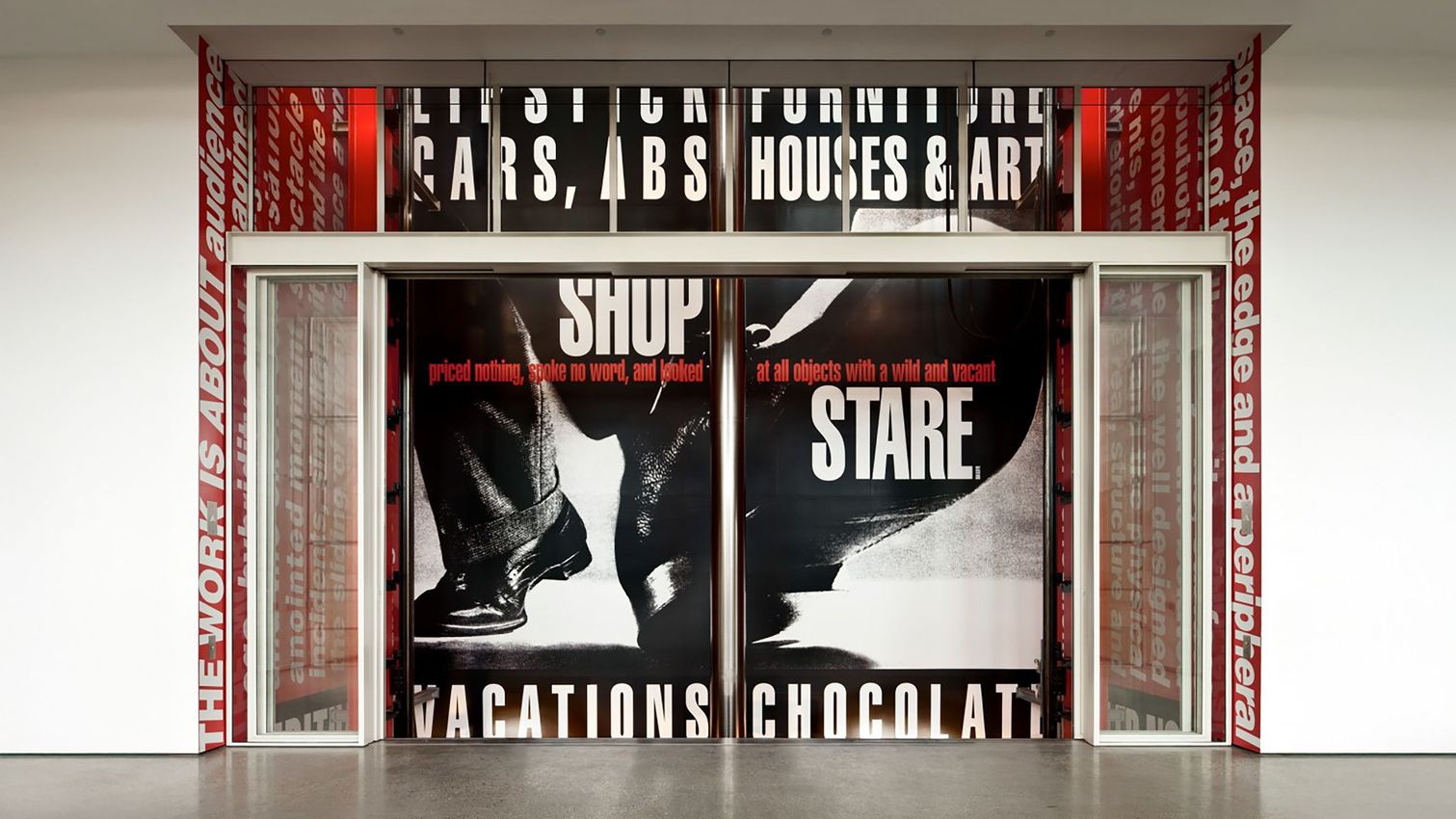
During the 1990s Kruger’s practice expanded into monumental public art that merged sharp socio-political critique with the tactics of guerrilla activism, infiltrating everyday spaces to challenge power structures. Her Bus (1997) transformed New York City buses into mobile provocations by wrapping them in vinyl texts like ‘Don’t threaten me with love’. For Untitled (Shopping) (2002), ****Kruger draped a Frankfurt department store’s facade with the slogan ‘You want it. You buy it. You forget it’ in German. This direct indictment of consumer culture repurposed commercial architecture as a canvas for its dissent, blurring lines between critique and the very systems it targeted.
In 2005, Kruger’s iconic Untitled (Façade) at the 51st Venice Biennale draped the Italian Pavilion in Italy’s national colours. Outspokenly, she plastered the words ‘power’ and ‘money’ on the portico’s columns, with interior texts like ‘Pretend things are going as planned’, dismantling illusions of authority. That same year, Kruger received the Golden Lion for Lifetime Achievement at the Venice Biennale.
From 2006, Kruger embraced interactive digital media: Untitled (Skype) (2012) and Untitled (The Drop) (2017) responded to viewer movement, while recent projects like Thinking of You. I Mean Me. I Mean You. (2021) and Untitled (Who Owns What?) (2023) deploy AI and facial recognition to interrogate surveillance capitalism, cementing her legacy as a relentless critic of power across mediums.
Public Commissions and Awards
Kruger’s work is the subject of numerous public commissions, and he has been the recipient of numerous awards, some of which are included below:
- Untitled (Who?), 2020, Sprüth Magers, Los Angeles.
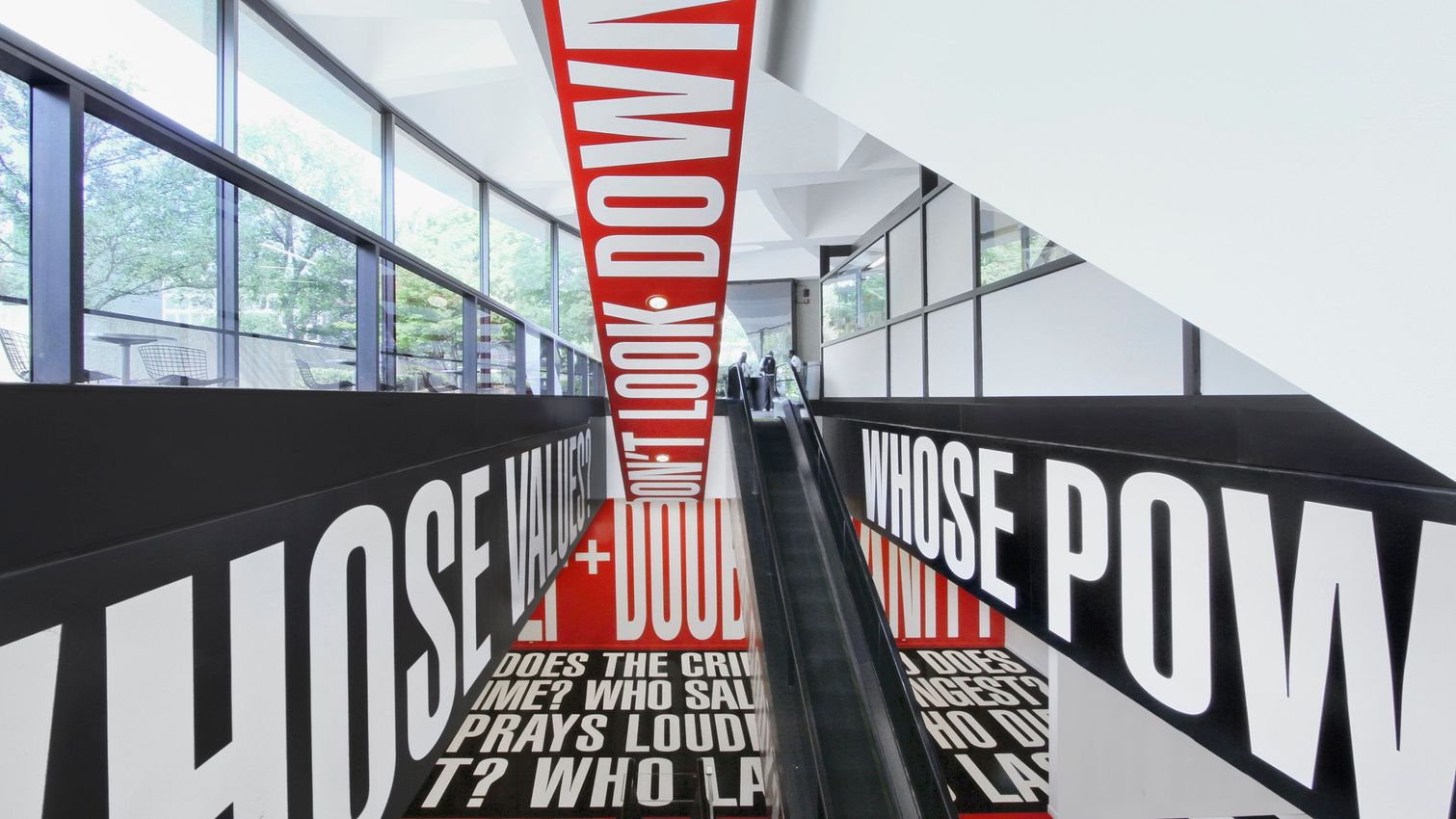
- Belief + Doubt, 2012, Hirshhorn Museum, Washington, D.C.
- Untitled (Facade), 2005, Venice Biennale (Italian Pavilion), Venice.
- You Belong Here, 1998, Parrish Art Museum, Southampton, New York.
- Untitled (Questions), 1990, Museum of Contemporary Art (MOCA), Los Angeles.
- Untitled (We Don’t Need Another Hero), 1987, Institute of Contemporary Arts, London.
What Are Some Notable Awards and Accolades?
- Distinguished Artist Award for Lifetime Achievement, 2023, College Art Association (CAA), USA.
- Kaiserring Prize, 2019, City of Goslar, Germany.
- Golden Lion for Lifetime Achievement, 2005, Venice Biennale, Italy.
- National Endowment for the Arts Grant, 1983–1984, National Endowment for the Arts (NEA), USA.
What Are Some Notable Exhibitions?
Barbara Kruger has been the subject of both solo exhibition and group exhibitions at important institutions, below are some examples:
Solo Exhibitions:
- Untitled (Shafted), 2024, Los Angeles County Museum of Art (LACMA), Los Angeles.
- Thinking of You. I Mean Me. I Mean You., 2024, Serpentine South, London.
- Bitte Lachen / Please Cry, 2022, Neue Nationalgalerie, Berlin.
- Untitled (Who?), 2021, Sprüth Magers, Los Angeles.
- Thinking of You, I Mean Me, I Mean You, 2021, Art Institute of Chicago, Chicago (travelled to LACMA, MoMA, and Serpentine).
- Barbara Kruger: Forever, 2019, Amorepacific Museum of Art (APMA), Seoul.
- In the Tower: Barbara Kruger, 2016, National Gallery of Art, Washington, D.C.
- Edition 46 - Barbara Kruger, 2011, Pinakothek der Moderne, Munich.
Group Exhibitions:
- Mondi Possibili, 2023, Seoul, South Korea.
- The Milk of Dreams, 2022, Venice Biennale, Venice.
- Pictures, Revisited, 2021, Metropolitan Museum of Art, New York.
- 20/20, 2020, David Zwirner, New York.
- Don’t Let This Be Easy, 2020, Walker Art Center, Minneapolis.
- The Street: Where the World Is Made, 2018, MAXXI, Rome.
- MashUp: The Birth of Modern Culture, 2016, Vancouver Art Gallery.
- America is Hard to See, 2015 Whitney Museum of American Art, New York.
Critical Reception
Barbara Kruger’s work has been hailed as ‘a visual jolt to the cultural nervous system’ (Artforum) for its incisive critiques of consumerism and patriarchy. The New York Times deemed her ‘a propagandist in the best sense’, while Art in America noted her ‘uncanny ability to distil complex ideologies into viral slogans’, cementing her postmodern legacy.
Barbara Kruger FAQs
What is Barbara Kruger’s studio process?
She works with a small team to scale digital drafts into installations but finalises all text and composition choices personally, maintaining hands-on control.
How do museums position Barbara Kruger in art history?
Retrospectives at LACMA (2022) and MoMA (2024) frame her as a precursor to ‘post-internet art’, bridging 1980s conceptualism and digital-age activism.
Do any feminist art collectives cite Barbara Kruger as foundational?
Collectives like Guerrilla Girls adopted her text-image strategies for activist campaigns, using bold visuals to address gender inequality and political representation.
How does the art market respond to Barbara Kruger’s work?
Kruger’s editioned prints command high auction prices e.g., Untitled (I Shop Therefore I Am) sold for $1.1M at Christie’s in 2022, while institutions acquire large installations. Despite her critique of commodification, limited editions maintain market appeal. She restricts commercial licensing but permits museum reproductions.
Which universities featured Barbara Kruger’s most impactful teaching roles?
She taught at UC San Diego (1976–1981), CalArts (1979), and UCLA (2002–2020), where she became Emerita Distinguished Professor of New Genres, shaping curricula around critical media analysis.
Did Barbara Kruger mentor notable contemporary artists?
Yes, former students include conceptual artists Tala Madani and Martine Syms, who credit her emphasis on text-image dynamics.
Where can I view Barbara Kruger’s work on permanent display today?
You can view Kruger’s permanent installations at the Hirshhorn Museum (Washington, D.C.), Parrish Art Museum (Southampton, NY), and Stockholm School of Economics. Major works are also held in rotating display at MoMA, Whitney, and The Broad. JFK Airport’s Terminal 6 will feature a permanent installation from 2026.
Timur Safardiar | Ocula | 2025





View Barbara Kruger's Artworks




























Barbara Kruger in Ocula Magazine







Explore and Follow Artists Shaping Contemporary Art
A respected voice in contemporary art discourse.
Focusing on ambitious storytelling and insightful art-world commentary. Ocula Magazine publishes in-depth interviews, critical essays and timely analysis on the artists, exhibitions and ideas driving the global art world.
Learn more about Ocula Magazine
Showcasing the best of the art world.
Ocula partners with galleries from around the world to highlight their artists, artworks and exhibitions. Gallery membership is by application and invitation, with each member vetted by an independent panel.
Learn more about Ocula Membership
Specialises in the sale of major artworks.
Led by a team with deep ties to the world’s leading auction houses, galleries and collectors. Ocula’s advisory team offers bespoke services to high-net-worth clients from around the world who are looking to acquire the best of contemporary and modern art.
Learn more about our team and services