Press Release

Between the 1940s and 1960s, both in Europe as well as in South America and Asia, artists from diverse backgrounds focused not only on recovering the “pure” properties and essences of art, but also on asking how and when an image that is not reduced to the mere representation of a thing is formed. These artists inquired on the existence of an image a priori, as well as on the experience provided by perception and human consciousness. They delimited the order of things to see and not see at the same time. An intermediate space was conceived, situated between both extremes, between a priori ideas and experience, the body and the spirit. In this enigmatic place where things happen: behind the screen. There, white is no paler than snow and reaches a shade of gray when compared to it. In this intermediate space white is not the same for everyone, it’s not opaque and transparent as it’s usually held in scientific theories of color: How can something transparent be green but not white? Transparency and reflection exist only in the depth dimension of a visual image.

It is the sensible dimension which grants peremptory definitions about space, colour, form, line, movement, depth (Paul Cézanne’s great obsession), virtuality, and reality. These aesthetic-philosophical issues—which were at the heart of the concerns of artists and groups linked to kinetic art, Op Art and the new abstraction trends that emerged in the post-war period or linked to accelerated modernsation processes in the Global South, —are gaining relevance given the imminent arrival of artificial intelligence.

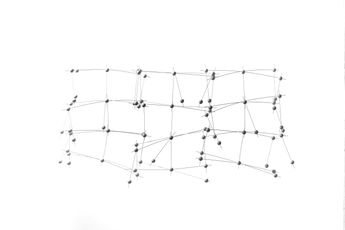
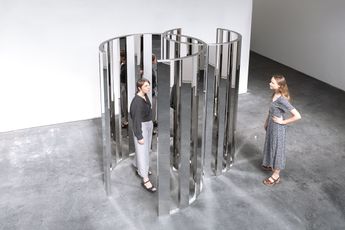
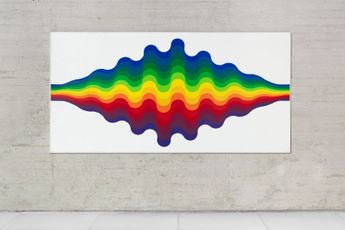
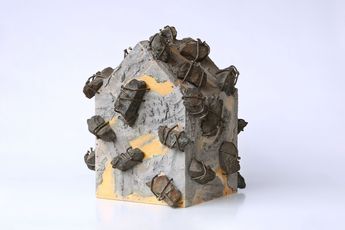
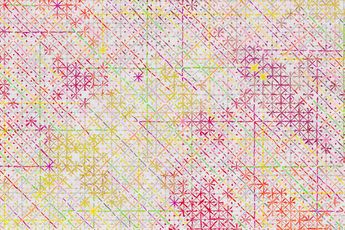
The artists gathered in the exhibition Detrás de la pantalla [Behind the Screen] capture in the space of the canvas color and movement, the enigma of seeing and not seeing. The impossibility of connecting sensible goals of experience with the reach of science in its eagerness to view things from fixed and stable categories. The smartphone’s screen—just like the canvas or support in painting—flattens what we see. These leave the exclusive dominance of three-dimensionality to sculpture, to what is often superimposed on the naked eye when we perceive an object. However, we know that a chair may or may not contain a body at rest. RGR offers a wide panorama of perspectives from artists who question what we see from this intermediate space that sometimes reverberates behind the screen.

Exhibition organized by Gabriela Rangel in collaboration with Ricardo González Ramos.

Read More

Artists Exhibiting

Also Exhibiting at Galería RGR

About the Gallery

RGR is a contemporary art gallery committed to fostering dialogue across generations, movements, and artistic practices. Founded in 2018 in Mexico City, the gallery presents a diverse program that brings together established artists, historical legacies, and emerging voices shaping the contemporary art landscape. With a strong focus on experimentation and critical discourse, Galería RGR represents both pioneering figures in modern and contemporary art and contemporary artists exploring new frontiers in painting, sculpture, installation, and digital media. Its exhibition program encompasses a wide range of artistic approaches, from geometric precision to conceptual and expansive narratives that reflect the cultural and social context of our time.

View Gallery Profile
Address
Gral. Antonio León 48
Colonia San Miguel Chapultepec
Mexico City
Mexico
Opening Hours
Monday–Thursday: 10.30 am –6.30 pm
Friday: 10.30 am – 4.30 pm
Saturday: 11 am –4.30 pm
(1)
Mexico City Gral. Antonio León 48, Colonia San Miguel Chapultepec
Galería RGR
Gral. Antonio León 48, Colonia San Miguel Chapultepec, Mexico City, Mexico
+52 1 55 8434 7759
http://www.rgrart.com

Opening hours
Monday–Thursday: 10.30 am –6.30 pm
Friday: 10.30 am – 4.30 pm
Saturday: 11 am –4.30 pm
The art world in focus