Right from the start of abstract art, there was a split between two lines, indicating seemingly opposed tendencies: on the one hand a structured and economical art, often proscribing curves, seeming to privilege the cerebral and programmatic, and on the other, a warmer and more informal art in which spontaneity and sensitivity imposed their rhythm. Yet these two lines have never ceased overlapping and enriching each other. In the case of many painters, they co-exist or succeed one another.
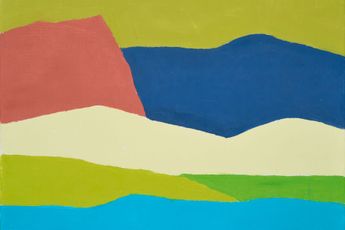
It is through the minimalist simplicity of her forms as well as through the sincerity of her colours that Etel Adnan’s full originality expresses itself. Revealed by the Kassel Documenta in 2012, Adnan, who was already a well-known poet published in many languages, has won an absolutely singular place in the art world. Her paintings have the force and self-evidence of a haiku.
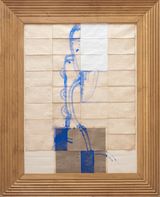
By pasting the back of an old road map onto his canvas, James Brown relies on the orthogonal structure given by the map’s folds to suspend an abstract, supple and mysterious figure. James Brown’s work, which was revealed in the early 80’s, at the same time as Basquiat and Keith Haring, immediately met with an international recognition for its treatment of the figure. James Brown, who had been living in Mexico since many years, passed away at the beginning of the year in a car accident.
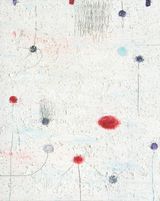
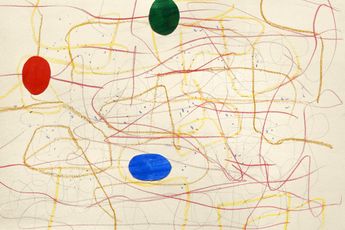
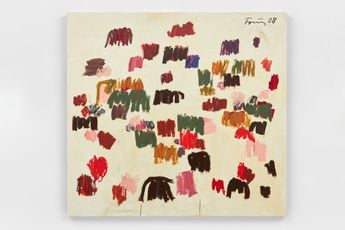
For Nicola De Maria, given their proportions, his small vertical paintings represent heads. That being the case, all that occurs on the surface, those points of colour interlinked by connections, the scratchings in the live material of the paint, is supposed to be the dream inhabiting this head. After a brief but intense international career in the 80s, Nicola Di Maria retired to Turino where, in isolation and calm, he pursues a secret and inspired work.
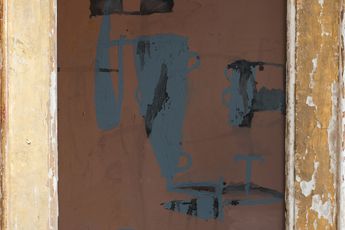
Grids, spots, drippings, none has better explored the infinite array of marks a paintbrush can make on a canvas as has Günther Förg. With irony and intelligence, he revisits art history, evoking through a form or a colour such or such another of his masters. The work chosen here is emblematic of our subject: the confrontation on the same surface of geometric rhythms and an informal and fluid space. Recently a major retrospective of Förg’s work was held at the Stedelijk Museum of Amsterdam, followed by one at the Dallas Museum of Art.
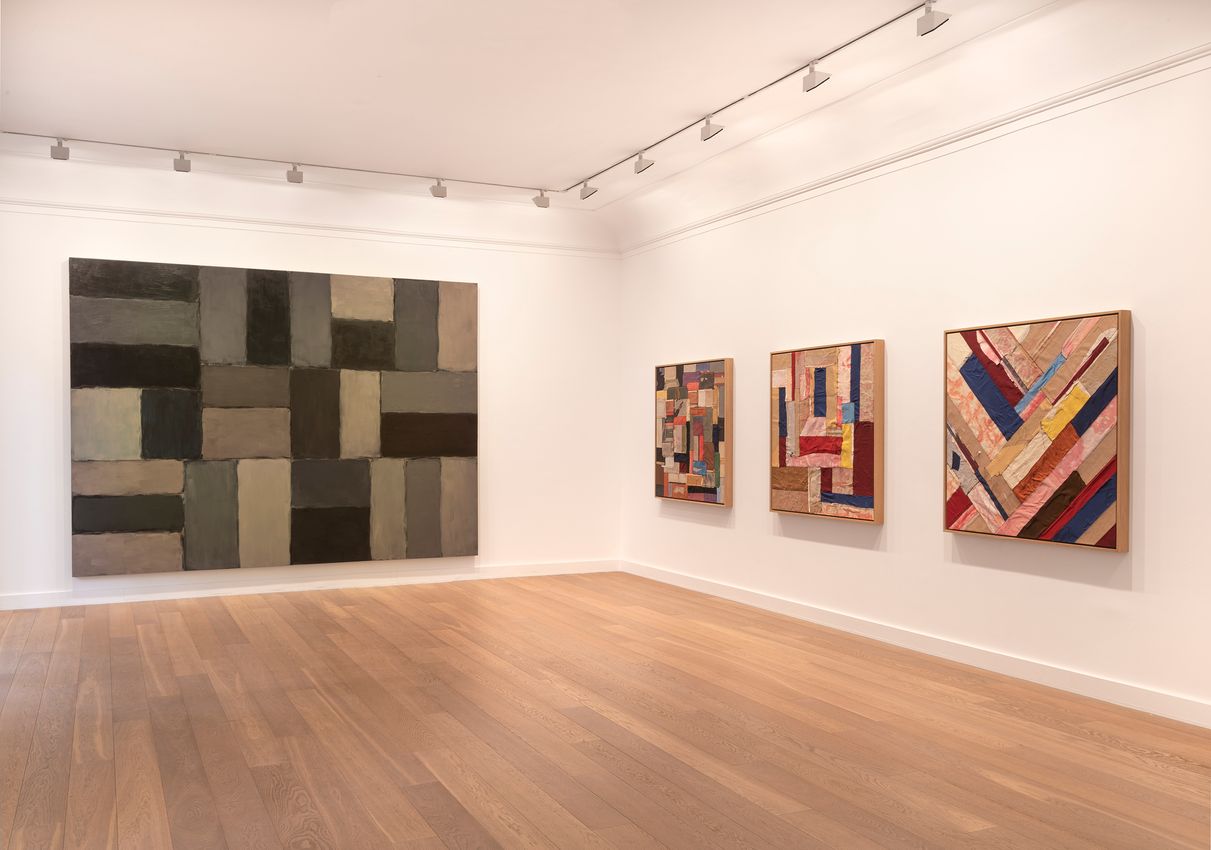
The formal description of Samuel Levi Jones’ work—cloth strips of varied width, length and colour, sewn together as in a patchwork—is not enough to reveal the painter’s aim. By having a closer look, one realises that this surface is composed of fragments from the bindings ripped off scientific or legal books. It is the academic knowledge these books transmit which the American artist intends, through this iconoclastic gesture, to question and deconstruct. From these rags, he makes a coat of arms. The Museum of Indianapolis (USA) dedicated an exhibition to the artist in 2019.
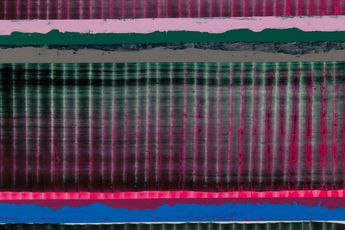
The luminous vibration of the many superposed layers of paint breathes life into the orthogonal structures which compose the framework of Sean Scully’s ‘Wall of Light’ series. A major retrospective, for which Galerie Lelong is lending a seminal work, was to open this spring at the Fort Worth Museum. The new dates of the show have not been fixed yet.
It is by listening, at night, to the rhythm of his heartbeats that Juan Uslé deposits each brushstroke, the succession of which form the intrigue of the paintings he calls Soñe que revelabas. Juan Uslé, who currently works in Cantabria and New York, just received in March 2020 the Florence and Daniel Guerlain Foundation Prize for Drawing.
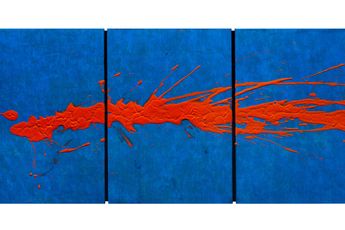
By handling with all the strength of her body, a large suspended paintbrush conceived by herself, across the canvas, Fabienne Verdier on it deposits the trace, the flux, the energy she concentrates in her movement. Control and freedom, premeditation and improvisation are here intimately linked. Following the huge success of her exhibition at the Musée Granet of Aix-en-Provence last summer, Fabienne Verdier is preparing for the Unterlinden Museum of Colmar in 2022 a series of paintings which will be a dialogue with Grünewald and Schongauer, the two artists whose masterpieces the museum hosts.


A respected voice in contemporary art discourse.
Focusing on ambitious storytelling and insightful art-world commentary. Ocula Magazine publishes in-depth interviews, critical essays and timely analysis on the artists, exhibitions and ideas driving the global art world.
Learn more about Ocula Magazine
Showcasing the best of the art world.
Ocula partners with galleries from around the world to highlight their artists, artworks and exhibitions. Gallery membership is by application and invitation, with each member vetted by an independent panel.
Learn more about Ocula Membership

Specialises in the sale of major artworks.
Led by a team with deep ties to the world’s leading auction houses, galleries and collectors. Ocula’s advisory team offers bespoke services to high-net-worth clients from around the world who are looking to acquire the best of contemporary and modern art.
Learn more about our team and services