Press Release
Xavier Hufkens is pleased to announce an exhibition of late fabric sculptures and gouaches by Louise Bourgeois (1911-2010). The show will be accompanied by a catalogue featuring an essay by Philip Larratt-Smith.

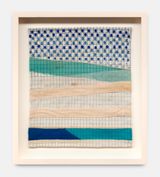
For Louise Bourgeois, fabric and sewing held great symbolic significance. Born into a family of tapestry restorers, she was surrounded by textiles as a child, and was witness to her mother’s constant efforts at conservation and repair. Bourgeois also helped in the atelier, drawing in the missing parts of tapestries that needed reweaving. The artist came to associate sewing with reconstruction, reparation and reconciliation. In contrast to her earlier bodies of work, in which aggressive acts of separation, like cutting and carving, were predominant, Bourgeois’s late work focused on joining elements together, a restorative act that helped to dispel anxiety and her life-long fear of abandonment.

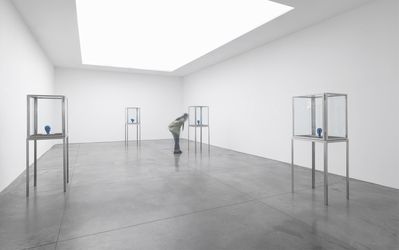
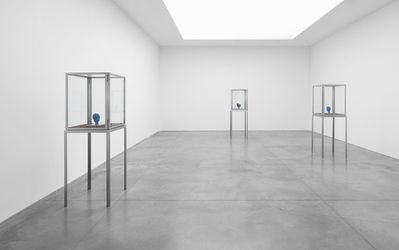
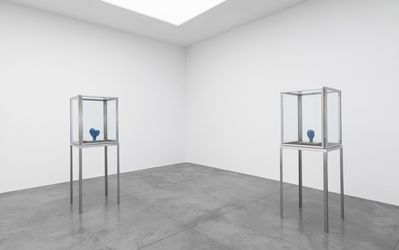
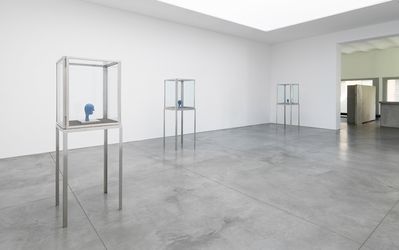
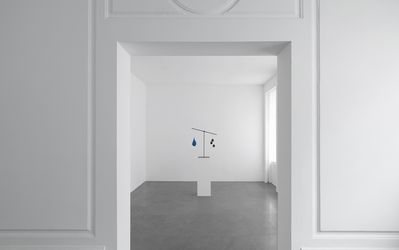
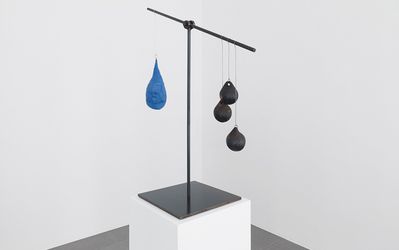
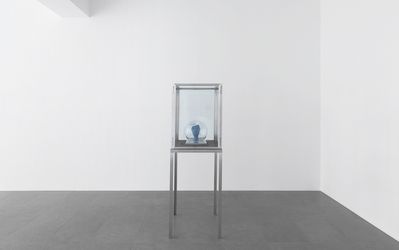
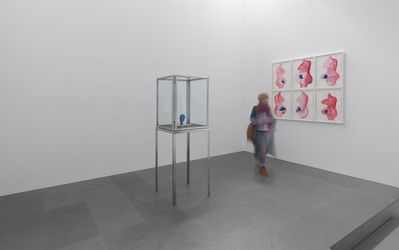
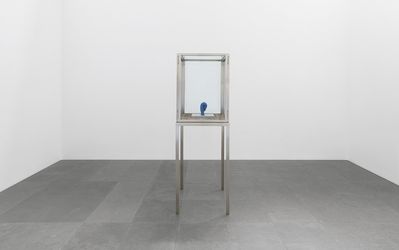
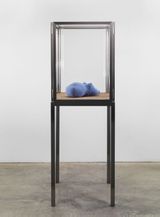
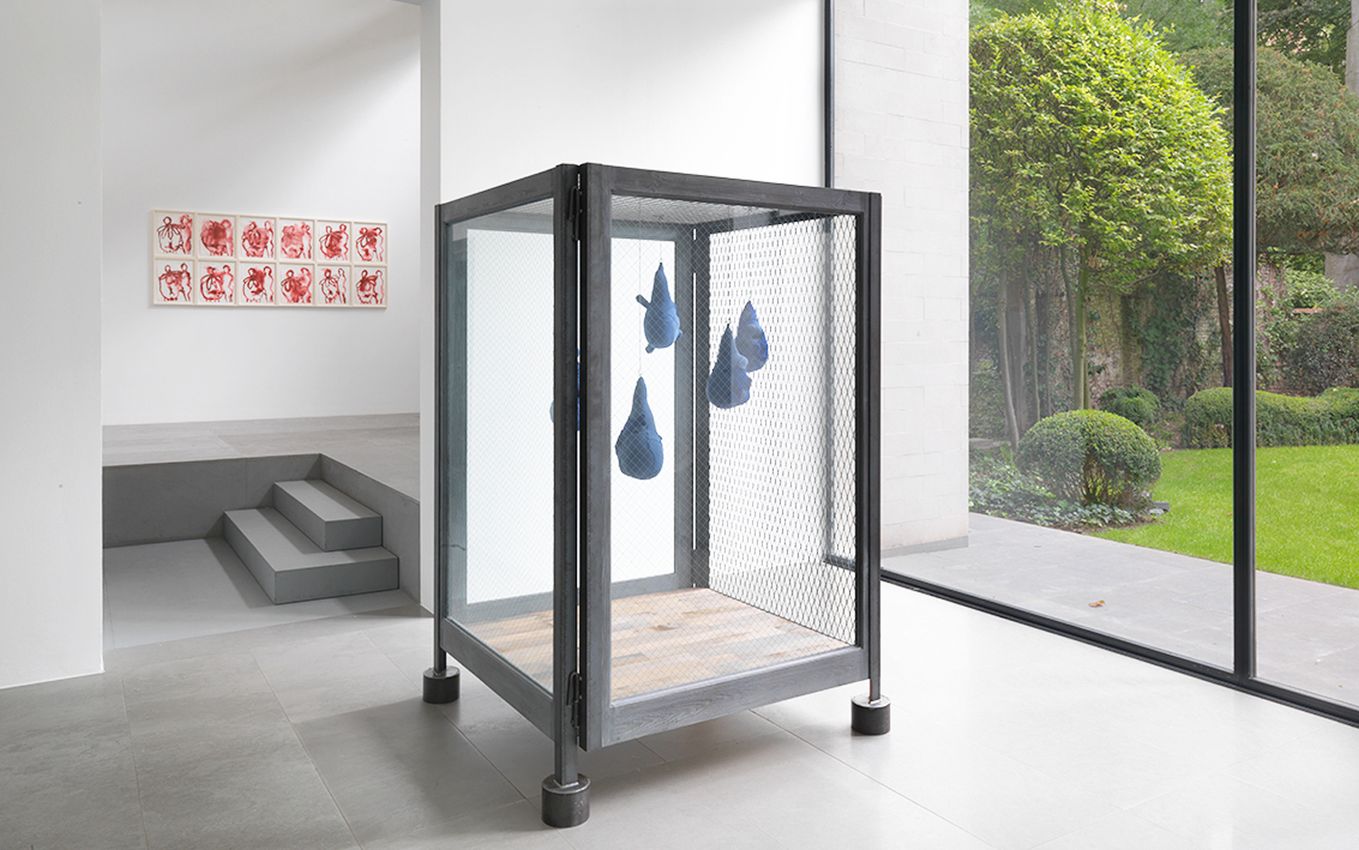
Bourgeois began making her fabric heads when she was in her eighties. To make these sculptures, which were mostly cut and crafted from the same bolt of cloth, she constructed an inner core and gradually added layers of fabric, hand-stitching the features as the form progressed. The crude stitching, loose threads and raw edges achieve an immediacy and directness that is reminiscent of her drawings. As Larratt-Smith notes in his text, the artist also associated colours with specific emotions or symbolic meanings. The intense blue of the heads exhibited here represents melancholia, suffering and acédie. It is also the colour of twilight and creativity: the threshold between day and night, conscious and unconscious, and the passage from one state to another.

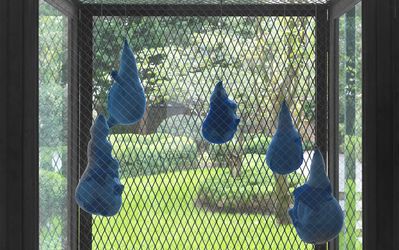
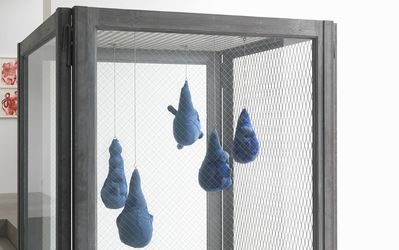
The largest and most complex piece, Cell XXVIII (Portrait), is typical of the self-enclosed ‘Cell’ structures that became an important feature of Bourgeois’s late work. Made from salvaged architectural materials, and incorporating found objects along with her own fabric sculptures, the assemblages explore a deeply personal narrative, revolving around the themes of architecture, memory, and the five senses. A subset of the ‘Cells,’ the ‘Portrait Cells’ present a concentrated portrait of a psychological or emotional state, and usually give prominence to the human head as the seat of identity. Cell XXVIII (Portrait) is a symbolic representation of the family dynamic. As Larratt-Smith describes, five heads, all hanging upside down, are “physically isolated from each other, yet imprisoned together within the same jail-like cage.” For Bourgeois, five elements always represented the family unit.

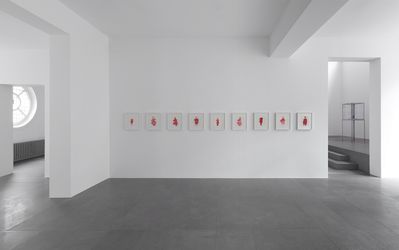
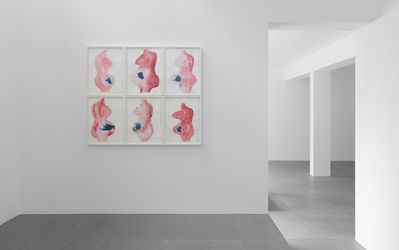
An undercurrent running throughout the exhibition is the eternal oscillation between masculinity and femininity, life and death, creativity and inertia. As Bourgeois famously stated, she had her ‘pink days’ (good, productive, creative) and ‘blue days’ (unproductive, filled with despair). Remaining within a compressed but intense emotional range, the ‘blue’ heads tend to have a fixed identity, which is consistent with her depictions of the male figure. This is counterbalanced by the instability and mutability of the brilliant pink and red gouache drawings of female figures, which the artist made by working ‘wet on wet’. This technique allowed the element of chance to shape the final outcome of her working process. With their full breasts and rounded stomachs, the figures are a lasting testament to Bourgeois’s preoccupation with sexuality, pregnancy, motherhood, and the cycles of life.


Louise Bourgeois was born in Paris in 1911 and died in New York in 2010. Her work is represented in the collections of important art institutions throughout the world, and continues to be exhibited on the international stage. Monographic exhibitions in 2015 included Louise Bourgeois. Works on Paper, Tate Modern, London; Louise Bourgeois. I Have Been to Hell and Back, Moderna Museet, Stockholm, Sweden (travelling to Museo Picasso, Málaga, Spain); Louise Bourgeois. Structures of Existence: The Cells, Haus der Kunst, Munich, Germany (travelling to the Museum of Contemporary Art, Moscow, Russia, and the Louisiana Museum of Modern Art, Humlebaek, Denmark during 2015-17).

Installation Views

About the Artist

Louise Bourgeois is widely considered to have been one of the most influential artists of the 20th century. In a career spanning seventy years, she produced an intensely personal body of work that is as complex as it is diverse. Bourgeois created sculptures in a wide range of media: unique environments, or ‘cells’, in which she combined traditional marble and bronze sculptures alongside the everyday objects imbued with a strong emotional charge (furniture, clothes and empty bottles); prints and drawings; and hand-stitched works made of fabric. Born in Paris, Bourgeois originally studied mathematics and geometry at the Sorbonne but switched to art in 1932. She moved to New York in 1938 upon her marriage to the American art historian, Robert Goldwater. Although she continued her artistic practice in America, her career evolved slowly. The Museum of Modern Art’s retrospective of her work in 1982, when she was seventy, marked a turning point. In an interview that coincided with the opening, Bourgeois explained that the imagery in her work, which deals with themes such as jealousy, violence, sexual desire, betrayal, fear, anxiety and loneliness, was wholly autobiographical and a form of catharsis. In 2000, she made the first sculpture in what would become an iconic series of giant spiders entitled Maman, and worked obsessively up until her death in 2010, aged ninety-eight.

View Artist Profile

Also Exhibiting at Xavier Hufkens

About the Gallery
Xavier Hufkens is one of Europe’s leading galleries for contemporary art. Located in Brussels, the gallery maintains a diverse exhibition programme with solo exhibitions of the gallery artists as well as group exhibitions and special projects. The gallery deals in a distinctive combination of painting, drawing, sculpture, photography, video and installation-based work.

The origins of the gallery date back to 1987, when Xavier Hufkens opened a gallery space in an un-refurbished warehouse in the neighbourhood of the South Station (Midi) in Brussels. During the early years, the focus of the gallery was upon mid-career and emerging artists and the gallery is known for having introduced some of the most influential contemporary artists to Brussels at a time when they were still relatively unknown. British sculptor Antony Gormley, who is still affiliated with the gallery, Felix Gonzalez-Torres and Rosemarie Trockel all showed in Belgium for the first time with Xavier Hufkens (Gormley in 1987; Gonzalez-Torres in 1991 and Trockel in 1993).

In 1992, the gallery moved to a 19th-century townhouse at 6 rue Saint-Georges, close to the Avenue Louise. Completely renovated by Belgian architects Paul Robbrecht, Hilde Daem and Marie-José Van Hee, the house quickly gained a reputation for being not just one of the most beautiful contemporary art spaces in the Belgian capital, but also one of the most interesting. The expanded exhibition programme coincided with the additional representation of a number of established artists from Belgium and abroad, including Richard Artschwager, Thierry De Cordier and Jan Vercruysse. In 1997, Hufkens expanded the gallery further by annexing the adjacent building and a number of new artists joined the gallery, including Louise Bourgeois, Roni Horn and Thomas Houseago.

A second space in the same street, at 107 rue Saint-Georges, opened in spring 2013. Located in the Galerie Rivoli, a mixed-use commercial development from the 1970s, the new gallery space was designed by Swiss architect Harry Gugger, who was previously in partnership with Herzog and De Meuron. Slegten & Toegemann, Brussels, managed the project. A third space opened in spring 2020, located at 44 Rue Van Eyck, designed by architect Bernard Dubois.

An eclectic but very clear vision underpins all of the gallery’s activities: ‘The definition of the gallery was established from the start. The common thread, then and now, is quality over and above everything else, which I find more intellectually challenging than a forced definition. From the early days I juxtaposed established artists such as Michelangelo Pistoletto with someone like Felix Gonzalez-Torres when he was totally unknown. Today I still mix my work: I have no problem showing Malcolm Morley … alongside Robert Ryman, or Willem de Kooning.’ [Xavier Hufkens in The Art Newspaper, Issue 220, January 2011, published online: 20 January 2011]

Xavier Hufkens represents some thirty artists from different generations. He was part of the six-member selection committee for Art Basel during seven years and also participates in up to five international Arts Fairs annually. The gallery has partnerships with the estates of Louise Bourgeois, Willem de Kooning, Robert Mapplethorpe and Alice Neel.
View Gallery Profile
Address
6 rue St-Georges
St-Jorisstraat
Brussels
Belgium
Opening Hours
Tuesday – Saturday
11am – 6pm
(1)
Brussels 6 rue St-Georges
Xavier Hufkens
6 rue St-Georges, St-Jorisstraat, Brussels, Belgium

Opening hours
Tuesday – Saturday
11am – 6pm
The art world in focus