





KENNETH NOLAND
1924-2010, United StatesKenneth Noland (1924—2010) was an American Color Field painter whose circle, chevron, stripe, and shaped-canvas paintings became emblems of what critic Clement Greenberg termed Post-Painterly Abstraction and, more specifically, the Washington Color School. He is best known for large-scale abstract works in which stained bands and rings of colour on unprimed canvas are both subject and structure, rather than a vehicle for depicting the outside world.
Noland’s paintings explore how hue, scale, and edge generate visual tension and balance, and they have entered leading collections including The Museum of Modern Art, the Metropolitan Museum of Art, the Whitney Museum of American Art, the Hirshhorn Museum and Sculpture Garden, Tate, and Kunsthaus Zürich.
Early life and Black Mountain College
Kenneth Noland was born in Asheville, North Carolina, and grew up during the Great Depression before serving in the US Army during the Second World War. After the war he used the G.I. Bill to enrol at Black Mountain College in 1946, an experimental school that played a major role in shaping postwar American art where artists such as John Cage and Josef Albers taught. There he studied with Ilya Bolotowsky, who introduced him to Neo-plasticism and the work of Piet Mondrian, and Albers, whose Bauhaus-derived colour theory left a lasting mark on Noland’s understanding of chromatic interaction.
Black Mountain also exposed Noland to visiting artists and thinkers whose approaches to abstraction and composition broadened his outlook. He developed an interest in Paul Klee‘s sensitivity to colour and in the idea that painting could be non-representational yet emotionally resonant. This early immersion in European modernism and rigorous colour study laid the groundwork for his later commitment to non-objective painting built from simple geometric formats and finely calibrated hues.
Paris and the move away from Cubism
In 1948 Noland left Black Mountain College for Paris, where he studied with Russian-born sculptor Ossip Zadkine. Zadkine’s teaching, grounded in Cubist structure, offered Noland a model of analytic composition, but the young artist soon found the style too constraining. By the time of his first solo exhibition at Galerie Raymond Creuze in 1949, he had begun to move away from Cubist fragmentation toward a radically simplified language of colour and form.
This period in Paris confirmed for Noland that his interests lay not in depicting objects but in orchestrating relationships between shapes and fields of colour. The experience helped sharpen his sense that abstraction could be autonomous and that a painting’s power might rest in its internal structure rather than any external reference.
Washington years and the Helen Frankenthaler encounter
Returning to the United States in 1949, Noland settled in Washington, DC, and began teaching at the Institute of Contemporary Art and later at Catholic University (1951—60). He also taught at the Washington Workshop Center for the Arts, where he met Morris Louis; both artists at this time were working in an Abstract Expressionist vein but were outside the New York first generation. Washington’s relative distance from New York allowed Noland to experiment without the same pressure to align with established schools.
A pivotal turning point came in 1952 or 1953, when Clement Greenberg took Noland and Louis to Helen Frankenthaler‘s New York studio to see Mountains and Sea (1952). Frankenthaler’s method of pouring thinned paint onto unprimed canvas, allowing it to soak into rather than sit on top of the fabric, revealed a new way to treat colour as a fused part of the support. Noland and Louis adapted this “soak-stain” approach, which helped them move decisively away from gestural brushwork and toward the flat, luminous expanses that would define their mature paintings.
Targets and the emergence of Color Field painting
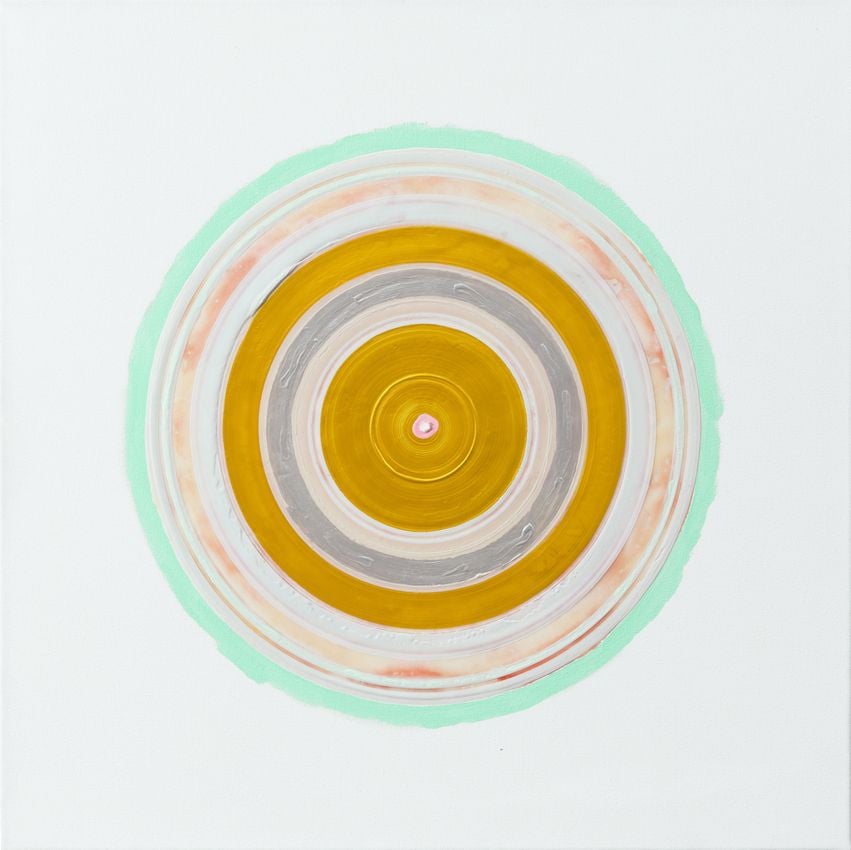
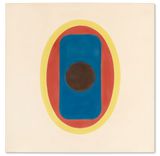
By the late 1950s Noland had begun the circle or target paintings that became his breakthrough works. Built from concentric bands of stained colour, these paintings use simple geometry to stage complex interactions of hue, luminosity, and surrounding field, inviting viewers to experience colour as an optical and physical force. The stain technique reduced visible brushwork, fusing pigment and canvas and underscoring the flatness of the picture plane in line with Greenberg’s formalist ideas.
In early versions, bold rings of colour sit against white or off-white grounds; by around 1962 Noland began using coloured backdrops and cleaner edges, sometimes making the innermost circle, rather than the outer rings, the visual focal point. Critics and curators quickly recognised these targets as key examples of the new Color Field painting, a post-Abstract Expressionist tendency defined by large, unbroken areas of colour and an emphasis on optical experience over gesture. Noland’s targets were widely reproduced and became among the most recognisable images of postwar American abstraction.
The Washington Color School
As his circle paintings developed, Noland became a central figure in what came to be known as the Washington Color School, a loose grouping of painters working in Washington, DC, in the late 1950s and 1960s. Artists associated with the movement include Morris Louis, Gene Davis, Howard Mehring, Thomas Downing, Paul Reed, and, in a broader sense, Sam Gilliam and Alma Thomas. They shared an interest in flat, solid areas of intense colour, often using acrylic paints on raw canvas and emphasising the surface’s unity rather than traditional compositional hierarchy.
The 1965 exhibition The Washington Color Painters at the Washington Gallery of Modern Art helped solidify the group’s reputation and made Washington a recognised centre for Color Field painting. Noland’s role as both teacher and practitioner meant that his experiments with soak-stain methods and shaped formats strongly influenced younger artists in the city. For search and scholarship alike, “Kenneth Noland Washington Color School” remains a key phrase linking the artist to this regional but influential movement.
Chevrons, Post-Painterly Abstraction, and Venice
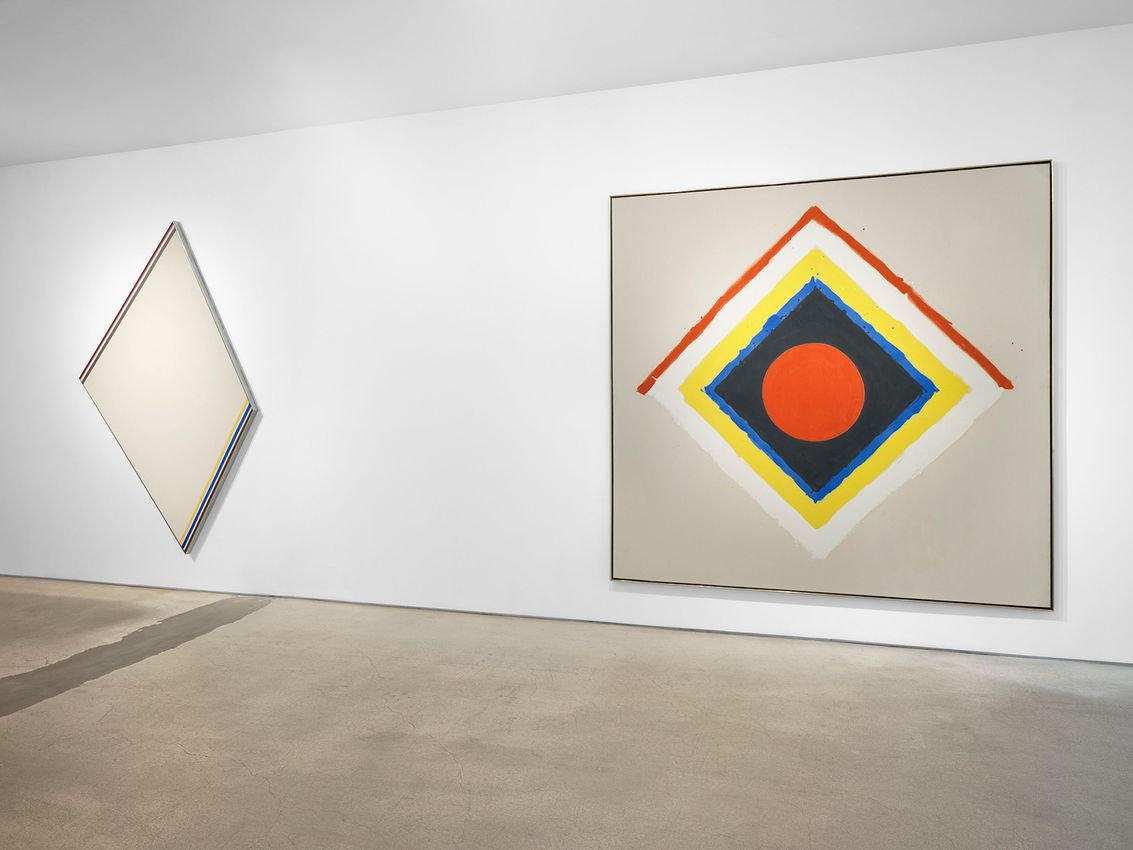
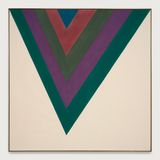
By the early 1960s Noland felt he had exhausted the possibilities of “circles in a square” and began looking for a new structure through which to continue exploring colour interactions. The result was the chevron series: nested V-shapes that drive colour toward the corners of the canvas and heighten awareness of the painting’s edges. These works shifted the viewer’s experience from radial expansion to directional pull, suggesting rising or falling movement while maintaining a rigorously flat surface.
In 1964 Noland’s position in the new abstraction was cemented when Clement Greenberg curated Post-Painterly Abstraction at the Los Angeles County Museum of Art, a travelling exhibition that presented artists including Noland, Helen Frankenthaler, Jules Olitski, and Frank Stella as exemplars of a cleaner, more open alternative to gestural Abstract Expressionism. That same year Noland and Louis were among eight artists representing the United States at the 32nd Venice Biennale, where his targets and chevrons were shown alongside works by Jasper Johns and Robert Rauschenberg. These exhibitions gave Noland international visibility and firmly identified him with Color Field painting and Post-Painterly Abstraction.
Stripes, shaped canvases, and Vermont
In the mid- to late 1960s Noland began dividing his time between New York and a farm called The Gully in South Shaftsbury, Vermont, purchased in 1963 from the estate of poet Robert Frost. There he developed close friendships with artists Jules Olitski and Anthony Caro, sharing a commitment to rigorous abstraction and ongoing formal experimentation. This rural setting provided the space for large paintings and further exploration of colour and format.
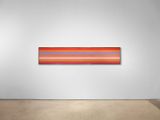
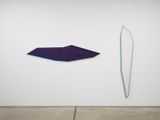
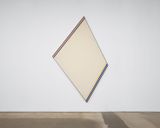
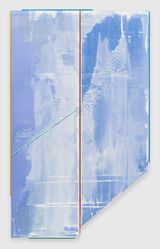
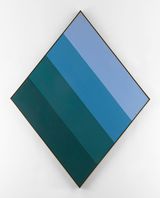
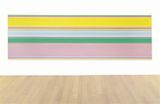
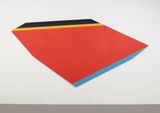
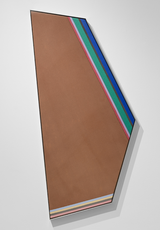
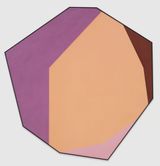
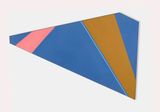
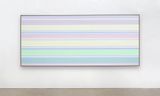
Having worked through multiple permutations of targets and chevrons, Noland turned to the Stripes series (c. 1967—70), reducing his compositions to parallel horizontal bands of varying widths and colours running across rectangular canvases. Unlike the earlier formats, the stripes often cover the entire surface, with no unpainted ground, making rhythm and interval the main compositional variables. Around the same time, Noland pioneered shaped canvases, first using symmetrical and asymmetrical diamonds and chevrons in which the edges of the canvas became as structurally important as the centre. During the 1970s and 1980s these shaped works grew increasingly irregular and complex, combining precise colour control with inventive, sometimes eccentric, silhouettes.
Late work, Mysteries series, and teaching
In the 1970s and 1980s Noland continued to revisit and revise earlier formats, briefly returning to chevrons and experimenting with plaid-like arrangements of intersecting bands. He also produced numerous shaped canvases whose highly irregular outlines pushed his investigation of edge and support further than before. Parallel to his studio work, he returned intermittently to teaching, serving for example as Milton Avery Professor of the Arts at Bard College in 1985, where he influenced a younger generation of abstract painters.
Around 1999 Noland began his Mysteries series (c. 1999—2002), a group of works on paper and unprimed canvas that revisited the target motif using acrylics. These new targets, symmetrical and boldly coloured, acknowledged his early breakthrough while reaffirming the continued relevance of pure colour and simple geometry at the turn of the millennium. The series underscored the consistency of his concerns across five decades, even as specific formats evolved.
Death and Legacy
Kenneth Noland died of cancer at his home in Port Clyde, Maine, on 5 January 2010, aged 85. He was survived by his wife, Paige Rense, editor-in-chief of Architectural Digest, and children from earlier marriages. Obituaries in major publications such as The New York Times and the Los Angeles Times described him as a central figure in Color Field painting whose brilliantly coloured circles, chevrons, and stripes were among the most recognised signatures of postwar abstraction.
Noland’s work is represented in museum collections worldwide, including The Museum of Modern Art, the Metropolitan Museum of Art, the Whitney Museum of American Art, the Hirshhorn Museum and Sculpture Garden, Tate, Kunsthaus Zürich, and many others. Critics and historians often situate him at the intersection of several key tendencies—Color Field painting, the Washington Color School, Post-Painterly Abstraction—and note that his flat, starkly simple compositions helped pave the way for Minimalism and later geometric movements. His influence can be traced in artists from Frank Stella and Donald Judd to subsequent generations of Washington-based abstract painters.
Themes, Methods, and Influence
Noland’s paintings rarely contain explicit narrative or political content, but they are not neutral exercises in design. They concentrate on perception: how the eye tracks colour, senses weight, and registers balance within a strictly non-illusionistic space. By eliminating overt gesture and imagery, he asked viewers to experience colour as something that can advance or recede, press outward or contract, creating calm or instability through small shifts in value, saturation, and proportion.Combining Mondrian’s structural clarity and Albers’s interest in colour interaction with the spiritual ambiguity of Color Field contemporaries like Mark Rothko and Barnett Newman, Noland created abstractions built from pure colours, shapes, and lines. His method—repeating simple formats while varying their internal relationships—demonstrated how tight formal constraints could yield a lifetime of invention.
Exhibitions, Collections, and Recognition
Noland’s prominence was cemented by his inclusion in the landmark 1964 exhibition Post-Painterly Abstraction, which showcased a generation of artists moving beyond gestural painting. In 1977 a major retrospective at the Solomon R. Guggenheim Museum surveyed his work and later travelled to institutions including the Hirshhorn Museum and Sculpture Garden and the Toledo Museum of Art, offering a comprehensive view of his development to a broad public. During his lifetime, Noland also participated in international exhibitions such as the Venice Biennale and appeared in multiple Whitney Museum annuals and biennials, further confirming his status within American and international abstraction.
Today, Noland’s paintings and works on paper are represented in major museum collections worldwide, including The Museum of Modern Art and the Metropolitan Museum of Art in New York, the Whitney Museum of American Art, the Hirshhorn Museum and Sculpture Garden in Washington, DC, and the Art Institute of Chicago. His estate continues to be represented by leading galleries, and his work remains a regular presence in museum collection displays and historical surveys of Color Field painting and postwar abstraction.
Kenneth Noland FAQs
What kind of painter was Kenneth Noland?
Kenneth Noland was an American Color Field painter associated with the Washington Color School and Post-Painterly Abstraction. He is especially known for abstract paintings built from targets, chevrons, stripes, and shaped canvases, in which stained colour fields replace traditional brushy gesture.
What is Kenneth Noland best known for?
Kenneth Noland is best known for his circle paintings, chevron paintings, stripe paintings, and shaped-canvas works that explore how colour and geometry can structure visual experience. These series made him one of the central figures in postwar American abstraction and are frequently cited in discussions of Color Field painting.
What themes does Kenneth Noland explore in his work?
Rather than narrative stories, Noland’s paintings explore themes of perception, balance, rhythm, and the relationship between colour and the physical edge of the canvas. His repeated use of circles, V-shapes, and stripes allows him to test how small shifts in hue, width, and spacing change the way a painting feels and how a viewer’s eye moves across it.
Where can I see Kenneth Noland’s work?
Kenneth Noland’s work can be seen in major museum collections including The Museum of Modern Art and the Metropolitan Museum of Art in New York, the Whitney Museum of American Art, the Hirshhorn Museum and Sculpture Garden in Washington, DC, and the Art Institute of Chicago. His paintings also appear in rotating displays and historical surveys of Color Field painting and postwar abstraction at museums and galleries in the United States and abroad.
What movement is Kenneth Noland associated with?
Kenneth Noland is most closely associated with Color Field painting, the Washington Color School, and the broader tendency known as Post-Painterly Abstraction. His stained, flatly painted targets, chevrons, stripes, and shaped canvases exemplify the move away from gestural Abstract Expressionism toward a cooler, more focused abstraction built around colour and surface.
Ocula | 2026


View Kenneth Noland's Artworks
























Explore and Follow Artists Shaping Contemporary Art
A respected voice in contemporary art discourse.
Focusing on ambitious storytelling and insightful art-world commentary. Ocula Magazine publishes in-depth interviews, critical essays and timely analysis on the artists, exhibitions and ideas driving the global art world.
Learn more about Ocula Magazine
Showcasing the best of the art world.
Ocula partners with galleries from around the world to highlight their artists, artworks and exhibitions. Gallery membership is by application and invitation, with each member vetted by an independent panel.
Learn more about Ocula Membership
Specialises in the sale of major artworks.
Led by a team with deep ties to the world’s leading auction houses, galleries and collectors. Ocula’s advisory team offers bespoke services to high-net-worth clients from around the world who are looking to acquire the best of contemporary and modern art.
Learn more about our team and services