





DOUGLAS GORDON
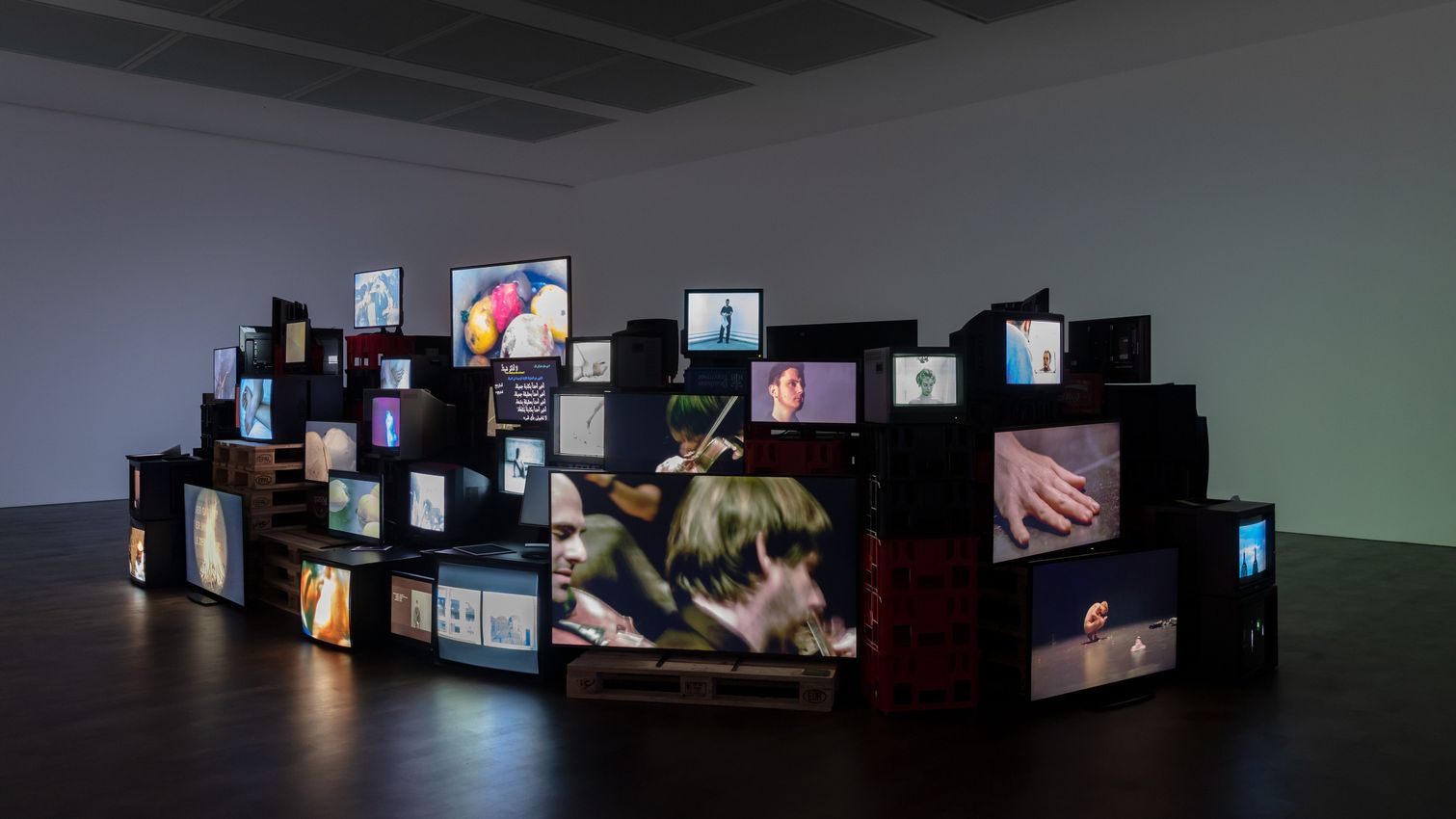
b. 1966, United KingdomIn his conceptually challenging video works, Scottish artist and Turner Prize winner, Douglas Gordon pillages footage from visual culture, dissecting scenes and re-presenting them in installations that invoke broad moral dilemmas.
Early Years
Gordon was born in Glasgow, Scotland. He received his Bachelor of Arts from the Glasgow School of Art in 1988 and graduated from the Slade School of Fine Art in London in 1990. Gordon was awarded the Turner Prize in 1996, the Premio 2000 at the 47th Venice Biennale in 1997, and the Hugo Boss Prize in 1998.
Douglas Gordon Artworks
Douglas Gordon appropriates imagery and sound from popular media, exposing our ambiguous relationships to memory and meaning through his disorienting reconfigurations.
Fractured Time
In his video works, Gordon tampers with time to disrupt preconceived notions of reality. This is gradually made apparent in 24 Hour Psycho (1993), where Gordon slows down Alfred Hitchcock’s 1960 film Psycho to run for 24 hours. Conceptually, this day-long deceleration reveals the complexity of memory mechanisms in the viewer’s mind. Tension and drama is excised from the film and inverted into a kind of daydreaming reality where the viewer no longer attempts to interpret scenes in relation to another. All meaning is diverted to the viewer’s subjectivity—a strategy Gordon also employs in 10ms-1 (1994) and Déjà-Vu (2000), both of which incorporate slowed-down footage and multiple projections.
Binary oppositions of good and evil are prominent in Gordon’s work and are often reflected in his installation methods. Using multiple screens and projections, works like A Divided Self I and II (1996) represent this opposition within a single person, presenting a hairy and shaved arm endlessly grappling one another. Eventually it becomes clear that both arms belong to the artist, insinuating a mysterious internal conflict. 24 Hour Psycho Back and Forth and To and Fro (2008) doubles the original work with an adjacent iteration played in reverse.
Gordon’s Turner Prize exhibition Confessions of a Justified Sinner (1995) presents two screens wrapping around a room’s corner, a negative and positive slowed-down segment from Rouben Mamoulian’s Dr. Jekyll and Mr. Hyde (1931). This emphasis on the characters’ shifting personalities reflects Gordon’s engagement with dualities, itself driven by the artist’s interest in Scottish literary history, which is dominated by tensions between darkness and light.
Text and Sound
Gordon also utilises text- and sound-based installations to explore themes of identity and memory. In List of Names (1990–ongoing), Gordon attempts to remember the names of everyone he has met, presented in memorial-type columns. This simple gesture conveys the functionality of imperfect human memory.
Text is also used in Pretty much every word written, spoken, heard, overheard from 1989... (2010), an installation of over 80 text-based works anointing the interior architecture at the Tate Britain. Simple phrases range from the biblical—‘We Are Evil’, ‘Read the Word ... Hear the Voice’—to pop culture—‘This May Be the Last Time’—taken from a Rolling Stones song. Here, Gordon appropriates textual semantics to question notions of authoritative truth.
Taking on another method of social communication, Gordon collates the songs most popular in the months preceding and following his birth in 1966. The sound installation Something Between My Mouth and Your Ear (1994) explores the hidden influence of this cultural context on the way that Gordon interprets reality. Throughout his works, Gordon appropriates these communal communication systems to consider how our perceptions are shaped by external and internal forces.
Awards and Accolades
Gordon has been the recipient of several prestigious awards. These include the London Awards for Art and Performance, London Festival Fringe (2011); Hugo Boss Prize (1998); Premio 2000 at Venice Biennale (1997); and the Turner Prize (1996).
Exhibitions
Douglas Gordon has been the subject of solo and group exhibitions internationally.
Select solo exhibitions include In My Shadow, ARoS Aarhus Kunstmuseum, Denmark (2019); k.364, K20 Kunstsammlung Nordrhein-Westfalen, Dusseldorf (2018); Îles Flottantes, Instituto Moreira Salles, Sao Paulo (2018); Portrait of Janus, Art Sonje Center, Seoul (2017); Black Burns, Scottish National Portrait Gallery, Edinburgh (2017); Gente Di Palermo!, Prisons of the Palazzo Ducale, Venice (2017); The Only Way Out Is The Only Way In, Australian Centre for Contemporary Art, Melbourne (2014); Pretty much every film and video work from about 1992 until now, Musée d’Art Moderne de Paris (2014); I Am Also..., Tel Aviv Museum of Art (2013); Blood, Sweat, Tears, DOX Centre for Contemporary Art, Prague (2009); and Between Darkness and Light: Works 1989–2007, Kunstmuseum Wolfsburg, Germany (2007).
Select group exhibitions include Icons, Villa Empain, Brussels (2021); Broadcast: Alternate Meanings in Film and Video, Gagosian, New York (2020); In Production: Art and the Studio System, Yuz Museum, Shanghai (2019); The Rat-Catcher, Wrocław Contemporary Museum, Poland (2018); About Photography, Gagosian, San Francisco (2018); Documenta 14, Athens (2017); Douglas Gordon / Lawrence Weiner, Gagosian, Athens (2017); LEXICON, Gagosian, Paris (2016); Hello Walls, Gladstone Gallery, New York (2015); Generation: 25 Years of Contemporary Art in Scotland, National Galleries of Scotland, Edinburgh (2014); Art under Attack: Histories of British Iconoclasm, Tate Britain, London (2013); Art Unlimited, Art Basel, Basel (2012); 29th São Paulo Biennial, Sao Paulo (2011); Art and the Sublime, Tate Britain, London (2010); and All Creatures Great and Small, Zacheta National Gallery of Art, Warsaw (2009).
Peter Derksen | Ocula | 2022


Explore Douglas Gordon's Exhibitions







Explore and Follow Artists Shaping Contemporary Art
A respected voice in contemporary art discourse.
Focusing on ambitious storytelling and insightful art-world commentary. Ocula Magazine publishes in-depth interviews, critical essays and timely analysis on the artists, exhibitions and ideas driving the global art world.
Learn more about Ocula Magazine
Showcasing the best of the art world.
Ocula partners with galleries from around the world to highlight their artists, artworks and exhibitions. Gallery membership is by application and invitation, with each member vetted by an independent panel.
Learn more about Ocula Membership
Specialises in the sale of major artworks.
Led by a team with deep ties to the world’s leading auction houses, galleries and collectors. Ocula’s advisory team offers bespoke services to high-net-worth clients from around the world who are looking to acquire the best of contemporary and modern art.
Learn more about our team and services