




GERHARD RICHTER
b. 1932, GermanyGerhard Richter is a renowned German painter and one of the most influential contemporary artists of the 20th and 21st centuries, celebrated for both his abstract paintings and photorealistic works. Over a career spanning more than six decades, Richter has explored how photography and painting borrow from, contradict, and reinvent each other, making him a key figure in postwar and contemporary art
Early life and education
Born in Dresden in 1932, Gerhard Richter’s early life was defined by wartime devastation and personal loss—experiences that would later inform his art’s preoccupation with memory, trauma, and fragility. His father, a teacher reluctantly conscripted into the German army, and his pianist-bookseller mother embodied a family navigating ideological pressures, fostering Richter’s lifelong scepticism of political and artistic dogma.
Upon leaving school, Richter trained as a sign and set painter, developing technical skills that conflicted with the Socialist Realist orthodoxy he encountered at Dresden’s Academy of Fine Arts (1951–1956). Though he mastered state-dictated mural painting, he ultimately rejected its constraints as creatively suffocating, paving the way for his later engagement with Western abstraction.
At Documenta II in 1959, Richter encountered definitive masterpieces of radical Western abstraction in Jackson Pollock‘s anarchic drip-painting and Lucio Fontana‘s slashed voids— twin manifestos of artistic liberation. This revelation destroyed his remaining faith in official figurative art coinciding with his defection to West Germany in 1961, before the Berlin Wall’s construction.
Gerhard Richter Artworks and Key themes
Gerhard Richter’s art employs blurred, erased, and layered techniques to dissect how photographic, painted, or archival images mediate and distort both collective and personal memory. Across his paintings, photographs, and glass works, Richter continuously questions whether images can ever present objective truth, or whether they inevitably construct fiction.
Düsseldorf, Capitalist Realism and Photopainting
Following his relocation to West Germany, Richter’s enrolment at Düsseldorf’s Kunstakademie (1961–1963) sparked a profound transformation in his artistic practice. There, he forged connections with fellow artists Sigmar Polke and Blinky Palermo, as well as future gallerist Konrad Lueg (later known as Konrad Fischer). United by a shared interest in political critique, they co-founded ‘Capitalist Realism’ in 1963—a brief but impactful movement that parodied Pop Art’s uncritical embrace of consumer culture through ephemeral installations and performances like Living with Pop: A Demonstration for Capitalist Realism (1963), first presented as a one-day action in an ordinary Düsseldorf furniture store. In this work, Richter and Lueg sat among mass-produced sofas, lamps, and wall units as if they themselves were commodities, turning the showroom into a live tableau that blurred the lines between performance, advertising display, and painting.
Richter’s Düsseldorf years also ignited his lifelong exploration into whether photographs reveal truth or manipulation. Responding to this fascination, he developed a technique of reworking figurative paintings while they were fresh, calling it Vermalung (“overpainting”). Works such as Table (Tisch) (1962) exemplify this practice, depicting a photorealist table obscured by gestural brushstrokes that blur the line between representation and chaos. This duality is echoed powerfully in later works such as Uncle Rudi (1965) and Aunt Marianne (1965), which draw on family photographs linked to the Nazi period.
In Uncle Rudi, one of his most iconic works: drawn from a full-length photograph of his uncle in Wehrmacht uniform, Richter meticulously reproduced the photograph in oil before deliberately smearing the surface. This act of erasure evokes memory’s fragility and the unsettling entanglement of family legacy, historical complicity, and moral reckoning.
Radical Experimentation: Atlas, Grey Paintings and Colour Charts
The 1960s and 1970s signalled Gerhard Richter’s embrace of conceptual art, a shift rooted in his decision in 1962 to compile a sprawling archive of photographs of family snapshots, landscapes, still lifes, newspaper clippings, and painting sketches. Over the next decade, this archive evolved into an artwork called Atlas, begun in 1962 and continuously expanded over subsequent decades. By exhibiting these fragments as a cohesive whole, Richter interrogated the mechanisms by which images shape, and often distort, collective memory.
Simultaneously, he produced a series of monochrome paintings called Grey (Grau) (1968–1975), which neutralised colour to explore the painted surface’s materiality and emotional ambiguity. The most famous example from this period is his 48 Portraits (1971–72), a grid of grey-toned, blurred portraits of historical figures—primarily male writers, composers, and scientists—questioning how modern culture memorialises “greatness”.
Whilst Richter would often reject the supposed objectivity of photography in his art, his ‘Colour Charts’ series (1966–1974) did the opposite. These paintings feature methodical grids of mechanically mixed paint squares, often arranged via chance systems like dice rolls, thereby avoiding as much subjectivity in the painting process as possible.
In this decade Richter also introduced his first glass constructions, such as Four Panes of Glass (1967), an installation that literalised his fascination with painting as a “window”. Here, the glass is transformed into reflective surfaces that refract fleeting glimpses of viewers and their surroundings, further complicating the act of looking.
Abstraction, Squeegee Paintings and Overpainted Photographs
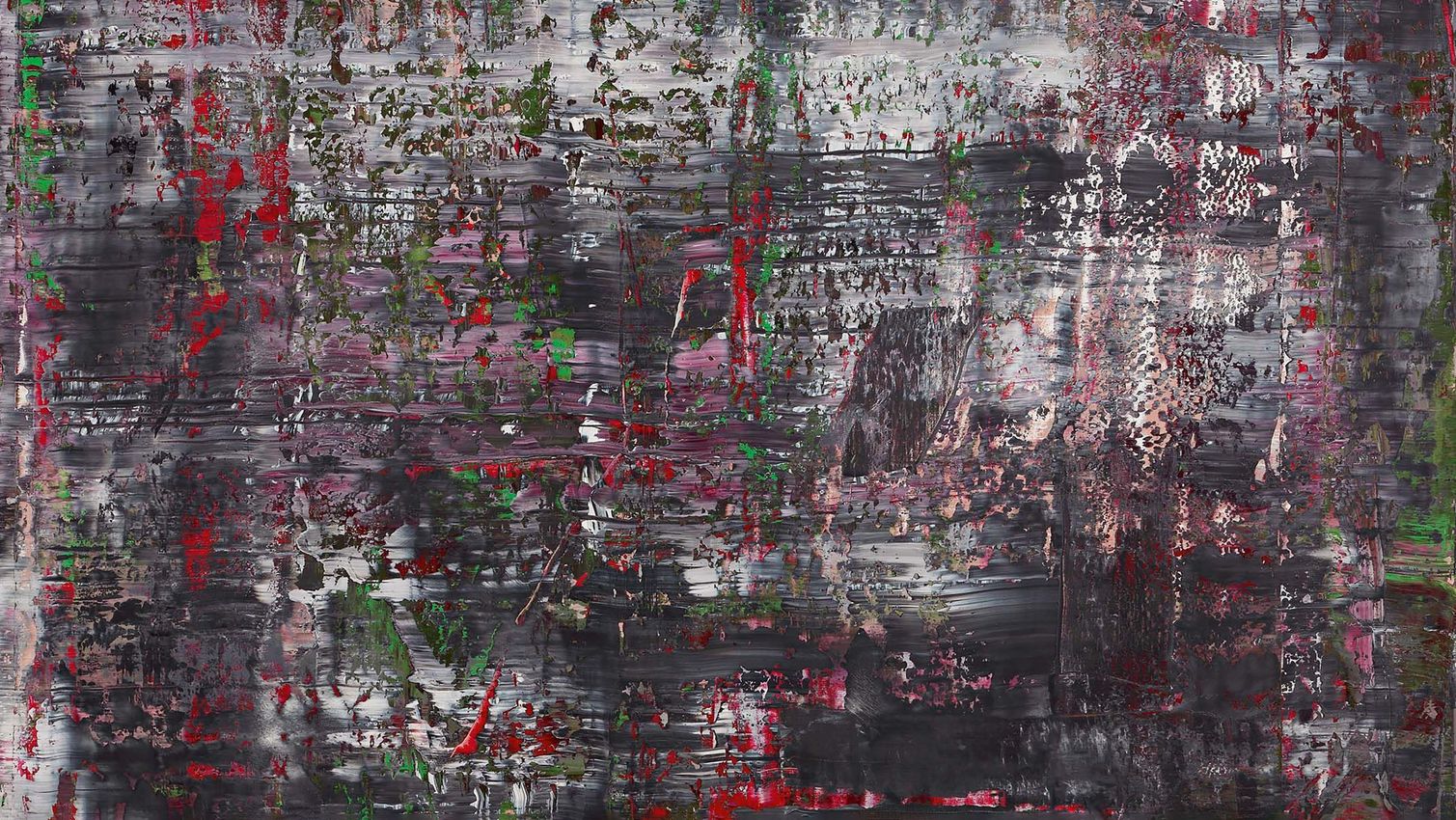
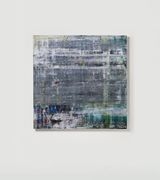
The 1980s heralded Richter’s shift to large-scale abstract painting. This era was defined by a more extreme use of Vermalung, which evolved into his now-famous squeegee technique, using large-scale squeegees to erase, drag, and rework forms painted on the canvas.
Featured heavily in paintings like Abstract Painting (599) (1986), Vermalung was not a destructive but a generative act. By stripping away narrative, Richter exposed the instability of images as vessels of meaning, remarking that “the painting is smarter than I am”, and embracing chance as a collaborator. This technique was emphasised most in his ‘Cage’ series (2006), named after composer John Cage, where vibrant striations echoed Cage’s experimental music, merging gesture with improvisation.
Richter’s Vermalung technique evolved to address increasingly charged subject matter in his late career. In works like Overpainted Photographs (1989–present) and Haggadah (2006), he applied the method to family snapshots and documentary images, smearing faces into anonymity—a gesture that mirrored Germany’s unresolved reckoning with collective guilt.
Birkenau (2014) is a four-part abstract series based on photographs secretly taken by Jewish prisoners at the Auschwitz-Birkenau concentration camp in 1944. The artist made photographic renditions of the images and painted over them until they became unrecognisable, leaving only layered abstractions and a profound meditation on the limits of representation in the face of atrocity.
Gerhard Richter Public Commissions
Richter’s work has been the subject of numerous public commissions around Europe and beyond. Selected examples include:
- Silicate (Glasvorhang) (2002–2003), glass installation at Dresden Royal Palace, Dresden.
- South Transept Window (often referred to as the Cologne Cathedral Window) (2007), Cologne Cathedral, Cologne.
- 4900 Colours (2007), panel work developed in relation to the Cologne Cathedral window; 4900 Colours: Version II (2008), Serpentine Galleries, London.
- Birkenau (2014), four-part painting cycle; Birkenau installation (2017), permanent display, German Bundestag (Reichstag), Berlin.
- Tholey Abbey stained-glass windows (2020), Tholey Abbey, Germany.
- STRIP-TOWER (2023–2024), outdoor sculpture, Serpentine Galleries & The Royal Parks, Kensington Gardens, London.
- Color Chase One and Color Chase Two (commissioned 2024, installed 2025), foyer installation, JPMorganChase Headquarters, 270 Park Avenue, New York.
What Are Some of Gerhard Richter’s Notable Awards and Accolades?
- Junger Westen Art Prize (1967), Kunsthalle Recklinghausen, Recklinghausen, Germany.
- Arnold Bode Prize (1981), Documenta Kassel, Kassel, Germany.
- Oskar Kokoschka Prize (1985), Vienna Biennale Foundation, Vienna, Austria.
- Kaiserring Prize (1988), Mönchehaus-Museum für Moderne Kunst, Goslar, Germany.
- Wolf Prize (1994/1995), Wolf Foundation, Jerusalem, Israel.
- Golden Lion for Painting (1997), Venice Biennale, Venice, Italy.
- Praemium Imperiale (1997), Japan Art Association, Tokyo, Japan.
- State Prize of North Rhine-Westphalia (2000), State Government of North Rhine-Westphalia, Düsseldorf, Germany.
- International Auschwitz Committee “Gift of Remembrance” / Statue of the Inverted B (2023), International Auschwitz Committee, Berlin/Cologne, Germany.
What Are Some of Gerhard Richter’s Notable Exhibitions?
Gerhard Richter has been the subject of both solo exhibition and group exhibitions at important institutions and galleries, including the selection provided below:
Solo Exhibitions:
- Gerhard Richter: Atlas of Photographs, Collages and Sketches (1989), Museum Ludwig, Cologne, Germany.
- 40 Years of Painting (2002), Museum of Modern Art (MoMA), New York City, USA (travelled to Chicago, San Francisco, and Washington, D.C., USA).
- Six Gray Mirrors (2003), Dia:Beacon, Beacon, USA.
- Sinbad (2008), Museum Ludwig, Cologne, Germany.
- Abstract Paintings (2008), Marian Goodman Gallery, Paris, France.
- 4900 Colours: Version II (2008), Serpentine Galleries, London, UK.
- Gerhard Richter: Painting After All (2020), The Met Breuer, New York City, USA.
- Icons from a Half Century of Art (2024), Gagosian Gallery, New York City, USA.
- Gerhard Richter: 100 Works for Berlin (2025–ongoing), Neue Nationalgalerie, Berlin, Germany.
- Gerhard Richter (2025–2026), Fondation Louis Vuitton, Paris, France.
Group Exhibitions:
- 36th Venice Biennale (1972), Venice, Italy.
- Documenta 7 (1982), Kassel, Germany.
- Documenta 12 (2007), Kassel, Germany.
- 52nd Venice Biennale (2007), Venice, Italy.
- Icons from a Half Century of Art (2024), Gagosian, New York, USA.
- Iconic: Portraiture from Francis Bacon to Andy Warhol (2025), The Holburne Museum, Bath, UK.
- Typologien (2025), Fondazione Prada, Milan, Italy.
Gerhard Richter FAQs
What is Gerhard Richter’s most iconic artwork?
Gerhard Richter’s October 18, 1977 (1988) is iconic for its political ambiguity. Cologne Cathedral Window (2007) and Birkenau (2014) also rank among his best-known and most famous works.
What defines Gerhard Richter’s ‘blur’ technique?
Gerhard Richter applies soft brushes or squeegees to wet paint, creating hazy edges that destabilise images. This blur questions photography’s truthfulness and evokes memory’s fragility.
Why does Gergard Richter switch between styles so often?
Gerhard Richter rejects artistic dogma, viewing style as a tool rather than an identity. This fluidity allows him to interrogate diverse themes, from history to perception, without constraints.
Has Gerhard Richter’s work faced controversy?
Yes. Gerhard Richter’s Baader-Meinhof cycle 18. Oktober 1977 (1988) sparked debates about art’s role in memorialising trauma, while Cologne Cathedral Window drew criticism for its abstract, non-religious design.
How has the art market responded to Gernard Richter’s work?
Gerhard Richter holds auction records for living artists, with works like Abstraktes Bild (809‑4) (1986) selling for approximately $46.3 million in 2015. His market appeal lies in his technical mastery and conceptual depth, attracting major collectors and institutions.
Where can I see Gerhard Richter’s work?
Gerhard Richter’s work is displayed permanently at institutions such as the Neue Nationalgalerie in Berlin and in public installations like the Cologne Cathedral window and STRIP-TOWER in London’s Kensington Gardens.
Ocula | 2026

Explore Gerhard Richter's Exhibitions On Now



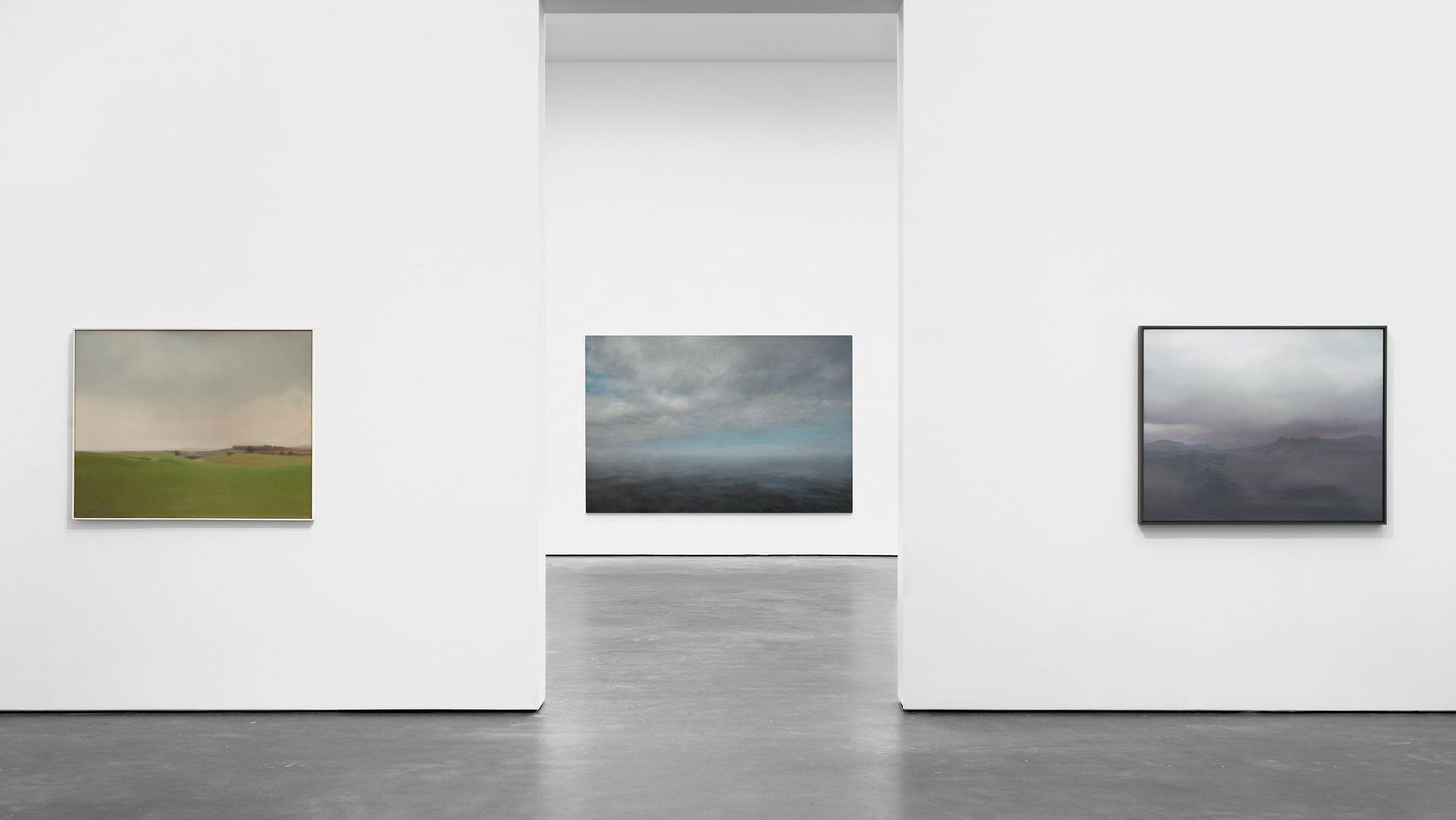
View Gerhard Richter's Artworks






















Gerhard Richter in Ocula Magazine






Explore and Follow Artists Shaping Contemporary Art
A respected voice in contemporary art discourse.
Focusing on ambitious storytelling and insightful art-world commentary. Ocula Magazine publishes in-depth interviews, critical essays and timely analysis on the artists, exhibitions and ideas driving the global art world.
Learn more about Ocula Magazine
Showcasing the best of the art world.
Ocula partners with galleries from around the world to highlight their artists, artworks and exhibitions. Gallery membership is by application and invitation, with each member vetted by an independent panel.
Learn more about Ocula Membership
Specialises in the sale of major artworks.
Led by a team with deep ties to the world’s leading auction houses, galleries and collectors. Ocula’s advisory team offers bespoke services to high-net-worth clients from around the world who are looking to acquire the best of contemporary and modern art.
Learn more about our team and services