





CY TWOMBLY
1928-2011, United StatesCy Twombly stands among the defining figures of post-war American art, celebrated for his dynamic, calligraphic paintings that merge abstraction, literature, and classical history. He is one of the most enduring and influential artists of the twentieth century, admired for transforming gesture into a vehicle for memory and myth. Major exhibitions at the Museum of Modern Art in New York, Tate Modern in London, and Centre Pompidou in Paris affirm his position within both European and American modernism, reflecting ongoing critical and curatorial interest across global art capitals.
Early Life and Education
Born in Lexington, Virginia, on 25 April 1928, Edwin Parker “Cy” Twombly Jr. was the son of a former Chicago White Sox pitcher, also nicknamed Cy, who in turn took his name from the baseball player Cy Young. As a child, Twombly took private art lessons with the Catalan painter Pierre Daura, and his early interest in drawing was further nurtured by mail-order art kits. After attending Lexington High School and Darlington School in Georgia, he studied at the School of the Museum of Fine Arts, Boston (1948–49), Washington and Lee University in Lexington (1949–50), and the Art Students League of New York (1950–51).
In the early 1950s, Twombly received a scholarship to Black Mountain College in North Carolina, where he encountered artists such as Franz Kline and Robert Motherwell and deepened his commitment to gestural abstraction. Motherwell supported his first solo exhibition at the Samuel M. Kootz Gallery in New York in 1951, at a moment when Twombly’s work reflected the impact of Kline’s stark black-and-white brushwork and an interest in Paul Klee’s poetic imagery. In 1952 he was awarded a grant from the Virginia Museum of Fine Arts that enabled an extended journey through North Africa and Europe, travelling with Robert Rauschenberg and absorbing Mediterranean landscapes and classical sites that would become lifelong touchstones.
Between 1953 and 1954 Twombly served in the U.S. Army as a cryptographer, an experience that heightened his fascination with codes, signs, and systems of writing. During periods of leave he made automatic drawings in the dark, producing biomorphic forms and nervous lines that anticipated his later graphic language. After his discharge he taught at Southern Seminary and Junior College in Buena Vista, Virginia (1955–56), while travelling frequently to New York to paint and exhibit.
Twombly’s travels with Rauschenberg through North Africa and Europe in the early 1950s crystallised his interest in classical mythology and Mediterranean culture. In 1957 he moved to Rome with the support of patron Baron Giorgio Franchetti, later marrying Franchetti’s sister Tatiana and establishing a studio practice that shifted between Rome and the coastal town of Gaeta. Living in Italy brought him into daily contact with ancient art, Renaissance painting, and baroque architecture, all of which informed the historical and poetic registers of his work.
Throughout the later 1950s Twombly divided his time between New York and Italy, maintaining close ties with artists such as Rauschenberg and Jasper Johns while developing a path distinct from both Abstract Expressionism and emerging Pop art. His early New York paintings explored a raw, graffiti-like approach to mark-making—thin white lines scratched across dark, heavily worked surfaces—hinting at the distinctive fusion of drawing and painting that would define his mature style.
Art and Visual Language
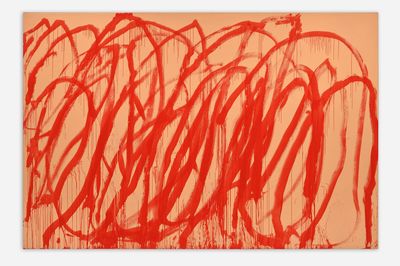
Twombly’s art is characterised by an emotive synthesis of painting, writing, and historical reference. His compositions often resemble palimpsests or ancient manuscripts, with layers of pencil, crayon, and paint accumulating as if over time. Lines loop, smear, and collide; words and names appear only to dissolve back into gesture, creating a productive tension between legibility and abstraction. Across paintings, works on paper, and sculpture, he cultivated a fragile yet monumental handwriting of history, built through erasure, repetition, and splashes of colour.
Twombly frequently incorporated fragments of poetry and literary citation into his work, drawing on figures such as Stéphane Mallarmé, John Keats, Rainer Maria Rilke, and the Roman poet Virgil, alongside references to Greek and Roman myth. Examples include Apollo and the Artist (1975), in which the god’s name and atmospheric marks intertwine on a luminous ground, and the portfolio Virgil (1960), a series of etchings and drawings built almost entirely from repeated inscriptions of the poet’s name. These works exemplify his ability to turn language itself into a kind of pictorial material.
Blackboard Paintings and Early Abstraction
During the 1950s and 1960s, Twombly created intensely tactile canvases combining pencil, paint, and gesso, scratching, scoring, and smearing wet surfaces to produce bristling, scarred fields of marks. Early works such as Tiznit and Volubilis (both 1953) take their titles from North African locations and feature webs of incised lines that blur the boundary between drawing and painting, suggesting maps, graffiti, or eroded architectural surfaces. Paintings like School of Athens (1961), Dutch Interior (1962), and Untitled (1964/1984) animate pale grounds with looping strokes, splatters, and partially legible letters, as though moments of thought and memory were being recorded in real time.
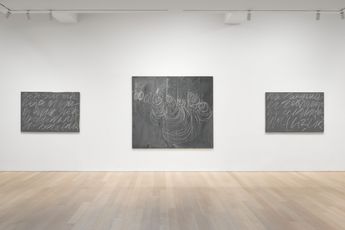
His iconic “blackboard paintings”, realised between 1966 and 1971, use white wax crayon on grey or slate-coloured grounds to create continuous, looping marks that evoke classroom cursive and the passing of time. Works such as Untitled (Rome) (1966), Untitled (New York City) (1968), and Untitled (1970) present rows of rhythmic, script-like arcs that speed up into dense knots or slow into hesitant repetitions, suggesting both disciplined practice and the fallibility of memory. The 1968 New York City canvas achieved an auction record of US$70.5 million at Sotheby’s New York in 2015, underscoring Twombly’s status among the world’s most valuable post-war artists.
Later Paintings: Colour and Monumentality
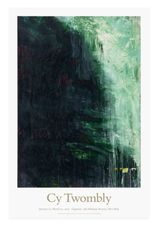
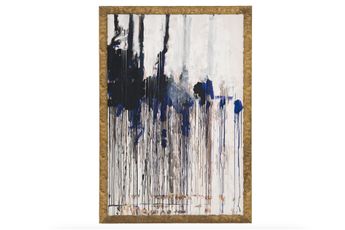
From the late 1980s onward, Twombly increasingly embraced vivid colour, larger formats, and more open compositions. The series Coronation of Sesostris (2000) combines sweeping arcs of red, yellow, and green with cascading drips and scribbled notations, alluding to the Egyptian pharaoh Sesostris while remaining resolutely abstract. The Blooming paintings (2001–2008) present explosive, flower-like forms in saturated pinks and whites against light grounds, their streaks and trickling paint suggesting petals in motion and the excess of nature in bloom.
The Bacchus works (2003–2005) consist of monumental canvases covered with coils and loops of blood-red paint poured and dragged across the surface, conjuring Dionysian ecstasy, wine, and violence in equal measure. Late works such as Camino Real (2010) and the Last Paintings series intensify this language through circular forms and vertical drips, using high-keyed reds, oranges, and whites to evoke cycles of life, death, and renewal. Across these canvases, expanses of unpainted ground heighten the drama of each gesture, allowing colour and line to register as both inscription and atmosphere.
Movements, Peers, and Influence
Although contemporary with Robert Rauschenberg and Jasper Johns, Twombly diverged from the Pop art focus on mass culture and instead extended Abstract Expressionism into a more literary and historically inflected mode. His work absorbs elements of Surrealist automatism, graffiti-like mark-making, and Art Informel, while maintaining a dialogue with European history painting and Romantic landscape traditions. Within post-war art, he occupies a singular position between American gestural abstraction and European neo-avant-garde practices, playing a crucial role in debates about the relationship between text and image.
Twombly’s influence can be traced in the work of artists such as Anselm Kiefer, Francesco Clemente, and Jean-Michel Basquiat, all of whom explore layered surfaces, writing, and mythic or historical subject matter. Many contemporary artists treat writing, memory, and archival material as painterly resources in ways that echo his example; Tacita Dean and Julie Mehretu, for instance, have engaged Twombly’s legacy directly through conversations and exhibitions, while developing their own densely layered, calligraphic spaces. His impact is also visible in the practices of Brice Marden and Christopher Wool, whose repetitive lines and script-like forms recall Twombly’s gestural language and its fusion of drawing, text, and painting.
Twombly Prints
Although best known for his paintings, Twombly was also an accomplished printmaker. From the late 1960s to the late 1970s he explored a wide range of techniques—including line etching, mezzotint, aquatint, lithography, screenprint, and collotype—using each medium to test how his fragile, handwritten marks could be translated into editioned form. Many of these works were issued as portfolios, in which recurring names, numbers, and motifs unfold across multiple sheets like visual poems.
Twombly Sculptures
Twombly also produced a distinctive body of sculpture, assembling humble materials such as wood, cardboard, plaster, and found objects into columnar or altar-like forms that he often painted white. These works, begun in the 1950s and taken up again in the mid-1970s, echo the architecture and fragments of classical sites while sharing the rough, inscribed surfaces of his paintings. Frequently mounted on simple plinths or boxes, the sculptures read as three-dimensional equivalents of his drawings—eroded, enigmatic monuments that extend his exploration of memory, archaeology, and the passage of time.
Twombly Photography
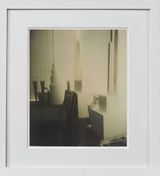
Cy Twombly’s photography forms a quiet, parallel strand to his painting and drawing, functioning less as documentation than as another way of thinking in images. Beginning with black-and-white photographs made as a student at Black Mountain College in the early 1950s and continuing through colour Polaroids taken in Rome, Gaeta, and elsewhere, he used the camera as a kind of visual notebook, recording studios, fragments of ancient architecture, seas and skies, and humble still lifes of fruit and flowers. Printed using a matte dry-print process that softens focus and mutes colour, these images have a deliberately faded, atmospheric quality, echoing the patina and memory-laden surfaces of his paintings and sculptures. Exhibitions and books such as Cy Twombly: Photographs 1951–2007 (2008) and Cy Twombly: Photographs 1951–2010 (Centre for Fine Arts, Brussels; exhibition 2012, catalogue 2011) have revealed this body of work as an intimate, lyrical cosmos in its own right, illuminating the sensibility that underpins his entire oeuvre.
Recognition and Awards
Twombly achieved numerous accolades during his lifetime and has continued to be celebrated posthumously. Key honours include the Golden Lion for Lifetime Achievement at the Venice Biennale (2001), the Praemium Imperiale for Painting from the Japan Art Association (1996), and appointment as an Officer of the Légion d’honneur in France (2010).
Exhibitions
Select Solo Exhibitions
- The Gift of Drawing: Cy Twombly, Menil Drawing Institute, Menil Collection, Houston (27 March–9 August 2026) – a presentation of twenty-seven works on paper spanning the 1950s to the 1980s, drawn from a recent gift by the Cy Twombly Foundation.
- Cy Twombly, Gagosian, 980 Madison Avenue, New York (23 January–22 March 2025) – an exhibition of historic paintings, a sculpture, and works on paper from 1968–1990, organised with the Cy Twombly Foundation.
- Cy Twombly: The Time of a Painting, Museo Nacional del Prado, Madrid (2021) – focused on his engagement with the traditions of European painting.
- Cy Twombly, Centre Pompidou, Paris (2016–2017) – highlighted his dialogue with European modernism and late painterly language.
- Cy Twombly: The Natural World, Selected Works 2000–2007, Art Institute of Chicago (2009) – explored his late investigations of nature, seasons, and colour.
- Cy Twombly: Photographs 1951–2007, Hermitage Museum, St Petersburg (2012).
- Cy Twombly: Cycles and Seasons, Tate Modern, London (2008).
- Cy Twombly: Lepanto, Museum of Fine Arts, Houston (2005).
- Cy Twombly: Fifty Years of Works on Paper, Kunsthaus Zürich and Tate Modern (2004–2005).
- Cy Twombly: A Retrospective, Museum of Modern Art, New York (1994).
- Cy Twombly: Last Paintings, Gagosian, Los Angeles, London, New York, and Hong Kong (2012) – presented his final cycle of large-scale works shortly after his death.
Select Group Exhibitions
- Outliers and American Vanguard Art, National Gallery of Art, Washington D.C. (2018).
- Leap Before You Look: Black Mountain College 1933–1957, ICA Boston (2015).
- America is Hard to See, Whitney Museum of American Art, New York (2015).
- The Forever Now: Contemporary Painting in an Atemporal World, Museum of Modern Art, New York (2014–2015).
- Abstraction in the Twentieth Century, Museum of Modern Art, New York (1996).
- The New American Painting, Museum of Modern Art, New York (1958).
Market and Legacy
Cy Twombly’s global market remains robust, anchored by high-profile results in New York, London, and Paris. His works are coveted by private collectors, major museums, and foundations seeking both historical importance and emotional depth, with demand for the 1960s blackboard paintings and the Bacchus series of the early 2000s, which regularly achieve multi-million-dollar prices. In 2026, Christie’s New York is scheduled to hold a major sale featuring a Twombly painting once owned by Agnes Gund, one of America’s foremost art philanthropists, a provenance that underscores his continuing significance in international collecting circles. Twombly’s market strength reflects not only scarcity but also enduring critical fascination with his synthesis of writing, gesture, and myth across the transatlantic history of modern art.
Further Reading
Twombly’s life and work are explored in publications such as The New Yorker, The New York Times, and The Guardian, as well as in catalogues from MoMA, Tate Modern, Centre Pompidou, and the Cy Twombly Foundation, which together sustain his prominence in art-historical scholarship and public discourse.
Cy Twombly FAQs
Who was Cy Twombly and why is he important in post-war American art?
Cy Twombly (1928–2011) was an American painter whose calligraphic, abstract works merged gestural mark-making with references to classical mythology, poetry, and history, placing him among the most influential post-war artists. His practice bridged Abstract Expressionism and European modernism, making him a key figure in both American and international art history.
What is Cy Twombly best known for in terms of style and technique?
Twombly is best known for his “scribble” or “graffiti-like” style, in which loose lines, scrawled words, and layered marks create a hybrid of drawing and painting. He frequently used pencil, wax crayon, and house paint on canvas, building up palimpsest-like surfaces that evoke handwriting, erased lessons, and ancient walls.
What are Cy Twombly’s ‘blackboard paintings’?
The “blackboard paintings” are a celebrated series from the mid-1960s to early 1970s featuring repetitive white loops and cursive-like lines drawn in wax crayon on grey grounds that resemble school blackboards. Works such as Untitled (New York City) (1968) exemplify this cycle and have set record prices at auction, including a US$70.5 million sale at Sotheby’s New York in 2015.
How did classical mythology and literature influence Cy Twombly’s art?
Twombly drew extensively on Greek and Roman myths, often inscribing names like “Bacchus,” “Orpheus,” or “Leda and the Swan” into his canvases alongside fragments of poetry by Sappho, Homer, Rilke, and Mallarmé. These references turn his abstract paintings into visual essays on desire, violence, memory, and the endurance of cultural stories.
How does Cy Twombly relate to Abstract Expressionism and other art movements?
Although associated with the second generation of Abstract Expressionists, Twombly transformed the movement’s gestural energy by infusing it with literary citation, semiotics, and European art-historical references. His work intersects with Art Informel, Minimalism (in the restraint of the blackboard works), and Conceptual practices that treat language as material.
Which artists were Twombly’s peers, and how did they influence each other?
Twombly was a contemporary of Robert Rauschenberg, Jasper Johns, and Brice Marden, and he studied with figures such as Franz Kline and Robert Motherwell at Black Mountain College. His friendship and travels with Rauschenberg in Europe helped shape both artists’ engagement with collage, assemblage, and the legacy of classical art.
Which contemporary artists show the influence of Cy Twombly’s work?
Twombly’s impact is visible in artists such as Julie Mehretu, Tacita Dean, Christopher Wool, and Brice Marden, who explore gestural mark-making, layered drawing, and text-image relationships. His approach to myth and memory also resonates in contemporary practices that fuse archival research, poetry, and abstraction.
What are some of Cy Twombly’s most famous paintings and series?
Key works include School of Athens (1961), Leda and the Swan (1962), the Ferragosto and Nine Discourses on Commodus series (1963), the blackboard paintings of 1966–1971, Coronation of Sesostris (2000), and the Bacchus cycle (2003–2005). These series showcase his evolution from dense, earth-toned surfaces to expansive canvases filled with vivid reds and looping lines.
Where can I see Cy Twombly’s art in major museums today?
Important holdings of Twombly’s work are in the Museum of Modern Art (New York), Tate Modern (London), Centre Pompidou (Paris), the Menil Collection (Houston), and Museum Brandhorst (Munich), among others. The Cy Twombly Foundation and partner institutions regularly organise exhibitions, ensuring ongoing public access to his paintings, drawings, and sculptures.
What are some significant recent Cy Twombly exhibitions?
Recent solo exhibitions include Cy Twombly: The Time of a Painting at Museo Nacional del Prado, Madrid (2021), and focused shows on his late work at Museum Brandhorst and Gagosian galleries. His art has also featured prominently in major group exhibitions on post-war abstraction and Black Mountain College at institutions such as the National Gallery of Art, ICA Boston, and MoMA.
How much are Cy Twombly’s paintings worth on the art market?
Cy Twombly’s market is among the strongest in post-war art, with major canvases regularly achieving multi-million-dollar results at auction and in private sales. The current auction record is US$70.5 million for Untitled (New York City) (1968), sold at Sotheby’s New York in 2015, reflecting sustained global demand for his most iconic works.
How did living in Rome and Gaeta influence Cy Twombly’s painting?
Relocating to Italy in 1957 immersed Twombly in the physical remnants of antiquity—ruins, inscriptions, and Mediterranean light—which became central to his imagery and palette. The coastal environment of Gaeta, where he maintained a studio, informed the luminous, sea-inflected colours and airy compositions of his late paintings and drawings.
What materials and processes did Cy Twombly use in his drawings and works on paper?
Twombly’s drawings often employ pencil, ballpoint pen, coloured crayon, and acrylic or house paint on paper, with lines that dart, loop, and fade like fragments of thought. He frequently worked in series, allowing themes of mythology, seasons, and landscape to unfold across multiple sheets that function almost like visual poems.
How do scholars interpret the “scribbles” and handwriting in Cy Twombly’s paintings?
Critics and art historians read Twombly’s scribbles as a deliberate strategy that positions his work “at the threshold between word and image,” where meaning oscillates between legible text and pure gesture. Rather than random marks, these lines are understood as a sophisticated visual language that encodes memory, emotion, and cultural references.
Ocula | 2026



Explore Cy Twombly's Exhibitions






Cy Twombly in Ocula Magazine









Explore and Follow Artists Shaping Contemporary Art
A respected voice in contemporary art discourse.
Focusing on ambitious storytelling and insightful art-world commentary. Ocula Magazine publishes in-depth interviews, critical essays and timely analysis on the artists, exhibitions and ideas driving the global art world.
Learn more about Ocula Magazine
Showcasing the best of the art world.
Ocula partners with galleries from around the world to highlight their artists, artworks and exhibitions. Gallery membership is by application and invitation, with each member vetted by an independent panel.
Learn more about Ocula Membership
Specialises in the sale of major artworks.
Led by a team with deep ties to the world’s leading auction houses, galleries and collectors. Ocula’s advisory team offers bespoke services to high-net-worth clients from around the world who are looking to acquire the best of contemporary and modern art.
Learn more about our team and services