





CITRA SASMITA
b. 1990, IndonesiaCitra Sasmita is a Balinese multidisciplinary artist whose work was included in Biennale Jogja XV (Jogja Biennale) in 2019 and has since been presented at major international biennials and museums worldwide, including at Venice. In 2025, she realised ’Into Eternal Land’, a major solo commission for The Curve at the Barbican Centre, London—her first solo exhibition in the United Kingdom.
Sasmita’s paintings, sculptures, and installations examine the traditional gender hierarchy within Indonesian society to upend a patriarchal system that has long overlooked the central role of women in the shaping of the nation’s history.
Early Years
Sasmita was born in Bali, Indonesia and is descended from a long line of performing artists. Despite maintaining an interest in painting, she never formally attended an art institution, instead gaining a Diploma in Literature from Udayana University, Bali, in 2008 and studying Physics Education at the Faculty of Mathematics and Sciences, Ganesha University of Education, Bali, in 2009 to appease her parents. It wasn’t until joining a theatre troupe at university that her interest in visual arts was reignited.
Sasmita’s entry into the art world followed a similarly unconventional path. She first became an illustrator for the Bali Post after accidentally meeting the editor, the writer Oka Rusmini, in 2012, when she was invited to read poetry on a television station. She worked at the newspaper for five years, developing her practice by ‘translating literary language into visual language’, which remains a key facet of her practice. When the short story section was discontinued in 2018, Sasmita devoted herself to life as a full-time artist.
Along with contributions to the visual arts, Sasmita has published many essays that support and contextualise her practice. In 2015, she wrote an essay titled ‘Metanarrative of Women in Fine Arts’ on her decision to pursue art seriously, which outlined the difficulties of being a Balinese female artist believed to be more suited to be painted, not to be a painter. The piece was published in a women’s journal and acted as a sounding board for healthy discussion, which Sasmita aims to achieve with her body of work as a whole.
Citra Sasmita Art Practice
Citra Sasmita’s practice challenges the post-colonial myths sustained within Balinese culture by showing powerful female figures as central characters in her retelling of history. Often using multisensory elements and traditional techniques kept within male lineages, her artworks aim to open discourse beyond the aesthetic to examine the experience of women in Bali. In recent years, her work has also engaged questions of the Anthropocene and post-human futures while continuing to reposition women within historical and cosmological narratives.
Torment
Torment (2015) depicts a nude woman kissing a severed pig’s head, drinking the blood that trickles from its lips and down her torso and arm. The pig in Balinese culture traditionally symbolises immorality, and the uncomfortable embrace depicted in the painting illustrates the psychological and physical abuse that is often left unacknowledged within its patriarchal society.
Torment was featured alongside her sculpture Mea Vulva, Maxima Vulva (2016) in the group exhibition Crossing: Beyond Baliseering at 45downstairs, Melbourne. The exhibition critiqued the post-colonial practice of Baliseering, which dictated the preservation of the culture from outside influence, leading to a romanticism and stagnation of Bali’s own cultural identity.
Timur Merah Project
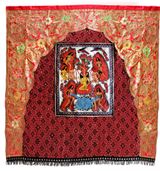
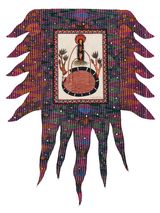
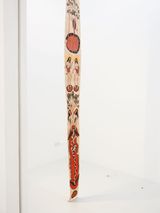
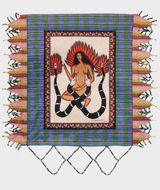
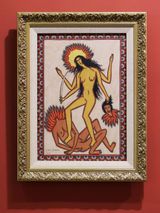
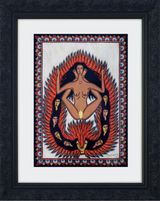
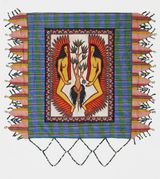
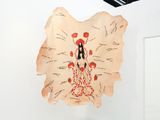
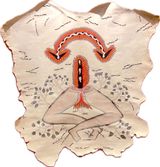
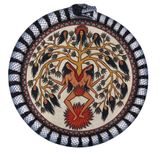
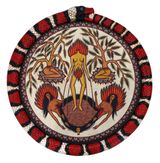
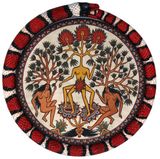
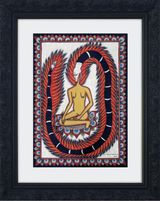
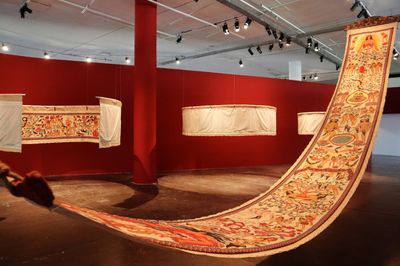
In 2019, Sasmita began her ongoing series ‘Timur Merah Project’, which features large-scale canvases and installations executed in the traditional Kamasan painting technique begun in the 15th century and historically learnt by men. These works are inspired by the ceiling paintings of the Kerta Gosa pavilion in Klungkung, which were used by the Klungkung royal court and narrated Hindu epics of cosmic significance. The paintings were so integral to society that they would be consulted by the king to decide his sentence over the fate of convicts in court trials.
Interviewing a female priest and Kamasan painter, Mangku Muriati, for her source material, Sasmita reappropriated this historic art form to instead centre female heroism where women had previously been described as witches, villains, or mere decoration. Just like the original source, Sasmita’s works aim to respond and give meaning to the space in which they are placed, which eventually led from two-dimensional canvases to immersive works.
Ode to the Sun
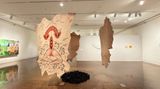
Originally shown in 2019 at the Jogja Biennale, Ode to the Sun was the third instalment of the ‘Timur Merah Project’ and later became the title of her 2020 solo exhibition at Yeo Workshop, Singapore. The work immersed the viewer in a multisensory environment announced by the smell of turmeric and herbs in Prologue, which was exhibited on the floor of the gallery space. This work symbolised the titular ‘sun’ beneath her heroic female Kamasan canvases, into which the artist wrote traditional Kakawin text or Balinese narrative poetry. The canvases above wrapped around in concentric circles, rewriting traditional male-centric Indonesian narratives and commenting on the Baliseering politics that reinforced them.
Citra Sasmita’s Major Projects (2023–2026)
Sasmita’s practice has expanded significantly onto the global stage. She has participated in major international biennials including the Kathmandu Triennale (2021–2022), the 3rd Thailand Biennale in Chiang Rai (2023), the 35th São Paulo Biennale (2023), the 24th Biennale of Sydney Ten Thousand Suns (2024), the Diriyah Contemporary Art Biennale After Rain in Saudi Arabia (2024), and the Toronto Biennial of Art Precarious Joys (2024).
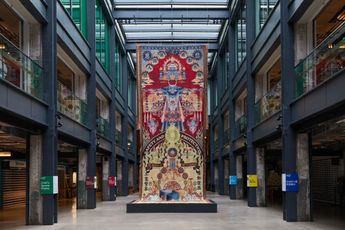
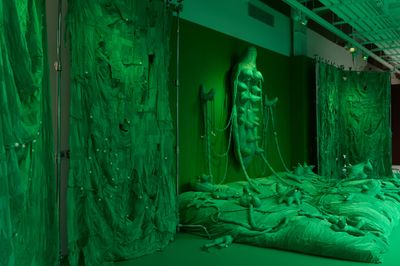
In January 2025, she realised ’Into Eternal Land’, a major solo commission for The Curve at the Barbican Centre, London—her first solo exhibition in the United Kingdom—transforming the 90-metre-long gallery into a multisensory journey exploring ancestral memory, ritual, and migration. Her Kamasan-inspired scrolls from the _Timur Merah Projec_t, including Timur Merah Project X: Bedtime Story and Timur Merah Project IV: Tales of Nowhere, have continued to travel, anchoring presentations at the 24th Biennale of Sydney and subsequent installations and fair presentations in 2024–2025.
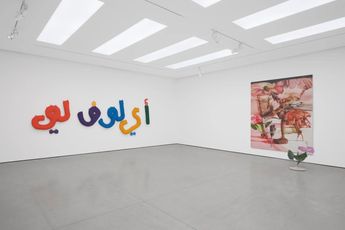
In 2025, her work has also been featured in Layers of Accumulated Time: Depicting the World at the 21st Century Museum of Contemporary Art, Kanazawa, and in Thresholds at White Cube Hong Kong (31 October 2025–10 January 2026), further cementing her position in contemporary global discourses on decolonial feminisms and post-human cosmologies. She has presented a solo project with Yeo Workshop at Frieze New York 2025 and participated in leading art fairs such as ARCOmadrid and SP-Arte in 2025.
In addition to her visual work, Sasmita has published her debut poetry collection, ‘Books of Fire’ (2025), which extends her narrative universe on the page and reimagines Balinese myth and memory in literary form.
Public Commissions
In 2020, Sasmita was commissioned to create Tales of Nowhere for the Children Art Space in Museum MACAN, Jakarta, presented from 2020–2021 and later reprised in expanded form within the Timur Merah Project for international biennials.
Awards and Accolades
In 2015, Sasmita was a semi-finalist at the Bandung Contemporary Art Award #4 and a finalist in the Kompetisi Karya Trimatra Salihara, Jakarta, in 2016. In 2017, she was a Gold Winner of the UOB Painting of the Year (Indonesia). In 2018, Sasmita was Artist in Residence at the Red Base Foundation, Yogyakarta, and participated in the Residensi Jogja Biennale di Kota Kinabalu, Sabah–Malaysia, in 2019. She has since undertaken further international residencies, including at WIELS Contemporary Art Centre, Brussels, Delfina Foundation, London, and other programmes that have supported the development of the Timur Merah Project on a global scale.
Citra Sasmita Exhibitions
Citra Sasmita has been the subject of both solo exhibitions and group exhibitions.
Solo exhibitions include:
- Ode To The Sun, Yeo Workshop – Gillman Barracks, Singapore (2020);
- Under The Skin, Redbase Foundation, Yogyakarta (2018);
- Beauty Anatomy, Laramona, Ubud, Bali (2017); and
- Maternal Skin, Ghostbird + Swoon, Bali (2015).
- Atlas of Curiosity, Yeo Workshop, Singapore (2023);
- Into Eternal Land, Barbican Centre, London (2025
Group exhibitions include ARTJOG MMXXI: Time To Wonder, Jogja National Museum, Yogyakarta (2021); A Life Beyond Boundaries, JWD Art Space, Bangkok (2021); Host, Edel Assanti, London (2021); and Fluid, Adiwana Resort, Ubud (2021). More recently, she has taken part in the 3rd Thailand Biennale (2023), 35th São Paulo Biennale (2023), 24th Biennale of Sydney (2024), Diriyah Contemporary Art Biennale (2024), Toronto Biennial of Art (2024), and other major international survey exhibitions.
Website and Instagram
Sasmita’s website can be found here and her Instagram can be found here.
Citra Sasmita FAQs
What is Citra Sasmita best known for?
Citra Sasmita is best known for her long-term Timur Merah Project, in which she reinterprets the traditional Balinese Kamasan painting style to centre powerful female figures and challenge patriarchal and colonial narratives in Bali. Citra Sasmita’s paintings, sculptures, installations, and texts together build a feminist cosmology that reclaims hidden histories and myths from a Balinese and wider Southeast Asian perspective.
What is Citra Sasmita’s Timur Merah Project about?
Citra Sasmita’s Timur Merah Project (meaning “East is Red”) is an ongoing, research-based body of work begun in 2019 that revisits Balinese manuscripts, legends, and visual traditions to expose how women were marginalised or demonised in these stories. Through large-scale Kamasan-style paintings and immersive installations, Citra Sasmita recasts women as protagonists and heroes, using a visual language that links feminism, ancestral memory, the Anthropocene, and post-human ideas.
Why does Citra Sasmita focus so much on Balinese myths and legends?
Citra Sasmita focuses on Balinese myths and legends because they are deeply embedded in everyday Balinese life and shape how people understand gender, power, and morality. By ‘hacking’ these stories rather than only protesting social rules, Citra Sasmita creates artworks that local communities can read intuitively, while also addressing global experiences of women and structural inequality.
What are some of Citra Sasmita’s most important recent exhibitions?
Some of Citra Sasmita’s most important recent exhibitions include Into Eternal Land at the Barbican Centre’s Curve gallery in London (2025), where Citra Sasmita transformed the 90-metre corridor into a multisensory journey through ancestral memory and ritual. Citra Sasmita has also presented work at major platforms such as the 24th Biennale of Sydney Ten Thousand Suns, the 35th São Paulo Biennale, and the 3rd Thailand Biennale, which foreground her decolonial and feminist perspectives.
How does Citra Sasmita’s work relate to feminism and ecology?
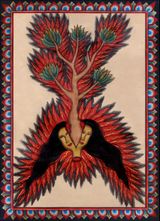
Citra Sasmita’s work advances a distinctly Balinese, non-Western feminism that is closely tied to ritual, nature, and cosmology rather than solely to capitalist or individualist frameworks. Through imagery of hybrid human–nonhuman figures, snakes, fire, and volcanic landscapes, Citra Sasmita proposes a post-patriarchal, post-human world in which bodies, spirits, and environments are interconnected, challenging extractive colonial logics and rigid social hierarchies.
Ocula | 2026

View Citra Sasmita's Artworks






















Explore Citra Sasmita's Exhibitions














Explore and Follow Artists Shaping Contemporary Art
A respected voice in contemporary art discourse.
Focusing on ambitious storytelling and insightful art-world commentary. Ocula Magazine publishes in-depth interviews, critical essays and timely analysis on the artists, exhibitions and ideas driving the global art world.
Learn more about Ocula Magazine
Showcasing the best of the art world.
Ocula partners with galleries from around the world to highlight their artists, artworks and exhibitions. Gallery membership is by application and invitation, with each member vetted by an independent panel.
Learn more about Ocula Membership
Specialises in the sale of major artworks.
Led by a team with deep ties to the world’s leading auction houses, galleries and collectors. Ocula’s advisory team offers bespoke services to high-net-worth clients from around the world who are looking to acquire the best of contemporary and modern art.
Learn more about our team and services