





AGNES MARTIN
1912-2004, CanadaAgnes Martin (1912–2004) was a Canadian-born, American-based painter whose subtle grid paintings and luminous bands of colour have made her one of the most influential figures in postwar abstraction.
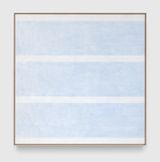
Best known for her hand-drawn graphite lines, pale washes, and square canvases, Martin developed a highly personal approach to abstraction that hovers between Minimalism and Abstract Expressionism. Signature works such as White Flower (1960), Night Sea (1963), and Red Bird (1964) exemplify her restrained palette and meticulous mark-making, while later paintings like With My Back to the World (1997) extend these ideas into horizontal bands of colour. Martin’s work has been the subject of major retrospectives at Tate Modern in London, the Solomon R. Guggenheim Museum in New York, and Dia Beacon, and is held in leading museum collections worldwide.
In 2026, Dia Art Foundation presents Agnes Martin: Painting is not making paintings at Dia Beacon, a year-long exhibition spanning nearly five decades of her practice. Bringing together canvases from Dia’s extensive holdings with key loans, the show charts her shift from quasi-organic abstraction to graphite grids and, later, to horizontal bands, underscoring her belief in painting as a slow, iterative ‘development of awareness’ rather than a product-driven activity.
Early years
Martin was born to a homesteading family in Macklin, Saskatchewan, in 1912. Scholars have speculated about how the austere landscape—with its vast, open plains and skies—may have influenced her later work. While little is known of her early relationship with art, in her twenties, Martin worked as a teacher in one-room schoolhouses in the Pacific Northwest.
In 1941, Martin moved to New York City to study fine arts at Teachers College, Columbia University. Early studies from this era, such as the moody, mountainous watercolour landscape Untitled (1946), showed an academic exploration of traditional materials and techniques. For several years, Martin lived between New York City and Taos in New Mexico, making abstract paintings such as Mid Winter (1954), which depicts rounded shapes in ivories, greys, and browns that suggest mud beneath melting snow.
Noting her talent, Martin’s dealer Betty Parsons encouraged the artist to settle in New York City in 1957. It was there, within a community of artists—including Ellsworth Kelly, Robert Indiana, and Lenore Tawney—in Lower Manhattan, that Martin’s work drastically changed. Shapes lost their round edges, and she began to add triangles and squares to paintings such as Harbor Number 1 (1957).
Development of the Grid (1950s–1960s)
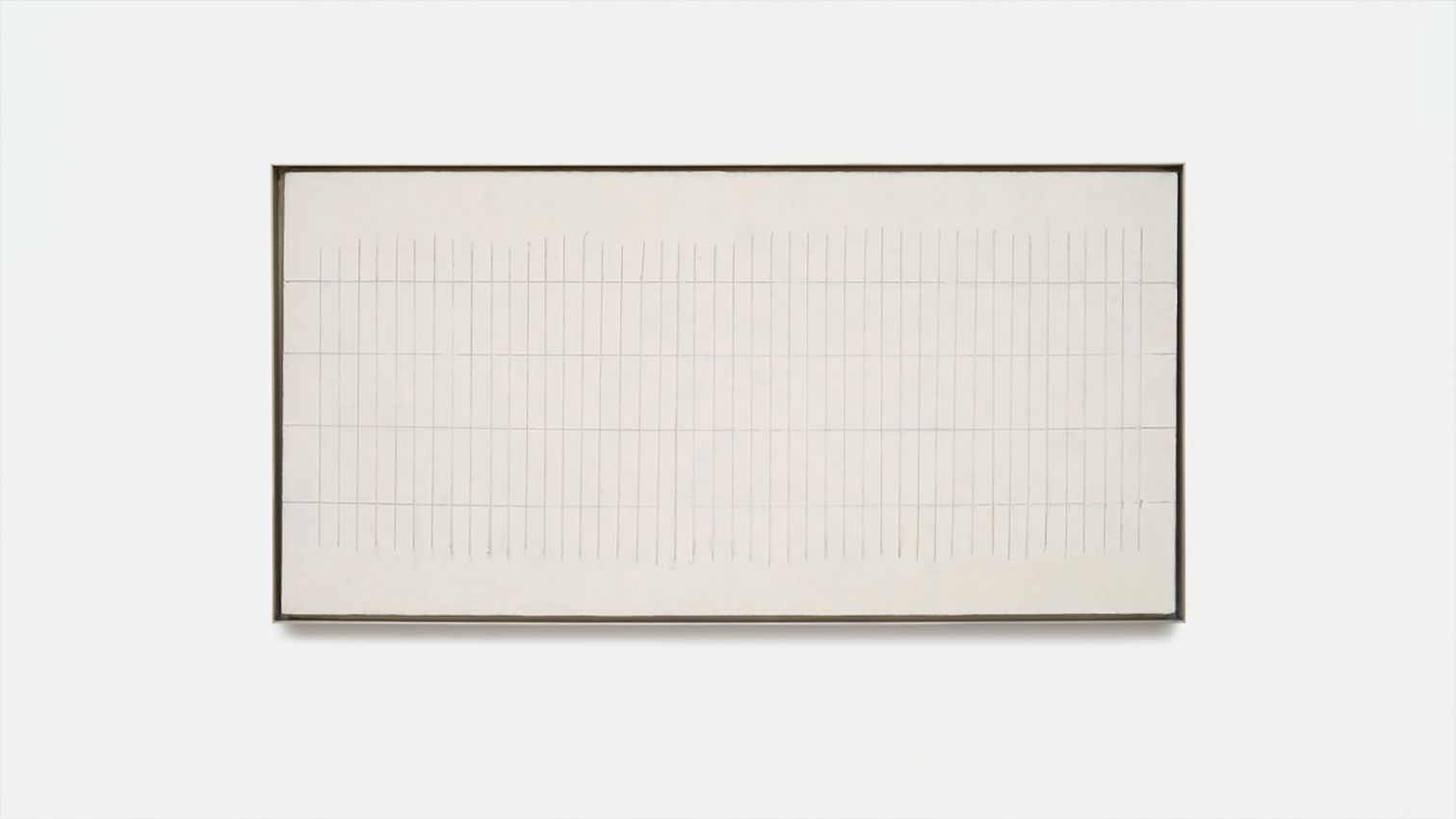
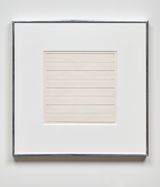
Martin’s early New York paintings show a gradual move from biomorphic shapes to more ordered geometry. Works such as White Flower (1960) and Night Sea (1963) introduce hand-drawn graphite lines, restrained colour, and a growing emphasis on surface rhythm, signalling her commitment to formal clarity and emotional restraint. By the mid-1960s, she had arrived at the square, six-foot canvas marked with delicate grids, which became a defining format in paintings like Red Bird (1964), where a nearly imperceptible red lattice hovers over a soft yellow ground.
Works such as Untitled #10 (1965) exemplify her pursuit of precision, quietude, and emotional clarity. Her late series, With My Back to the World (1997), comprising six horizontal-striped paintings, reflects her ongoing search for beauty and serenity. These series have been widely exhibited and are central to her enduring legacy in contemporary art.
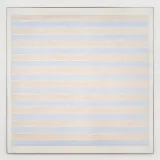
To produce these paintings, Martin used pencil, rulers, tape, and string, sometimes incising the surface of paint and gesso to create faint yet insistent lines. The resulting fields of repetition invite prolonged looking: slight variations in pressure, spacing, and tone generate a quiet sense of movement that many viewers experience as contemplative or meditative. Although she was included in key Minimalist exhibitions, Martin resisted the movement’s industrial materials and overtly conceptual framing, aligning herself instead with the emotional intensity of Abstract Expressionism while stripping away gesture and imagery.
While some works carry simple, evocative titles such as Stone (1964), Martin often preferred that her paintings remain untitled. She believed that the encounter with the work should not be directed by language, insisting that the painting itself, rather than a title or explicit narrative, should hold and transmit the experience. This resistance to descriptive naming reflects her broader refusal of representation, as she worked toward an art of pure feeling grounded in rhythm, proportion, and the viewer’s quiet, sustained attention.In 1967, after a period of personal difficulty and increasing discomfort with the New York art scene, Martin left the city, abandoned painting, and settled in rural New Mexico.
Return to Painting in New Mexico (1970s–1990s)
After a nearly seven-year hiatus, Martin returned to painting in the mid-1970s with renewed clarity and focus. Her later works abandoned the grid in favour of horizontal bands of subtle colour, as seen in Untitled #3 (1975) and With My Back to the World (1997). These compositions evoke the vast, open landscapes of New Mexico, where Martin lived in relative isolation, and embody the quietude of her daily life. Despite their minimalist appearance, these paintings resonate with emotional depth and spiritual sensitivity, offering viewers a sense of harmony and contemplation akin to visual meditation.
Influence and Legacy
Agnes Martin’s influence on contemporary art lies in her unique approach to abstraction as a conduit for emotion, spirituality, and inner calm. Her restrained visual language, built from grids, lines, and soft fields of colour, has inspired generations of artists to explore minimalism as a personal and contemplative practice rather than a purely formal or conceptual one—artists such as Roni Horn, Vija Celmins, and Jennie C. Jones has cited Martin’s sensitivity to touch and tone as a significant influence. Her writings and philosophy continue to resonate with those seeking to express stillness, transcendence, and emotional clarity through art.
Awards and Accolades
- National Medal of Arts, United States (1998)
- Golden Lion for Lifetime Achievement, Venice Biennale (1997)
- Elected to the American Academy of Arts and Letters (1990)
Selected Solo Exhibitions
- Agnes Martin: Painting is not making paintings, Dia Beacon, Beacon, 2026–27 (year-long exhibition drawing on Dia’s collection and key loans).
- Agnes Martin: Moments of Perfection, Sorol Art Museum, Gangneung, South Korea
- Agnes Martin, Tate Modern, London (2015), travelled to Kunstsammlung Nordrhein-Westfalen, Düsseldorf (2015–2016); Los Angeles County Museum of Art (2016); Solomon R. Guggenheim Museum, New York (2016–2017)
- Agnes Martin, Aspen Art Museum (2014–2015)
- Agnes Martin: Before the Grid, Harwood Museum of Art, Taos, New Mexico (2012)
- Agnes Martin: Paintings, Writings, Remembrances, Menil Collection, Houston (2011)
- Agnes Martin, Whitney Museum of American Art, New York (1992)
- Agnes Martin, Museum of Modern Art, Oxford (1977)
Selected Group Exhibitions
- Shadow and Light, New Mexico Museum of Art, Santa Fe, New Mexico (2023–2024)
- New York: 1962–1964, Jewish Museum, New York (2022–2023)
- Minimalism: Space. Light. Object., National Gallery Singapore (2018)
- America is Hard to See, Whitney Museum of American Art, New York (2015)
- The Art of Zen, Los Angeles County Museum of Art (2001)
- Systemic Painting, Solomon R. Guggenheim Museum, New York (1966)
- 16 Americans, Museum of Modern Art, New York (1959)
Critical Reception
Agnes Martin’s work has been widely featured in publications such as ARTnews, Artnet, Ocula, and The Guardian.
Agnes Martin FAQs
Who was Agnes Martin?
Agnes Martin (1912–2004) was an influential American abstract painter originally from Canada. She is best known for her minimalist style characterised by hand-painted grids and subtle bands of color, combining abstract expressionism with serene and spiritual qualities.
What were Agnes Martin’s early works like?
Agnes Martin’s early works from the 1950s involved experimentation with surrealist and biomorphic styles featuring organic shapes and delicate lines. They often abstracted memories of landscapes and skies. By the late 1950s, she gradually shifted toward geometric forms, foreshadowing the minimalist grids and subtle compositions that defined her mature work. Many early pieces were later destroyed as she refined her vision focused on simplicity, spirituality, and inner tranquility. These early works laid the foundation for her signature minimalist style.
What inspired Agnes Martin’s grid paintings?
Agnes Martin’s grids were inspired by her search for emotional purity and order. She viewed the grid as a means to express abstract emotions and achieve a sense of tranquility, drawing inspiration from nature, music, and Eastern philosophy.
How did living in New Mexico affect Martin’s art?
The vast, open landscapes and solitude of New Mexico profoundly influenced Agnes Martin’s later work, leading her to adopt horizontal bands of colour that evoke the horizon and the region’s sense of quietude.
How did Agnes Martin view the associations made concerning particular art movements?
Although often linked to Minimalism, Martin rejected the movement’s conceptual and industrial focus, instead grounding her practice in personal emotion, introspection, and spirituality. Her hand-drawn lines and subtle colour fields evoke a sense of intimacy and vulnerability, distinguishing her work from that of her peers.
How has Agnes Martin influenced other artists?
Agnes Martin’s meditative approach to abstraction has inspired artists to explore minimalism as a deeply personal practice. Her sensitivity to touch, tone, and emotional clarity continues to resonate with contemporary artists seeking to convey stillness and transcendence.
What is Agnes Martin’s artistic style and what themes does she explore?
Agnes Martin’s work is noted for its minimalist grid compositions, ethereal color bands, and delicate pencil lines. Her paintings evoke emotional states such as tranquility, innocence, happiness, and spiritual contentment. She often explored the contrast between ordered geometry and the irregularities of the human hand, reflecting on the human condition.
Where did Agnes Martin live and work?
Born in Saskatchewan, Canada, Martin moved to the United States in 1932. She lived and worked primarily in New York and New Mexico, retreating to New Mexico later in life for solitude and continued artistic practice until her death.
Why is Agnes Martin considered important in art history?
Agnes Martin is recognised as a major figure in postwar American abstraction. Her pioneering minimalist style, spiritual approach to abstract art, and profound influence on contemporary artists and design make her an enduring and celebrated figure. Her works are held in prominent museum collections worldwide and have fetched millions at auction.
What are Agnes Martin’s most famous quotes?
Agnes Martin is widely quoted for her contemplative reflections on art, nature, and happiness. Some of her most notable quotes include:
- “Beauty is the mystery of life. It is not in the eye, it is in the mind. In our minds there is awareness of perfection.”
- “You can’t make a perfect painting. We can see perfection in our minds. But we can’t make a perfect painting.”
- “Happiness is being on the beam with life—to feel the pull of life.”
- “I paint with my back to the world.”
- “Of all the pitfalls in our paths and the tremendous delays and wanderings off the track I want to say that they are not what they seem to be. I want to say that all that seems like fantastic mistakes are not mistakes...”
How and when did Agnes Martin die?
Agnes Martin died on December 16, 2004, at the age of 92 in Taos, New Mexico. The cause of death was complications related to pneumonia, as reported by her dealer and various obituaries at the time.
What is Agnes Martin’s most famous painting?
Many art historians and critics consider “Friendship” (1963), a large gold leaf grid painting, to be one of Agnes Martin’s most famous works, emblematic of her early minimalism. Other works frequently cited are “With My Back to the World” (1997) from her late career, and “Summer” (1964–65).
What is the most expensive Agnes Martin painting?
Agnes Martin’s most expensive painting at auction is “Grey Stone II” (1961), which sold for $18.7 million (including fees) at Sotheby’s New York on November 8, 2023, setting a new record for her work.
Are there other artists like Agnes Martin?
Agnes Martin is closely associated with Minimalist and Abstract Expressionist art. Artists with similar aesthetics, philosophies, or influence include:
- Donald Judd
- Frank Stella
- Anne Truitt
- Jo Baer
- Mary Corse
- Carmen Herrera
- Nasreen Mohamedi
- Charlotte Posenenske
- Critics also compare her to Ellsworth Kelly, Robert Ryman, and Dan Flavin for their shared use of simplicity, repetition, and subtlety.
Ocula | 2026




















Agnes Martin in Ocula Magazine







Explore and Follow Artists Shaping Contemporary Art
A respected voice in contemporary art discourse.
Focusing on ambitious storytelling and insightful art-world commentary. Ocula Magazine publishes in-depth interviews, critical essays and timely analysis on the artists, exhibitions and ideas driving the global art world.
Learn more about Ocula Magazine
Showcasing the best of the art world.
Ocula partners with galleries from around the world to highlight their artists, artworks and exhibitions. Gallery membership is by application and invitation, with each member vetted by an independent panel.
Learn more about Ocula Membership
Specialises in the sale of major artworks.
Led by a team with deep ties to the world’s leading auction houses, galleries and collectors. Ocula’s advisory team offers bespoke services to high-net-worth clients from around the world who are looking to acquire the best of contemporary and modern art.
Learn more about our team and services