




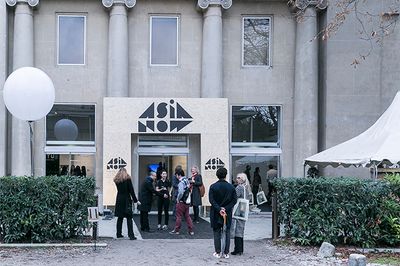
ASIA NOW Paris 2015 Photo: © Charles Roussel & Ocula
When details of the new Parisian art fair ASIA NOW were announced only shortly before its inaugural opening on 20 October 2015, it sounded as if the event might be a last‑minute enterprise. Yet the first edition was anything but improvised: carefully planned and well organised, it seemed to draw collectors with a genuine interest in contemporary Asian art. As Vincent de Sarthe of de Sarthe Gallery observed, “The fair truly cared about the participants, and there was a great crowd.” That level of attention was not accidental. Planning for the fair began five years earlier, when its founders, Alexandra Fain and her father, Claude Fain, travelled to Beijing to get to know the city’s art scene.
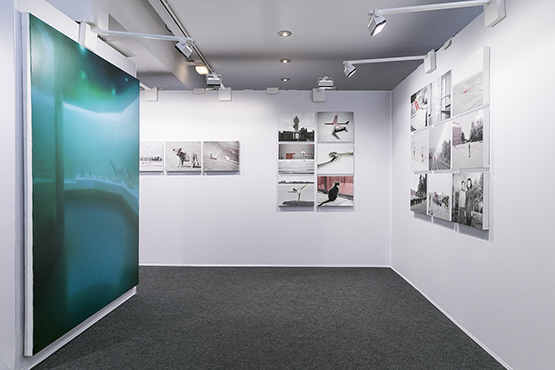
In 2010, with the help of Karen Levy—whose family’s DSL Collection has become one of the most comprehensive holdings of Chinese contemporary art—the Fains visited numerous studios and met many of Beijing’s key figures. The trip ignited a lasting fascination with the region. Aware of how narrowly “Asian art” was often imagined in France, they set out to bring to Paris the work and conversations they had encountered in Asia. Five years later, that desire took form as ASIA NOW, the first fair in the city devoted to the contemporary Asian scene.
In contrast to the behemoths of the international fair calendar—Frieze London and FIAC, between which ASIA NOW strategically positioned itself—the Paris fair is deliberately compact. Housed in the low, elegant Espace Pierre Cardin, a short walk from the Grand Palais, its inaugural edition occupied two floors and presented only 18 galleries, underscoring its ambition to remain on what Fain calls “a human scale.” Rather than offering a panoramic survey, she aims for a “vertical” view of the region: a tightly edited selection of galleries from across Asia, with plans to deepen representation from territories such as Japan, India and the Philippines while keeping overall numbers modest. The benchmarks she cites are Shanghai’s ART021 and the London‑based but Africa‑focused 1:54 Contemporary African Art Fair, both boutique‑sized platforms that privilege strong programmes and discerning collectors.
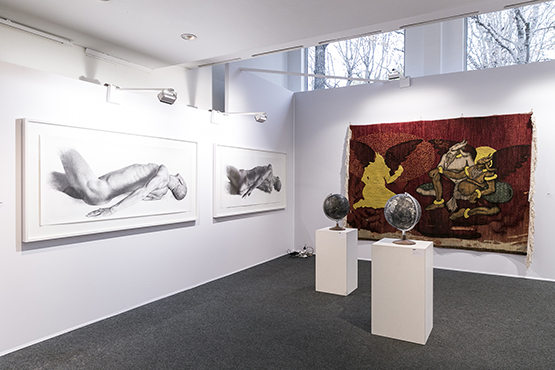
One of the leading participants at ASIA NOW’s first edition was the Berlin‑ and Singapore‑based gallery ARNDT, which presented a carefully pitched selection of works. Among the standouts were two exquisitely executed charcoal drawings on paper by Malaysian artist Ahmad Zakii Anwar, Reclining Figure 14 (2015) and Reclining Figure 15 (2015). Each horizontal composition depicts a male figure lying naked with his back turned, the body taut and sinuous, caught in a pose that hovers between agony and ecstasy.
Zakii’s drawings were shown alongside works in a range of media by artists from across the broader Asian region: a wool, cotton thread and ink piece by Australian‑Afghani artist Khadim Ali; paintings by Filipino painter Rodel Tapaya; sculptures by China’s Qiu Zhijie and Thailand’s Pinaree Sanpitak; and a finely detailed ink‑on‑silk work by Chinese artist Yang Jiechang. Outside the booth, on the staircase linking the fair’s two floors, the gallery installed an embroidery by Indonesian artist Eko Nugroho, one of three artists featured in Roots. Indonesian Contemporary Art at the Frankfurter Kunstverein in Frankfurt. Another work of note on the periphery of the fair, Beijing Air (Dec 2012) No. 2 (2013) by Zhou Wendou, was presented by de Sarthe Gallery.
ARNDT’s booth set the tone for the rest of ASIA NOW, which showcased a diversity of practices from multiple centres and, in doing so, gently unsettled any lingering preconceptions about what “Asian” art might look like. On the same floor, the fair’s sole Vietnamese gallery, Galerie Quynh, presented works by Hoang Duong Cam and Trong Gia Nguyen, both known for conceptually driven, materially varied practices. One of Nguyen’s pieces, from his Library project, involves painstakingly copying entire chapters of books onto individual grains of rice. The grains are then jumbled together in a clear plastic bag, which is attached to a library card, scrambling the original text into an unreadable mass. The work cuts both ways: it points to the futility of language and, at the same time, to its capacity to distort and generate new meanings.

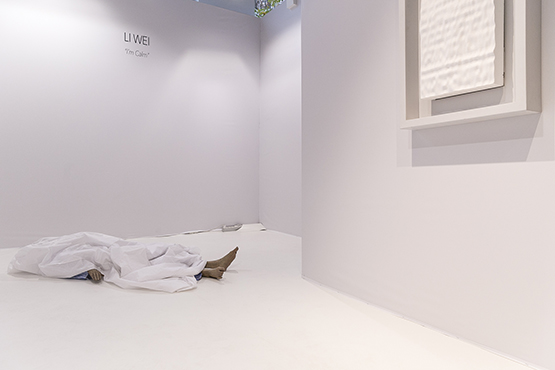
Opposite Galerie Quynh, Italian gallery Primo Marella divided its booth in two: one side devoted to a solo presentation of Chinese artist Li Wei, the other to a group show. Among the latter was a haunting work by Vietnamese artist Nguyen Thai Tuan: a headless male figure in a white shirt and beige trousers crouches in a corner with his back to the viewer, his hands bound; where his hands should be, there are two dark voids. Like Zakii’s reclining figures, Tuan’s image underscores how the body becomes a vessel, absorbing the psychological, cultural and historical projections of its audience. It was difficult to view either work without thinking of Europe’s ongoing refugee crisis and, in particular, the camp at Calais, only a few hours’ drive from the fair.
Elsewhere, three conceptually sharp booths—by Edouard Malingue Gallery, BANK and Leo Xu Projects—lightened the mood while remaining firmly engaged with pressing questions. Edouard Malingue presented Molyneux (2014), a solo curatorial project by Taiwanese artist Chou Yu‑Cheng. Painted and carpeted a deep blue, the booth arranged Chou’s works so that visitors seemed to step inside a geometric abstraction. The project reinterpreted the work of veteran artist Geoff Molyneux, probing the formal language of his paintings while also raising questions about the status of the art object and the ethics and limits of appropriation.

BANK also opted for blue walls, this time as a backdrop to Do the Same Good Deed (2014), a video by the five‑member Chinese collective Polit‑Sheer‑Form Office (PSFO), comprising Hong Hao, Xiao Yu, Song Dong, Liu Jianhua and Leng Lin. The work documents a performance staged in Guangzhou at the Guangdong Times Museum and later at the Queens Museum in New York, in which volunteers clean their respective cities. The action is simple, almost banal, yet it reflects PSFO’s ongoing interest in testing the tension between individualism and collective ideals.
Aike‑Dellarco’s booth featured one of the fair’s most compelling video works, Tao Hui’s The Dusk of Teheran (2014). Tao, who received the Grand Prize at the 19th Contemporary Art Festival Sesc_Videobrasil, treads the space between documentary and fiction, and here a lone female figure sits in the back of a moving car dressed as a Middle Eastern bride. She speaks in Arabic to an unseen companion, and gradually it becomes clear that she is an actress in character. As she laments the irony of repeatedly playing a bride while never being one in life, the narrative echoes the public story of Hong Kong star Anita Mui, whose views on marriage and solitude played out in the tabloids. With disarming simplicity, Tao’s video folds together questions of gender, religion and social expectation, and in doing so touches on shared human vulnerabilities across cultural divides.

Leo Xu Projects presented another artist invested in the friction between fact and fiction: Chen Wei, whose photographs depict meticulously constructed sets made to look like fragments of everyday life. Alongside Chen’s images, the gallery re‑staged Michael Lin’s Please remove your shoes before stepping on to the carpet. Feel free to choose from the selection of music (1996). Originally shown in Interior, Lin’s solo exhibition at Taipei’s alternative space IT Park in 1996, the work transformed ASIA NOW’s booth into a modest domestic environment—two carpets, a stereo, a selection of music and a wall text echoing the title. Lin’s installation is historically significant, marking an early exploration by a Chinese‑born artist of participatory, environment‑based works that incorporate everyday objects and invite viewers into a shared space.
For a satellite fair dedicated to what is still perceived in Europe as a relatively emerging scene, the risk of ghettoising the very practices it seeks to promote is real. ASIA NOW appears acutely aware of that danger. While uneven in places, the overall calibre of galleries was strong, and important works appeared throughout the fair. Just as crucially, the fair’s carefully conceived Conversation Platform—which brought together a roster of key figures in the Asian art ecosystem, from curator Philip Tinari to collector Guy Ullens and critic and curator Jérôme Sans—signalled serious intent. If these discussions are any indication of ASIA NOW’s ambitions, then Alexandra and Claude Fain have laid a thoughtful foundation for their project of sharing some of the most compelling contemporary art from Asia with Paris.—[O]
Main image: ASIA NOW Paris 2015 Photo: © Charles Roussel & Ocula


A respected voice in contemporary art discourse.
Focusing on ambitious storytelling and insightful art-world commentary. Ocula Magazine publishes in-depth interviews, critical essays and timely analysis on the artists, exhibitions and ideas driving the global art world.
Learn more about Ocula Magazine
Showcasing the best of the art world.
Ocula partners with galleries from around the world to highlight their artists, artworks and exhibitions. Gallery membership is by application and invitation, with each member vetted by an independent panel.
Learn more about Ocula Membership
Specialises in the sale of major artworks.
Led by a team with deep ties to the world’s leading auction houses, galleries and collectors. Ocula’s advisory team offers bespoke services to high-net-worth clients from around the world who are looking to acquire the best of contemporary and modern art.
Learn more about our team and services